The Overpopulation Project
TOP – Research and Outreach
Too many people consuming too much
Category: Population growth
-
‘Climate refugees’ and the question of limiting immigration: a response to Migration in Hotter Times
A recent discussion paper on climate refugees, Migration in Hotter Times: Humanity at Risk, does much to muddy the water without presenting practical solutions. by Jane O’Sullivan and Philip Cafaro Immigration is a deeply divisive topic, even among population activists. It is not uncommon to have a strong commitment to global population stabilisation while believing…
18 comments on ‘Climate refugees’ and the question of limiting immigration: a response to Migration in Hotter Times -
Losing Our Minds
In the 1970’s the leading intellectuals in the United States were concerned about overpopulation. Fifty years later, the best and brightest minds in America now think we are running out of people. What the hell is going on? by Brad Meiklejohn “Growth for the sake of growth is the ideology of the cancer cell.” –…
-
New US population projection tool under construction
TOP is developing a new population projection tool for the United States, based on US Census Bureau methodology and data. Check it out! You can run your own US population projections under different fertility and immigration scenarios — and help us improve the projection tool with your suggestions. by Philip Cafaro One of our more…
-
Songs about population and the environment – what’s your favorite?
Music is a rich source of inspiration for those of us who want to end population growth and improve environmental conditions. TOP looks at some classic hits and new songs recently sent to us and asks for more. By The Overpopulation Project A few weeks ago, two readers contacted us regarding their own songs. Kelvin…
-
Green parties lose big in EU parliamentary elections by ignoring the relationship between immigration and environmental damage
Green and left-wing parties lost ground in recent elections to the European Union Parliament, in part by neglecting and even denying the relationship between population growth by immigration and environmental stress. They could have used the topic to their advantage, but failed to do so. Instead it became the flagship issue of the right. By…
-
Time to vote!
Immigration is proving to be a hot topic in the run up to EU parliamentary elections. While the focus has been on immigration’s cultural and social effects, changes in immigration policy could also impact future population numbers across Europe. This has consequences for citizens, the environment and ecosystems. by Philip Cafaro According to the European…
-
Meet the Nigerian Teacher Who Advocates for Family Planning
Coming from a family of seven children, Chidera Benoit knows better than anyone how challenging it is to grow up in a big family in Nigeria and achieve a good living standard. Convinced that Nigerian women and men should be free to decide their family size, this young and motivated teacher and Executive Director of…
-
Overpopulation Is Still a Huge Problem: An Interview with Jane O’Sullivan
Despite reports that world population is peaking and fertility rates dropping, the human population is still growing at an unrelenting and unsustainable pace. In an interview by Richard Heinberg, Jane O’Sullivan sets the record straight. By Richard Heinberg, originally published by Resilience.org In February, I interviewed biochemist Chris Bystroff, whose peer-reviewed analysis suggests that world…
-
The International Conference on Population and Development (ICPD) at 30 – Let’s Address the Unfinished Agenda
This year marks the 30th anniversary of the United Nations International Conference on Population and Development (ICPD) in Cairo, a watershed event in international population and reproductive health policy. It’s a good time to reflect on its legacy. by Joseph Speidel and Jane N. O’Sullivan The ICPD Programme of Action (POA) has served as a…
-
Carbon emissions and the desperate search for culprits
Are rich people with their private jets the main cause of climate change? Or are the hundreds of millions joining the middle class in China and India? Or maybe large families of poor farmers in the tropics deforesting to make room for low-productive agriculture? This blog questions the search for specific culprits, which is often…
-
Kohei Saito’s Degrowth Manifesto: A nonviable solution to a misidentified problem
An obscure Japanese philosophy professor produces a surprise best seller, urging the world to slow down and shrink consumption via economic “degrowth.” Population Institute Canada’s president provides a critical overview. by Madeline Weld Until his book “Slow down: The Degrowth Manifesto” recently hit the market and became a surprise bestseller in Japan, I had never…
-
A new sustainability initiative of the Swiss People’s Party
While population growth lies at the root of many environmental problems, concerned citizens often feel disempowered from addressing it. A popular initiative in Switzerland may provide a blueprint for activists in other developed countries. by Roland Schmutz After Swiss voters narrowly rejected joining the European Economic Area in 1992, the European Union and Switzerland began…
-
Demography and reproductive rights are environmental issues: Insights from sub-Saharan Africa
Rapid population growth impacts many social, economic, and environmental issues, and sub-Saharan Africa is the fastest growing region in the world. Céline Delacroix and Nkechi S. Owoo asked stakeholders in the region how important they think population growth is as a factor in meeting the region’s challenges. By Céline Delacroix Sub-Saharan Africa’s population is growing…
-
Pronatalism on the Rise to Counter Growing Push for Gender Equality
Pronatalists try to present their ideology as promoting the security of the family, but it is linked to the far-right agenda, uses falsified data to prove their points, and counteracts gender equality. By Nandita Bajaj There’s an insidious new tactic emerging for selling right-wing ideology to wider audiences, evident in [the September 2023] Budapest Demographic…
-
Can nature-based tourism offer additional protection of wildlife in developing countries with strong population growth?
Recently, a TOP blog emphasized the importance of addressing luxurious overconsumption, including the hypocrisy of rich people wanting to be seen as environmentally friendly. Is nature-based tourism merely pandering to this hypocrisy, or can sites with nature-based tourism or ecotourism be beneficial for wildlife in developing countries with increasing populations? By Oskar Lindvall and the…
-
No need to hold COP 29: Just follow Japan’s lead!
Japan has accomplished the difficult task of reducing their emissions, mainly through its decreasing population. by Terry Spahr COP 28, the United Nations’ annual climate summit is happening right now in Dubai, United Arab Emirates. These climate conferences have been taking place since 1995 and as Axios reported, each and every year, save for temporary recessions,…
-
Declining population and GDP growth
There is a general idea among businesspeople and mainstream economists that a decreasing population is not good for the economy. Our empirical work on countries experiencing population decline suggests that a declining population can bring about changes that reduce unemployment, increase wages, and lead to a larger real GDP per capita. by Theodore Lianos and…
-
Wealth Never Sleeps
Wishing away overconsumption without reducing population or affluence is a denial of math. By Brad Meiklejohn “It is easier to imagine the end of the world than the end of capitalism.” – Mark Fisher I am congenitally cheap. There is Scottish blood in my veins, which may explain why our family crest reads: “Fix it…
-
EurASP Statement on Migration
The European Alliance for a Sustainable Population (eurASP) is a coalition of groups with the mission to raise awareness about the impact of human population, its size and density, on planet Earth. It includes groups from seven European countries. Recently they issued the following statement on migration. by The European Alliance for a Sustainable Population…
-
Overpopulation as a local problem
Overpopulation is commonly associated with global ecological overshoot, but it can occur at any level from the local to the global. Ecological overshoot in industrialised countries is complicated by labour migration, especially in urban areas. Population pressure on top of ecological overshoot should force these countries to reconsider overly permissive immigration policies. by Jan van…
-
The Catalyst of Overpopulation in the Gaza Conflict
Mountains of work have analysed the roots of the conflict in Gaza, but all have missed the catalyst of increasing population. By Jon Austen and Jane O’Sullivan The Israel-Palestine conflict has been ongoing for 75 years. The recent eruption of violence is a tragedy but not surprising. Neither side is going to back down, both…
-
How environmental professionals acknowledge overpopulation – and then ignore it
We can have an environmentalism that ignores the fundamental causes of environmental problems, including lucrative careers treating overshoot’s many symptoms. Just not a successful environmentalism. by Leon Kolankiewicz Veteran population campaigners like me have long lamented the fact that at both the national and international scales, the environmental establishment (Big Green) and climate activists alike…
-
Strange bedfellows of sustainability: How identity politics obstructs the future of wilderness
Preserving wild places is key to protecting Earth’s biodiversity. In the United States and elsewhere, identity politics undermines the commitment to do so. by Karen Shragg Preserving wilderness is in the best interests of all of us, especially the four-legged and two-legged creatures with whom we share our countries. When people give other species room,…
-
What you should know – but didn’t know to ask – about overshoot and the ‘population question’
William Rees explores the nature of humanity’s relationship with energy and the ecosphere, and reaches the unsettling conclusion that a population ‘correction’ is in the offing. By William Rees What would you think if someone called you out as a ‘dissipative structure’? Or better, claimed that you were a ‘thermodynamically far-from-equilibrium dissipative structure’? Chances are,…
-
Human population reduction is not a quick fix for environmental problems
Then again, neither is anything else. The long lag time between fertility reduction and population stabilization is a key reason we need to address excessive human numbers sooner rather than later. by Phil Cafaro There’s an argument one often hears that goes like this: “sure, population is important. But we need to reduce our environmental…
-
Even with strong early family planning programs, 50 years or more are needed to halt population growth
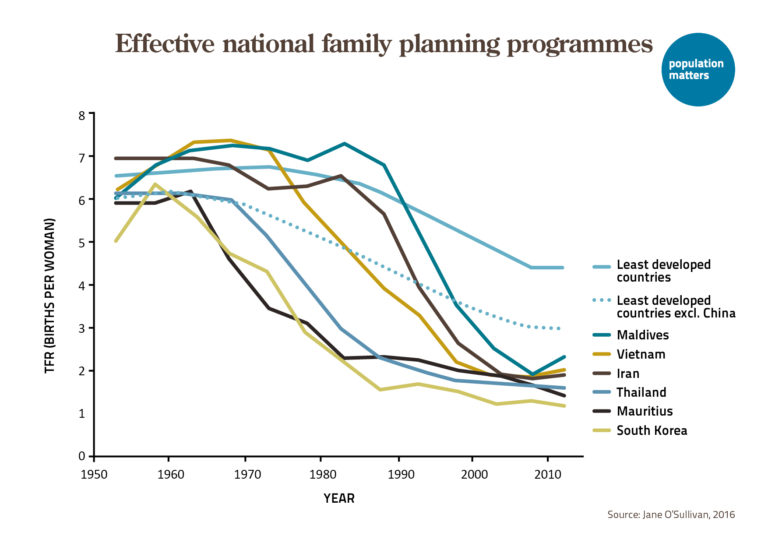
Low birth rates are often regarded as problematic by major media, which overlook the perils of population increase. Here we show that unsustainable long-term population growth prevails in developing countries, despite historical family planning and gradually sinking birth rates. One lesson is that further reduced rates are urgently needed in high-fertility countries, in Africa and…
-
Big Australia needs rethink on World Population Day 2023
Another UN World Population Day passed with the UN focussing on anything but population growth. Australia’s population is growing faster than most, with sustainability not on the government’s radar, as Stephen Williams laments. By Stephen Williams I don’t pay much attention to awareness days, but I make an exception for World Population Day, first observed…
-
Population’s effects on biodiversity: evidence from recent scientific literature
A lot of great scientific work has been done lately on population and biodiversity, spanning all areas of the globe. A new study from TOP describes this work and summarizes its main lessons. by The Overpopulation Project Earlier this year, Phil, Pernilla and Frank released A Bibliography of Recent Scientific Work on Population and Biodiversity…
-
Australia’s population growth rate of nearly half a million ‘too high’
Australia is growing rapidly, in large part due to immigration. This causes strain on both infrastructure and the environment. By Sustainable Population Australia Sustainable Population Australia (SPA) considers Australia’s population growth rate in 2022 too high and called on the federal government to put a brake on immigration. The Australian Bureau of Statistics (ABS) released…
-
Wildlife in decline: the impact of human population growth and consumption
In a short film about wildlife loss, Nastaran Rahnama takes a broad approach, investigating food sold in the UK, its production far away, and the links to population growth and declining large mammals. By Nastaran Rahnama In my lifetime including living in Iran, England, and traveling, I noticed that the natural world and the sound…
-
The Population Factor back by popular demand
In 2020 and 2021, I recorded two seasons of the TV show The Population Factor. Each episode features in-depth conversations focused on a particular aspect of the population/environment connection. Check out seasons one (hour-long episodes) and two (half-hour episodes), all available for free streaming at the links below. by Phil Cafaro Season 1 Episode 1.…
-
To Advance Humanity and Save Nature We Need a Common Agenda
Problems caused by rapid population growth, environmental degradation and climate disruption are harming human welfare and the natural world. These problems are largely addressed separately, with little common understanding or integration of efforts. Our recent paper, Advancing the Welfare of People and the Planet with a Common Agenda for Reproductive Justice, Population, and the Environment,…
-
More population neglect from the United Nations
The UN’s latest State of the World Population 2023 report deepens its denouncement of population concerns. While it commendably emphasizes women’s reproductive rights, it neglects the role an excessive and growing population plays in driving global ecological degradation and overlooks the many ways overpopulation can undermine poor people’s rights to safety and security. by Jan…
-
A British perspective on population and biodiversity
A distinguished scientist’s new book makes the case that more people means less wildlife, in the United Kingdom and globally. This excellent offering is a must-read for anyone interested in the connection between human numbers and biodiversity protection. by Phil Cafaro For Trevor Beebe, the issue of people crowding out other species surfaced early in…
-
The imaginary world of Earth4All’s low population projections
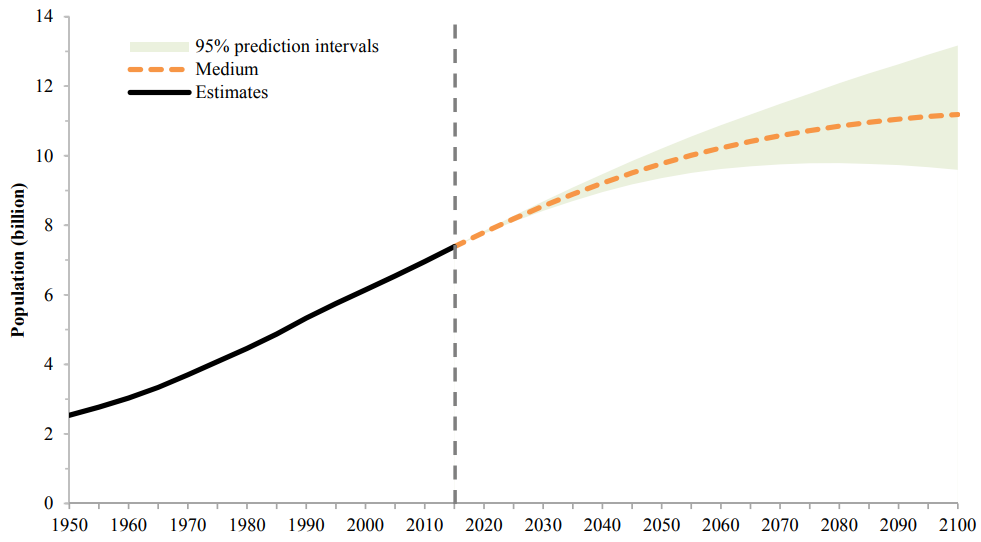
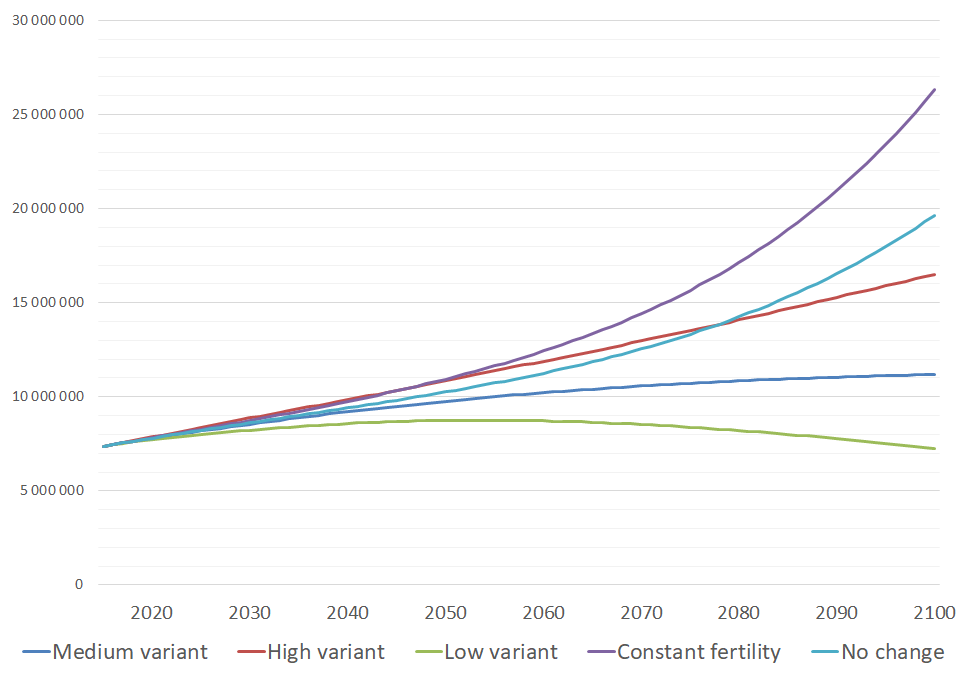
A new report from Earth4All says world population will peak below 9 billion. While it celebrates this result and says we must work to get it even lower, this unrealistically low projection itself is likely to have the opposite effect. by Jane O’Sullivan Last week a consortium under the name of Earth4All published new population…
-
Dangerous distraction or elephant in the room? The role of population growth during three decades of increasing carbon emissions
How often have you heard some version of this claim: “population growth is not a problem for climate change, because populations are growing in poor countries whose contributions to global emissions are negligible”? It gets repeated like a mantra, soothing words that banish thought. But what justifies a claim is not the number of times…
-
Linking population growth and biodiversity loss: a new bibliography
Excessive and growing human numbers are a leading cause of decreasing biodiversity in many parts of the world. In researching a paper on this topic last year, we became aware of the large amount of good scientific work recently published on it. In an effort to spur more such work, we are publishing an annotated…
-
The moral imperative of depopulation
Anthropocentrism is preventing humanity from dealing with the world’s cascading environmental crises. Stephen Williams reviews the work of Catholic historian Paul Collins who argues depopulation is an urgent moral imperative. By Stephen Williams A new discussion paper on population ethics written by Catholic historian Paul Collins is as radical as it is worthy. The paper…
-
Population growth has contributed 80% of ecological overshoot
William Rees is the originator of ecological footprint analysis, the influential approach to measuring sustainability. In a new article, he argues that humanity is deep into ecological overshoot and that we need to ratchet back our numbers and the size of our economies before nature does it for us. by Philip Cafaro William Rees has…
-
Hello World of 8 Billion!
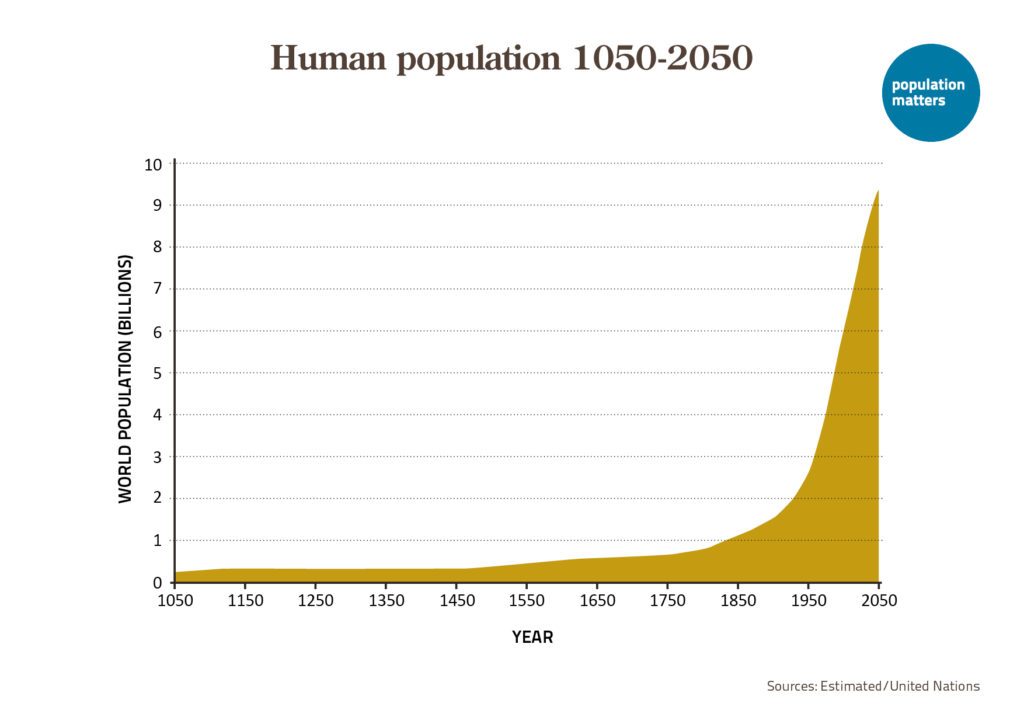
On 15 November 2022, Earth’s human population will pass 8 Billion, according to estimates by the United Nations. This sobering milestone should galvanise us to redouble our efforts to minimise further growth. By Valorie M. Allen I have found myself checking out the population counter on my website more and more often as it approaches…
Explore the content and topics covered by TOP, search here
Recent blog posts
- Reproductive rights: an unfinished project and an ecological imperative
- A shrinking population might actually be a good thing
- Cutting the global population in half to achieve sustainability
- Ceuta incident: Population growth threatens both poor Africans and climate stability
- Reality Check: We’re Still Overpopulated—And It’s Still A Problem
Blog categories
What we are reading, listening to and watching
Gallery of infographics – Learn more about overpopulation and environment