
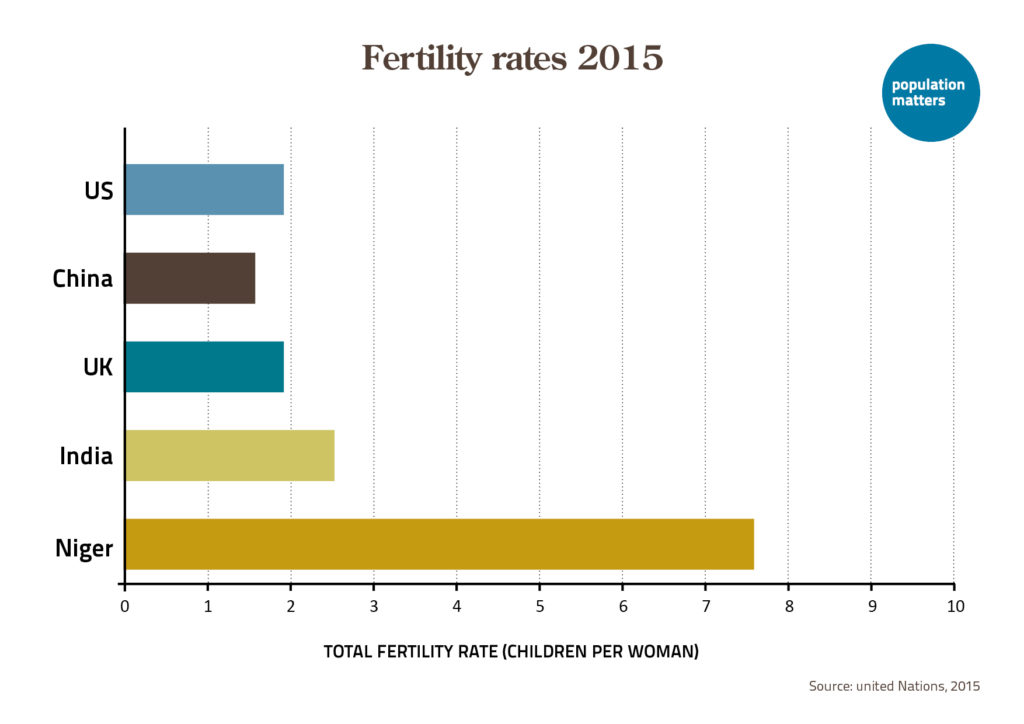
Many of those concerned about overpopulation are encouraged by trends showing declining births per woman (TFR). However, a recent study by Skirbekk and Spoorenberg shows that taking declining death rates into account, net reproduction and hence the population growth rate have peaked later than typically reported. Most striking, in seven African countries, fertility transitions have yet to even begin.
By Vegard Skirbekk and Thomas Spoorenberg, abridged by The Overpopulation Project

For decades, demographers have relied primarily on the total fertility rate (TFR) to understand when and how fertility transitions occur across the globe. This measure, representing the average number of children a woman would bear under current fertility conditions, has become the gold standard for tracking demographic change. However, a critical component has been largely overlooked: mortality.
In a recent paper (Skirbekk and Spoorenberg 2025), we argue that this narrow focus on gross fertility measures provides an incomplete and potentially misleading picture of demographic change. Our comprehensive analysis of 236 countries from 1950 to 2023 reveals that when mortality is incorporated through net reproduction measures, our understanding of global fertility changes dramatically.
The missing piece: mortality’s role in reproduction
We advocate for the systematic use of the 2-Sex Net Reproductive Rate (2SNRR) (Keilman et al 2014) which accounts for both fertility and mortality by measuring how many children actually survive to reproductive age, and which can be approximated as TFR multiplied by the probability of survival to mean age of childbearing. Unlike the TFR, which assumes that all births contribute equally to future generations regardless of survival prospects, the 2SNRR reflects the biological reality that only children who reach adulthood can reproduce. This means that in high-mortality contexts, the effective reproductive contribution of births is substantially lower than raw birth numbers indicate.
The implications of this methodological shift are profound. Globally, fertility peaked in 1963 at 4.1 “effective” children per woman using the 2SNRR framework, compared to 5.3 using TFR measures. While both indicators show the same timing for the onset of decline at the global level, the magnitude of historical fertility levels appears significantly lower when mortality is considered.
These differences become even more pronounced at regional levels. In Middle Africa, TFR data suggest that fertility peaked in 1987 and has since declined, while 2SNRR measurements indicate that fertility has yet to decline at all in this region. Similar discrepancies appear across Southern Asia and parts of Northern and Eastern Africa, where 2SNRR-based fertility transitions occur later, peak at lower levels, and decline more gradually than TFR-based assessments suggest.
The laggard countries: where fertility transitions haven’t begun
Perhaps most striking is the identification of seven countries where, according to 2SNRR measures, fertility transitions have yet to begin as of 2023: Angola, Central African Republic, Chad, Democratic Republic of Congo, Mali, Mozambique, and Somalia. These countries, representing 3% of the world’s population, challenge the conventional wisdom that fertility decline is universal and inevitable (figure 1).

For these nations, declining mortality rates have resulted in stable or even increasing net reproduction, despite changes in gross fertility rates. In other words, improvements in survival have offset declines in birth rates, meaning these populations have not yet reached the point where reproduction begins to fall towards replacement levels.
A call for methodological integration
This research represents more than a technical adjustment to demographic measurement. It calls for fundamental reconsideration of how we conceptualize and study fertility transitions. By bringing mortality back into the analytical framework, demographers can develop more nuanced understandings of reproductive change that better reflect the biological and social realities of human reproduction.
For policymakers and researchers working on population issues, these insights underscore the importance of considering both components of demographic change. Only by accounting for mortality alongside fertility can we develop a comprehensive understanding of how human reproduction actually evolves across different contexts and time periods.
The full-length version of this piece by Vegard Skirbekk and Thomas Spoorenberg was originally published by IUSSP.
In other news, congratulations to David Attenborough who on 8th May became 100 years old! We wish to give attention to one of his valuable lectures on overpopulation and biodiversity, see and listen here.













Leave a Reply