The Overpopulation Project
TOP – Research and Outreach
Too many people consuming too much
Tag: environment
-
Big Australia needs rethink on World Population Day 2023
Another UN World Population Day passed with the UN focussing on anything but population growth. Australia’s population is growing faster than most, with sustainability not on the government’s radar, as Stephen Williams laments. By Stephen Williams I don’t pay much attention to awareness days, but I make an exception for World Population Day, first observed…
9 comments on Big Australia needs rethink on World Population Day 2023 -
Population’s effects on biodiversity: evidence from recent scientific literature
A lot of great scientific work has been done lately on population and biodiversity, spanning all areas of the globe. A new study from TOP describes this work and summarizes its main lessons. by The Overpopulation Project Earlier this year, Phil, Pernilla and Frank released A Bibliography of Recent Scientific Work on Population and Biodiversity…
-
Wildlife in decline: the impact of human population growth and consumption
In a short film about wildlife loss, Nastaran Rahnama takes a broad approach, investigating food sold in the UK, its production far away, and the links to population growth and declining large mammals. By Nastaran Rahnama In my lifetime including living in Iran, England, and traveling, I noticed that the natural world and the sound…
-
Why Overpopulation Should Be a Women’s Issue
The costs of overpopulation and lack of family planning access fall disproportionately on women. Securing women’s rights and ecological sustainability depend on a clear-eyed understanding of this. This raises the question of why there are not more women who are actively involved in the issue of human overpopulation. By Karen Shragg and Madeline Weld An observation…
-
The Population Factor back by popular demand
In 2020 and 2021, I recorded two seasons of the TV show The Population Factor. Each episode features in-depth conversations focused on a particular aspect of the population/environment connection. Check out seasons one (hour-long episodes) and two (half-hour episodes), all available for free streaming at the links below. by Phil Cafaro Season 1 Episode 1.…
-
To Advance Humanity and Save Nature We Need a Common Agenda
Problems caused by rapid population growth, environmental degradation and climate disruption are harming human welfare and the natural world. These problems are largely addressed separately, with little common understanding or integration of efforts. Our recent paper, Advancing the Welfare of People and the Planet with a Common Agenda for Reproductive Justice, Population, and the Environment,…
-
Adversity for Biodiversity: A Reflection on My Experience at COP15
The Kunming-Montreal Global Biodiversity Framework1 adopted in December 2022 by representatives of most of the world’s national governments is inadequate to halt and reverse the disturbing loss of biodiversity globally. Concerted efforts to increase the new Framework’s ambition were dismissed and ultimately ignored. Human overshoot – the collective impacts of more than eight billion people…
-
A British perspective on population and biodiversity
A distinguished scientist’s new book makes the case that more people means less wildlife, in the United Kingdom and globally. This excellent offering is a must-read for anyone interested in the connection between human numbers and biodiversity protection. by Phil Cafaro For Trevor Beebe, the issue of people crowding out other species surfaced early in…
-
Fewer people make for a great day of skiing
As we transition to spring skiing conditions in Colorado, the crowds thin out and the skiing experience improves despite the stickier snow. A day on the slopes got me wondering – what other benefits might await societies as their populations decrease? by Philip Cafaro Yesterday I went downhill skiing in Winter Park, Colorado – a…
-
Cultured meat and the lifeless world
By attempting to avoid animal suffering, are we depriving them of life? Is lab-cultured ‘meat’ enlightened environmentalism, or just another attempt to cheat limits to growth, divorcing us further from the natural world? Gaia Baracetti reflects on her sheep, her fields, food culture and the moral pitfalls of seductive new technologies. by Gaia Baracetti Many…
-
Global population has hit 8 billion
The world population has hit 8 billion, a milestone which has been widely discussed in the media. In this article originally published by The Hill, William Ryerson of the Population Media Center and Kathleen Mogelgaard of the Population Institute reflect on the economic and environmental effects of this milestone. By William Ryerson and Kathleen Mogelgaard…
-
Smaller human populations are neither a necessary nor sufficient condition for biodiversity conservation
That’s the title of a paper just published in Biological Conservation in response to TOP’s recent paper on population and biodiversity loss in that journal. Are its authors right? by The Overpopulation Project In one sense, Alice Hughes and company clearly are correct. Efforts to protect wild nature are ongoing throughout the world, and for…
-
Boiling Frogs
Human population growth has exploded during the last century, decimating wildlife and devastating ecosystems. Without honest conversations about overpopulation, continued growth will likely condemn most wild animals to extinction and leave us with a much poorer planet By Brad Meiklejohn “Fewer people, more wild animals. Right now that feels like coming back from a time…
-
Linking population growth and biodiversity loss: a new bibliography
Excessive and growing human numbers are a leading cause of decreasing biodiversity in many parts of the world. In researching a paper on this topic last year, we became aware of the large amount of good scientific work recently published on it. In an effort to spur more such work, we are publishing an annotated…
-
Eight Billion – Our Greatest Mistake
According to the United Nations Population Fund, reaching a global human population of 8 billion is an achievement to be celebrated. In “a world of infinite possibilities,” they state, “imagine the boundless paths 8 billion can take.” Rather than taking refuge in irresponsible fantasies, it’s time our bloated societies reckoned honesty with demographic reality. By…
-
The moral imperative of depopulation
Anthropocentrism is preventing humanity from dealing with the world’s cascading environmental crises. Stephen Williams reviews the work of Catholic historian Paul Collins who argues depopulation is an urgent moral imperative. By Stephen Williams A new discussion paper on population ethics written by Catholic historian Paul Collins is as radical as it is worthy. The paper…
-
Population growth has contributed 80% of ecological overshoot
William Rees is the originator of ecological footprint analysis, the influential approach to measuring sustainability. In a new article, he argues that humanity is deep into ecological overshoot and that we need to ratchet back our numbers and the size of our economies before nature does it for us. by Philip Cafaro William Rees has…
-
The per capita fallacy
Are many tiny ecological footprints more virtuous than fewer, larger ones? Will they be better for the Earth, or easier to accomplish? These hard questions need to be asked as humanity hurtles past 8 billion people and deeper into ecological overshoot. By Gaia Baracetti You’ve all heard the argument: high birth rates in poor countries…
-
Herman Daly
TOP mourns the death of a giant: Herman Daly, co-founder of the discipline of ecological economics, champion of the steady-state economy and a long-time voice for sanity on population. We add our praise to the chorus. by The Overpopulation Project Herman Daly, Professor Emeritus of Economics at the University of Maryland, USA, passed away on…
-
More like a dying planet report
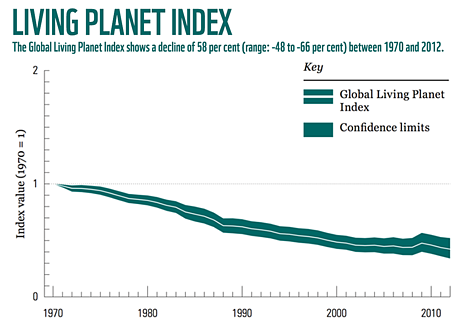
Earth continues to hemorrhage biodiversity, according to the latest Living Planet Report. Unfortunately, its authors cannot manage a clear statement of how to stop the bleeding. by The Overpopulation Project “You could think of it as a health check for the planet,” says the World Wildlife Fund, introducing its most recent biennial Living Planet Report,…
-
Conserving biodiversity means limiting human numbers
A recent letter in Biological Conservation criticized TOP researchers for writing about how more people means less space for wildlife. We responded that without limiting our numbers, people will not be able to protect the natural world. Who’s right? Please share your thoughts and ideas in the on-line comments below. by The Overpopulation Project This…
-
Is it wrong to explore the connections between overpopulation and biodiversity loss?
A recent letter in Biological Conservation criticizes TOP researchers for writing about how more people means less space for wildlife. We are curious what our readers think of the arguments and how you would respond. Please share your suggestions in the on-line comments below. by The Overpopulation Project This summer, TOP researchers published an article…
-
The Natural Synergy between Population Stabilization and Reproductive Rights
In the second essay we are featuring from the Great Transition Initiative’s forum The Population Debate Revisited, Céline Delacroix highlights the win-win relationship between elevating women’s health, rights and autonomy and minimising population growth. Why then is the topic so unwelcome in international policy discourse? By Céline Delacroix Reading Ian Lowe’s opening essay to this…
-
Population and the Great Transition
In June, the Great Transition Initiative ran a month-long forum under the title The Population Debate Revisited. The collection of contributed essays is now accessible on the GTI’s site, and makes for interesting reading. We thought three of the essays held particular merit and will republish them here over the next few weeks. The first…
-
Elon Musk is wrong about population growth
Tech entrepreneur and multibillionaire Elon Musk claims that underpopulation rather than overpopulation is the greatest threat that faces humanity, despite current destruction of nature and the millions of people living in extreme poverty. Dr. David Walker examines Musk’s dangerous statements and sets the facts straight. By Dr. David Walker As a South African, I must…
-
New publication shows how overpopulation drives biodiversity loss
The concept of human overpopulation, once common, is now rarely used in the scientific literature. Yet overpopulation is a major driver of biodiversity loss and a key obstacle to fairly sharing habitat and resources with other species. A new publication from TOP explores the connections between human numbers and preserving wild nature. by The Overpopulation…
-
The United Nations celebrates World Population Day by shaming population ‘alarmists’
Not content with omitting overpopulation concerns from its own rhetoric, in its World Population Day statement the UNFPA has gone on the attack, labelling all concerns about the numbers of humans ‘alarmist’. Jane O’Sullivan takes them to task. By Jane O’Sullivan The United Nations Population Fund (UNFPA) was created in 1969 to act on the…
-
Breaking boundaries but not population taboos
The book Breaking Boundaries by Johan Rockström and Owen Gaffney explains the basics of how the Earth works and how humanity is rocking the boat, ecologically speaking. While describing monumental challenges, it views the future with optimism. Despite having a chapter dedicated to population, it fails to acknowledge how larger global populations reduce our chances…
-
On Threats and How to Prevent Them
Threats that humanity faces today are planetary in scale. That and their menacing character require long-term thinking and preventive politics to deal with or, better yet, prevent them. This may require planetary governance that unites humanity for mutual protection. by Jan Greguš, Masaryk University, Czech Republic Few would have believed five or ten years ago…
-
A new approach for defining optimum population size
The concept of optimum population size is nothing new, but in recent decades the methodology used to calculate it has seen little development. In a recently published book, We Zijn Met Te Veel (Dutch for We Are Too Many), a new approach is proposed for calculating optimum population size. by Fons Jena In the available literature…
-
The Making of 8 Billion Angels
8 Billion Angels is a rare full-length environmental film focused on population issues. Producer Terry Spahr joins Phil Cafaro for a discussion of the making of this fascinating film in an episode from season two of The Population Factor. by the Overpopulation Project 8 Billion Angels is both visually stunning and thought-provoking. If you haven’t…
-
Limits to Sustainability, Population, and the TEDx Experience
A recent TEDx talk delves into our species’ reverence for economic and population growth, which is pushing us – and the natural world – outside our safe operating space. In ‘Limits to Sustainability’, João Abegão attempts to communicate the expanding footprint of our species by comparing it with transformations suffered by past complex societies. By…
-
Move Upstream
Environmental organizations around the world are often stuck treating symptoms, rather than addressing the root causes of environmental problems. Author and naturalist Karen Shragg joins Phil Cafaro for a new episode of The Population Factor to discuss how “moving upstream” could reinvigorate a tired environmental movement. by The Overpopulation Project As representatives from the nations…
-
The Population Factor returns for a second season
The Population Factor, the show hosted by The Overpopulation Project’s own Phil Cafaro, returns with a second season, starting off with a discussion about the Nature Needs Half proposal. by The Overpopulation Project Wildlife populations are dwindling rapidly across much of the world and the number one cause is habitat loss, driven by excessive human…
-
The most ethical gift: Towards a sustainable demographic future
Demographic changes are not immediate, but rather take a long time to happen. In an article originally posted in The Ecological Citizen, Joe Bish argues that the population discussion needs to be reframed as an imperative to achieving a long-term sustainable civilisation, rather than an overriding priority for near term goals. By Joe Bish The…
-
The demographic fantasies of the IPCC
Climate change is now unequivocally an emergency according to the latest report from the IPCC. Our only hope lies in extremely rapid abandonment of fossil fuels and reversal of forest loss. But these lifeline scenarios also assume birth rates plummet in high-fertility regions. Jane O’Sullivan offers a reality check. By Jane O’Sullivan The Intergovernmental Panel…
-
Why we must become fewer people and consume less – and suggestions to improve the situation
The mainstream media rarely report about the role of population growth in environmental and climate disruptions, but the Op-Ed below was actually published in the high-circulating Swedish Social Democratic newspaper Aftonbladet a week ago. The original Swedish text is available here. The article gives a broad overview, ending with an unusual suggestion. There were 250…
Explore the content and topics covered by TOP, search here
Recent blog posts
Blog categories
What we are reading, listening to and watching
Gallery of infographics – Learn more about overpopulation and environment