
A recent paper documents the role population growth has played in driving global ecological overshoot and advocates gradual population decline by encouraging low birth rates to help reverse it. “Malthus was wrong, Ehrlich was wrong, and these idiots are wrong,” wrote one annoyed commentator on X. Yet it has gotten a surprisingly thoughtful hearing in the mainstream media, including Britain’s Daily Mail and the Independent.
by Philip Cafaro
“Achieve Sustainability by Easing Population to 4 Billion by 2200.” That’s the provocative title of an article recently published in the academic journal Sustainable Development. Columbia University’s Mark Keegan led an international team of authors that included Jane O’Sullivan and myself from TOP (with Frank Götmark contributing as well). Predictably, many commentators have invoked Thanos from the film Avenger’s Endgame in criticizing the piece which, just for the record, does not propose culling half the current global population.

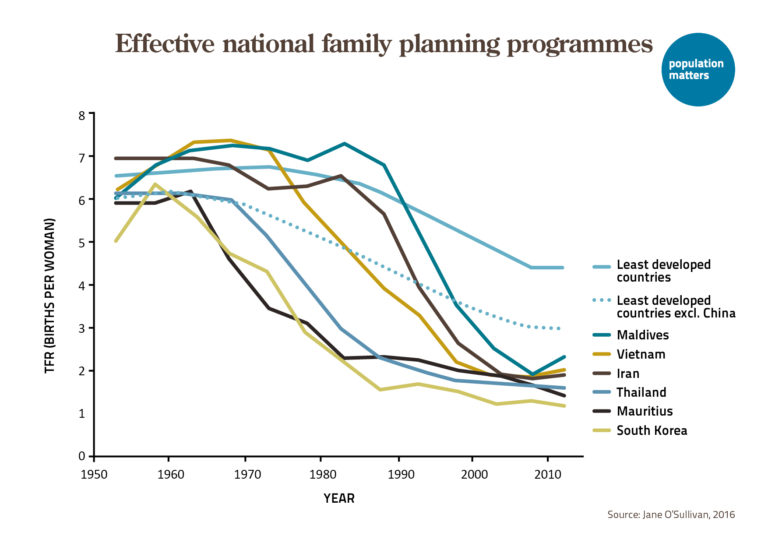
What the paper does propose is improved education for girls and young women, universal access to contraception, and full freedom for couples to use it. It encourages societies to embrace population decline as key to genuine sustainability, rather than fighting it with pronatalist campaigns, as many are doing.
The Past Fifty Years
The paper is grounded in the truism that human population levels and per capita impacts multiply together to produce our total impact on the Earth’s systems. The global picture for any particular resource use, pollution level, or other environmental impact can be expressed by a simple formula: Total Impact = Population X Per Capita Impact. This is the original form of the IPAT equation described over half a century ago by Paul Ehrlich and John Holdren, and the form Holdren later re-embraced.
In its first half, the paper graphs data for eight areas of global resource use, pollution and environmental decline against global population increase, for the period 1970-2020. These graphs show very strong correlations between population growth and recent negative environmental trends.
More people has helped drive increased total energy use:

And increased mineral extraction:

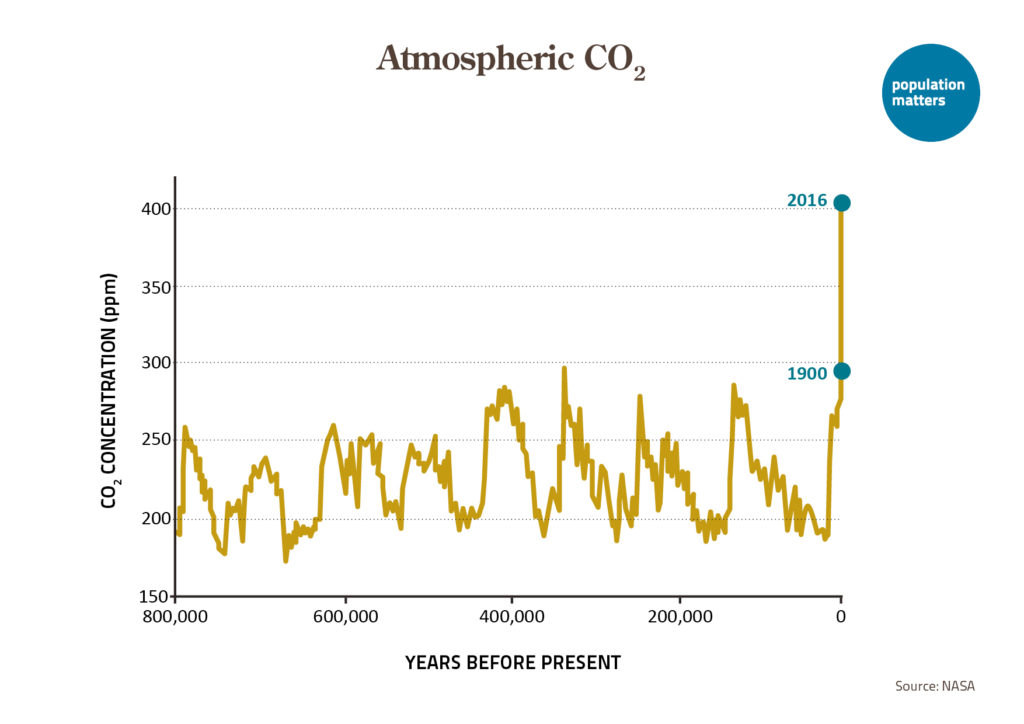
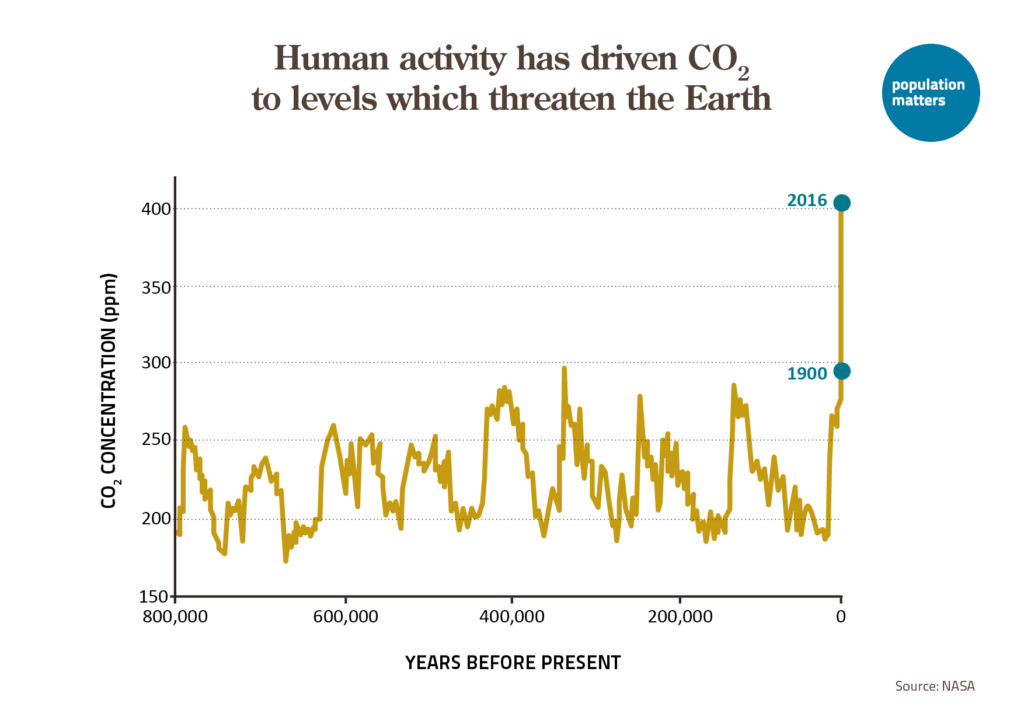
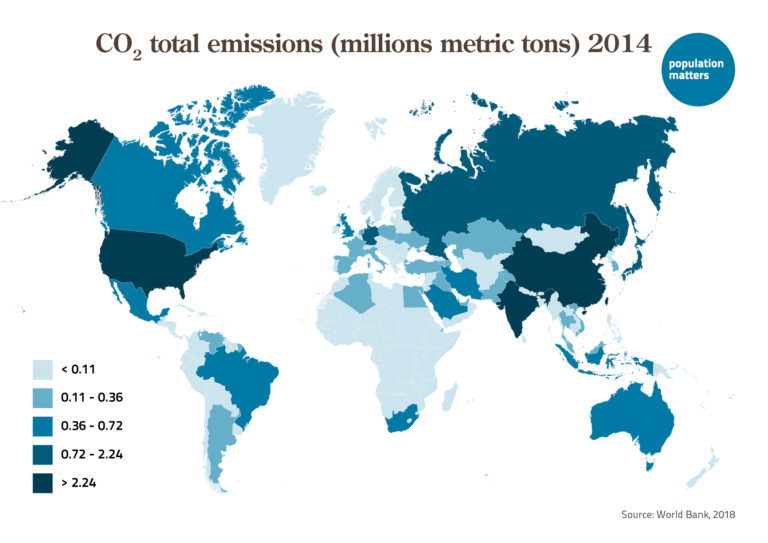
These increases in human resource use, in turn, have led to increased CO2 emissions:

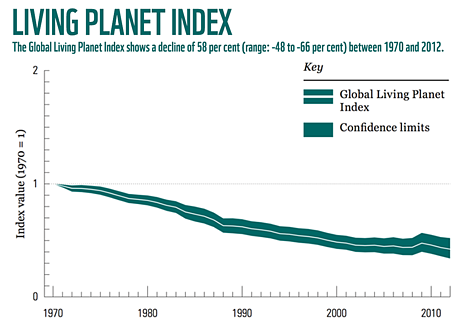
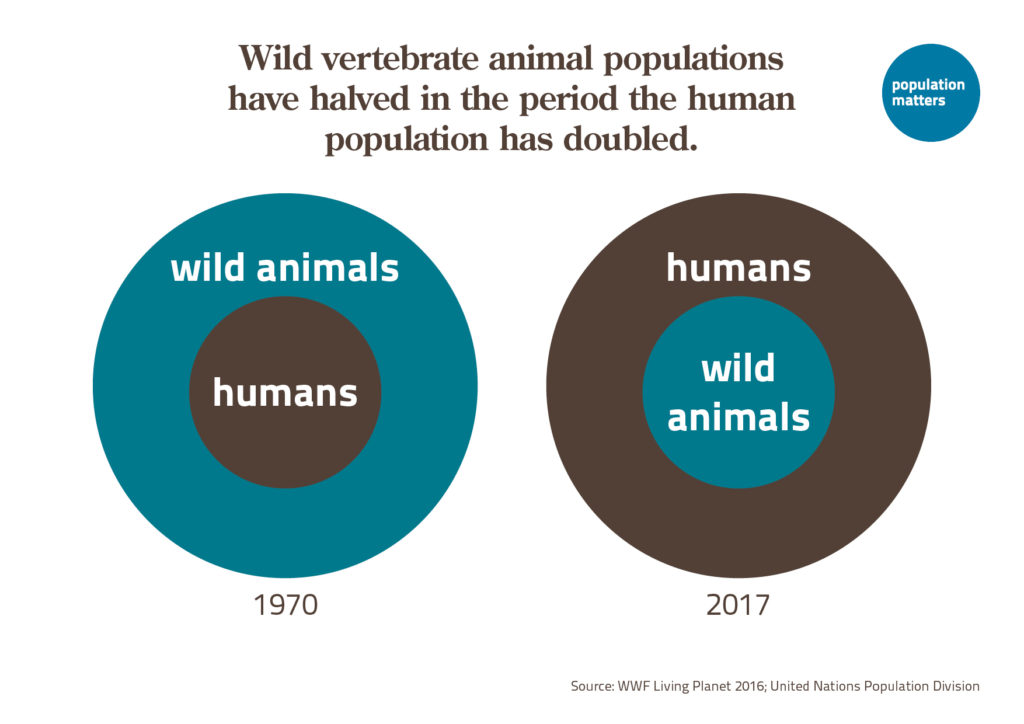
And declining wildlife populations:

Similar strong correlations were found between population growth and increased freshwater use, pesticide use, plastics production, and overall ecological footprint. Over the past half century, population growth increased resource use and pollution across the board.
This may seem like stating the blindingly obvious. But in the face of rampant population denial, it’s important to reiterate the basic fact that more people cause more resource use and pollution.
How Important Was Population Growth?
Population growth wasn’t the only cause of increased environmental impacts during this period, our study found. Per capita impacts also increased, due to increased wealth and the deployment of more powerful and destructive technologies. The paper goes on to quantify the relative strength of population growth and changing per capita impacts between 1970 and 2020.
We found that population growth was the main driver for five of eight important environmental impacts (wildlife decline and increases in CO2 emissions, total energy use, ecological footprint, and freshwater use). For two of these (ecological footprint and freshwater use), per capita impacts actually declined between 1970 and 2020, but population growth drove total impacts significantly higher. For two other metrics (mineral extraction and pesticide use), population growth and per capita consumption increases were approximately equal drivers of the total increases. And for the huge global increase in plastics production and pollution, increased per capita use was the main driver.
One way to summarize these results is to say that between 1970 and 2020, population growth was more important than growth in our per capita impacts in driving increases in humanity’s overall environmental impacts. But we should not draw the wrong conclusion from this. For all eight major environmental impacts studied, both human numbers and per capita impacts were and remain important factors.
The Next One Hundred and Seventy-Five Years
If population growth increases resource use and pollution, population decline can decrease them. Going forward, how big a difference might smart population policies make in efforts to lower humanity’s global environmental impacts? That depends both on how successful the policies are at lowering our numbers and how successful societies are at lowering per capita environmental impacts.
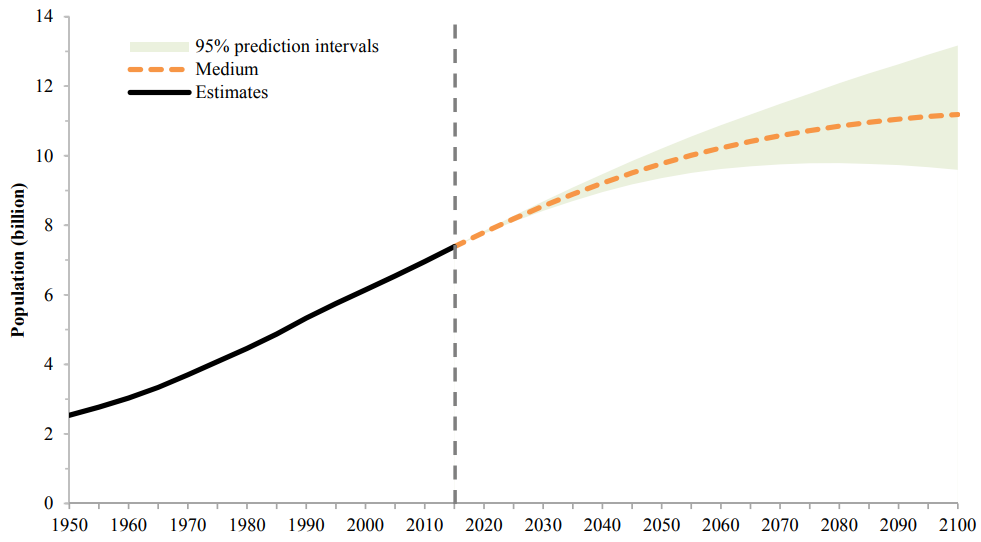
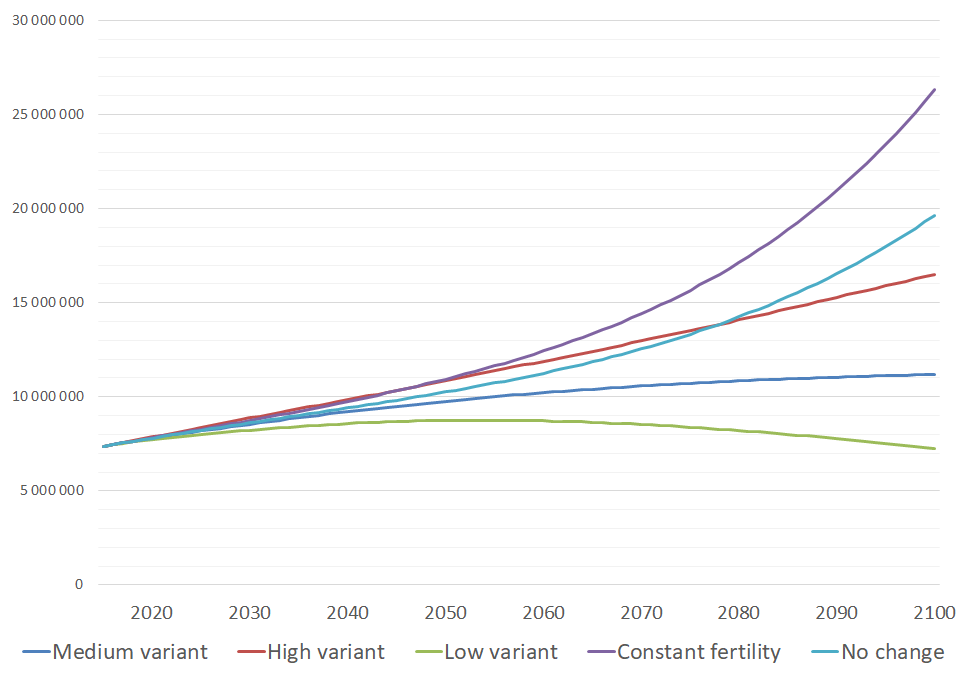
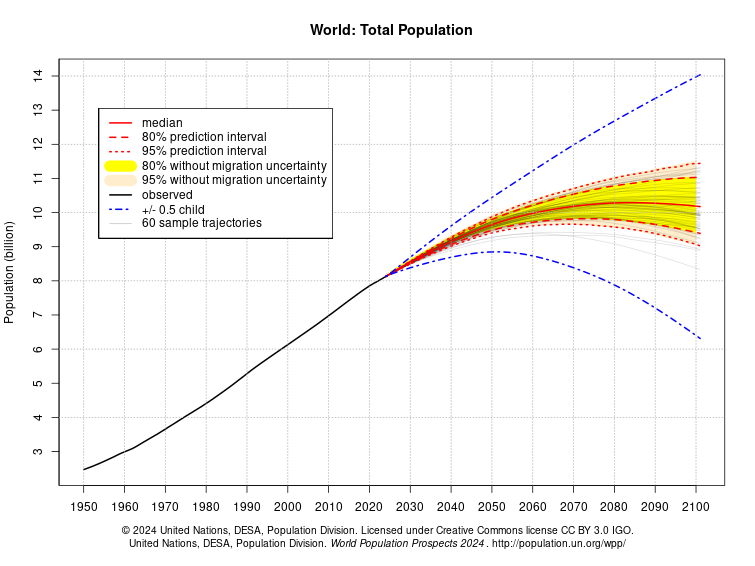
Our study imagined per capita impacts holding steady at current levels and showed what total impacts for our eight key areas would look like in 2100 and 2200 under three different demographic scenarios: the UN’s most recent high and low fertility trajectories and a “fastest progress” scenario of increased contraceptive availability and use developed by the Institute for Health Metrics and Evaluation. The average fertility rates in these three scenarios differ by less than a single child per woman (2.25 versus 1.60 TFR). Yet they lead to large differences in resource use and pollution by 2100 and immense differences by 2200, as shown in the table below.

For example, total energy use under the lowest fertility scenario is only 55% of what it would be under the highest fertility scenario in 2100 — and in 2200 it is only 14% as much. By 2200, humanity would use three times as much freshwater under the highest fertility scenario compared to the lowest one, discharge six times as many CO2 emissions, and use thirteen times as much agricultural pesticides. These figures show the cumulative benefits of good population policies and the folly of poor-mouthing them for not immediately solving all our environmental problems.
Of course, one could always hope that some of these per capita impacts would be driven so close to zero that large differences in human numbers would not make much difference to our total environmental impacts. But that seems highly unlikely. As our study showed, the trends in most areas have been for increased per capita impacts.
Even with much greater effort and self-sacrifice than people have exhibited so far, our per capita environmental impacts will remain high enough that the number of capitas will remain consequential. Whatever numbers future scholars eventually fill in for actual per capita environmental impacts for 2100 and 2200, more people will increase our total impacts while fewer people will decrease them.
A Caveat
If we are serious about avoiding ecological collapse, we cannot ignore the population factor. At the same time, our new study shows that we must also work to reduce per capita impacts, particularly among the wealthy whose impacts are the largest.
One of the most oft-repeated criticisms of our paper on X was that focusing on population was a ruse to avoid addressing overconsumption among the wealthy.
“This is what they’ll propose instead of just cutting the excesses of capitalism and reining in the military,” complained one person. “They’ve been banging the ‘overpopulation’ drum for decades, and the solution is always for poor, and usually non-white people to not have kids.”
“We must address the top 10%,” tweeted another, with an illustration of Oxfam’s champagne flute for CO2 emissions.
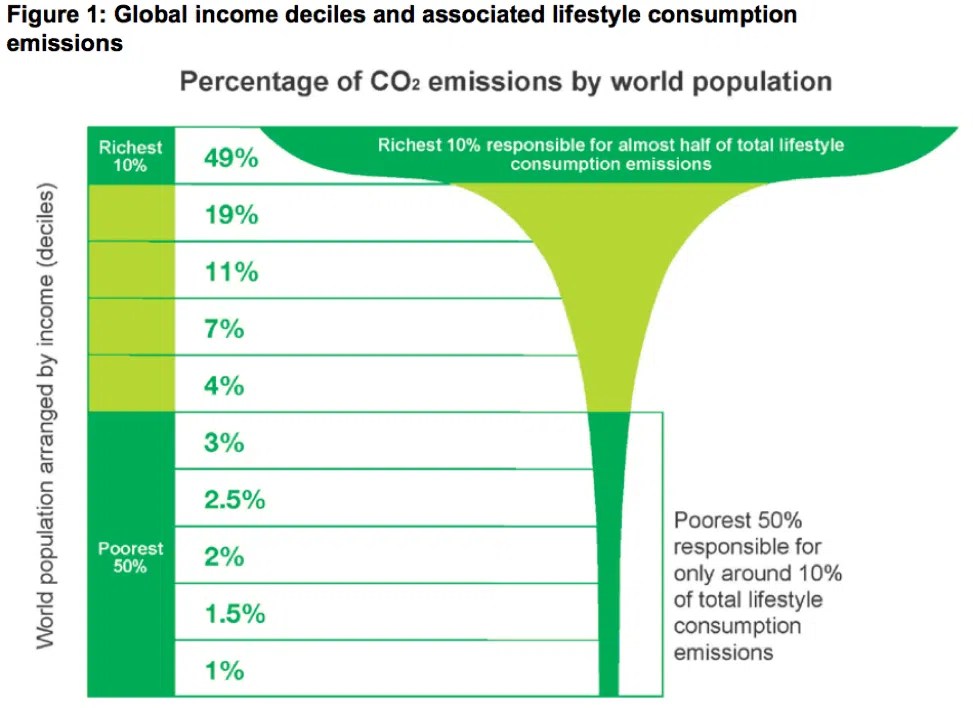
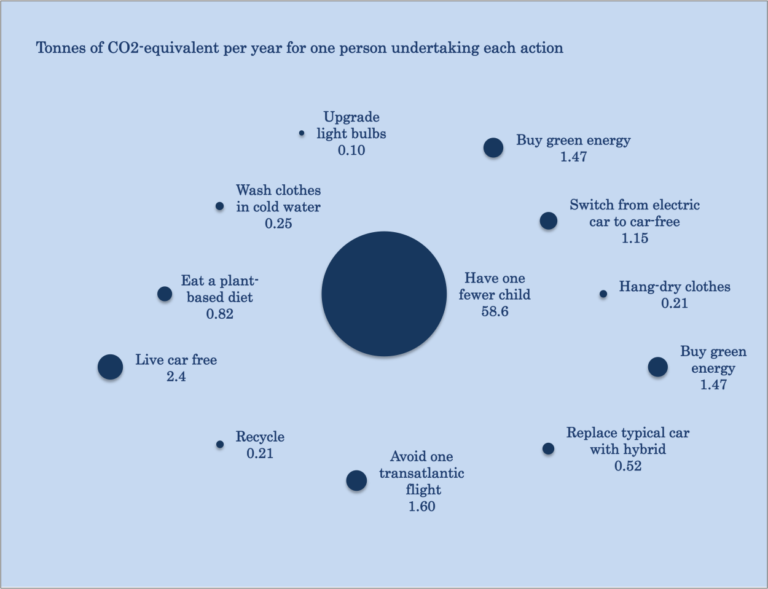
The Oxfam diagram is long out-of-date, failing to accurately reflect the recent growth of a one to two billion-strong global “consumer class.” Still, it’s true that wealthy people generate more than our fair share of carbon emissions and other environmental impacts. We also model lifestyles that serve as examples to billions of poorer people. Reducing unnecessary consumption among the wealthy (of whatever race or ethnicity) should be part of reducing humanity’s average per capita environmental impacts. A world serious about mitigating climate change would outlaw private jet ownership and limit personal air travel (which is largely the province of the world’s richest 10%).
That said, reducing the average environmental impacts of the wealthy, like reducing the average environmental impacts of the middle-class, will be hard to do. If the past is any guide, efforts to do so will be partly successful at best. However successful they are, it will make a big difference environmentally whether the world’s wealthiest 10% number 400 million in 2200, as they would under the IMHE’s low fertility scenario, or 2.1 billion, as they would under the UN’s high fertility scenario.
Critics are right that overpopulation in rich countries must not be overlooked. Each person added to Canada or Australia, whether through births or immigration, adds far more environmental impact than an extra Ugandan or Bangladeshi. At the same time, residents in poor countries face exceptional risks due to continued population growth. We believe “targeting” them with support for voluntary birth control is a moral imperative to minimize poverty and economic deprivation. For all these reasons, and above all because we share one world, our paper advocates reducing human numbers across the board, slowly and humanely, in richer and poorer countries alike.
Another Caveat
While the Oxfam diagram stresses that consumption by the rich is too high, it also suggests, plausibly, that consumption by the lowest 50% is too low. To bring half of humanity out of poverty will take a lot more energy and resources. In a world already deep into ecological overshoot, we cannot hope to do so without a much smaller overall population.
Indeed, some scientists argue that four billion people is still too many to achieve sustainability. Several well-reasoned estimates put the global human carrying capacity somewhere between half a billion and three billion, aiming for a reasonable standard of living for everyone. We are sympathetic to such arguments. However, if humanity sets sail for four billion, there is nothing in the way of continuing beyond that benchmark to two billion, or fewer.
The important point, at this moment in history, is to embrace population decline and take measures to enable it. The sooner and faster we retreat from ecological overshoot, the less damage to Earth’s essential life support systems. What number we stabilize at is not a practical question for the current generation, but for our descendants.
The Upshot
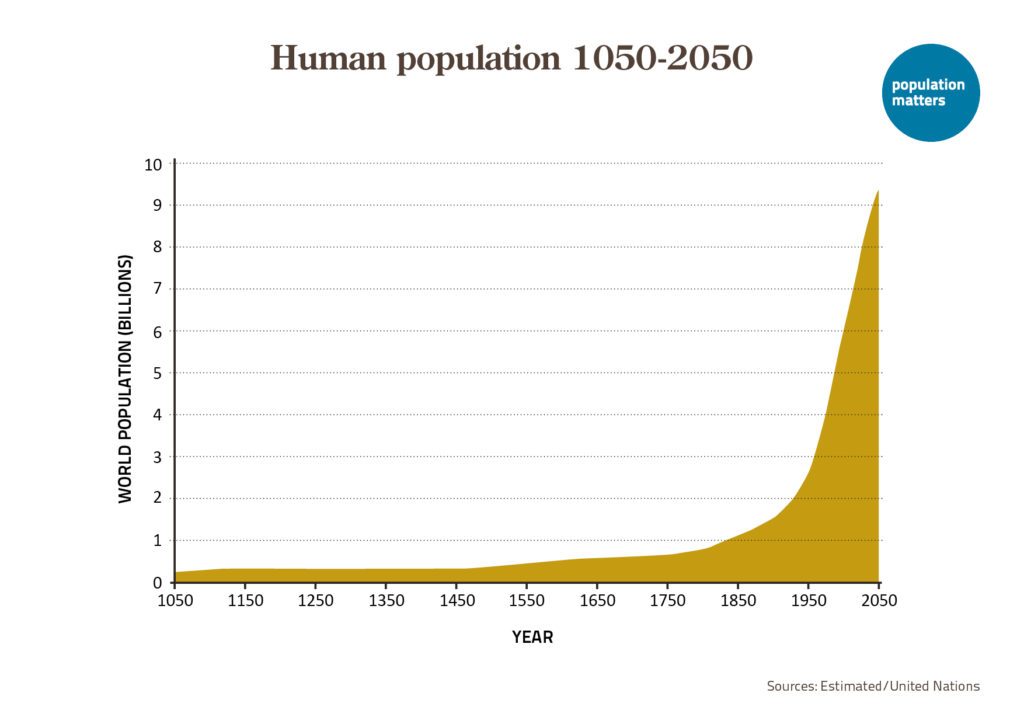
Reducing human numbers will ease pressure on natural resources and reduce pollution. It will lessen poverty in high fertility regions and improve quality of life in densely populated ones. A more modest human population of four billion (the same number we had around 1974) will help preserve ecosystem services essential to human well-being and allow us to share the world more generously with the ten million other species who currently inhabit it.
Such a world is possible. There is overwhelming evidence that sub-replacement fertility can be achieved quickly and non-coercively in a wide range of societies. We are already slowly progressing toward population decline globally by the sum of billions of individual choices. This can and should be accelerated with the right policies.











Leave a Reply