The Overpopulation Project
TOP – Research and Outreach
Too many people consuming too much
Category: Fertility rate
-
What do citizens of a donor country think drives fertility decline in low-income countries?
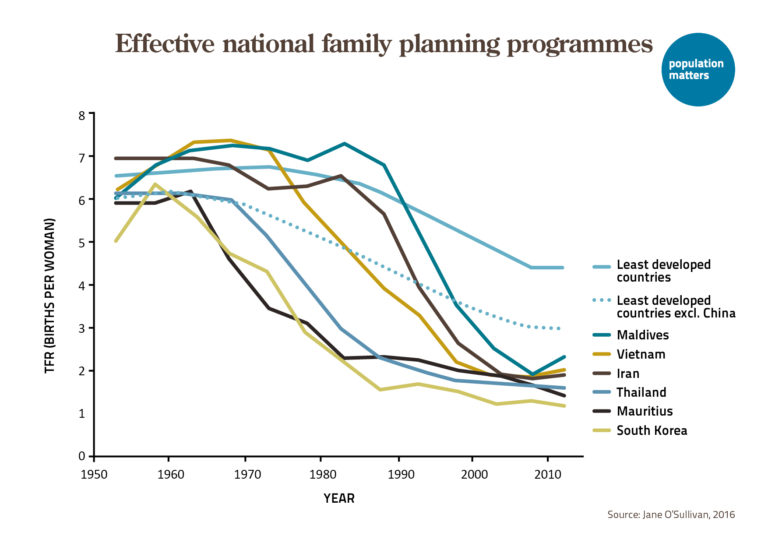
In TOP, we have researched what causes the birth rate and family size to fall in developing countries. A major factor has been voluntary family planning programs in countries like Costa Rica, Iran and South Korea. In current academic literature, the dominating paradigm is increased education of women. In developmental aid, “reproductive health” is often…
7 comments on What do citizens of a donor country think drives fertility decline in low-income countries? -
Religion, Fertility and Contraceptive Use in Sub-Saharan Africa, Part 6: Progressive Religious Organisations
While contraception in Sub-Saharan Africa is still considered taboo in many religious settings and children are viewed as a “gift from God”, some religious leaders are actively promoting the importance of family planning and considering its role in population growth. In this last part of our series on religion, fertility and contraceptive use in Sub-Saharan…
-
Religion, Fertility and Contraception in Sub-Saharan Africa, Part 5: Views and Opinions of the Local People
While statistical analyses of data can paint a picture of contraception and fertility trends in Sub-Saharan Africa, much can also be learned from speaking directly with citizens. In Part 5 of our series, we examine focus group discussions and in-depth interviews conducted by researchers with local groups across Sub-Saharan Africa. From such work, one gains…
-
The Making of 8 Billion Angels
8 Billion Angels is a rare full-length environmental film focused on population issues. Producer Terry Spahr joins Phil Cafaro for a discussion of the making of this fascinating film in an episode from season two of The Population Factor. by the Overpopulation Project 8 Billion Angels is both visually stunning and thought-provoking. If you haven’t…
-
Religion, Religiosity, Fertility and Contraception in Sub-Saharan Africa: Part 3, A Study of Christian Denominations in Mozambique
How does affiliation with different Christian denominations influence fertility? In a study1 from a Christian high-fertility area in Mozambique, Victor Agadjanian and Scott Yabiku examine fertility from two perspectives: dynamically, by looking at risks of births in any given year, and cumulatively, by the number of children ever born versus length of membership in a…
-
Religion and Fertility in Sub-Saharan Africa – Part 2, Differences Among Denominations
Among the eight regional groups used for the United Nations Sustainable Development Goals (SDGs), only Sub-Saharan Africa (SSA) is projected to sustain a rapid population growth up to 2100, while the seven other regions either have started to decline, or are projected to stabilise, by 21001. In SSA, many countries have a young population; 40-50%…
-
Past, present, and future population: a personal account of India
Sometime this decade, India is set to overtake China as the most populous nation on Earth. Below, a reader from India reflects on what these immense numbers mean for his country’s future. Despite being in the position of being able to have a family of his own, he chooses not to in protest. For him…
-
Coercion and population policies, Part 2 – the remarkable case of Peru
The unsustainable growth of the global population needs to be halted through informed voluntary action. Coercive population policies such as those used in China are unacceptable. On the other hand, many millions of women and couples around the world face pro-natalist forms of coercion, such as being forced to give birth to unwanted children, in…
-
Earth Wars: Nature Strikes Back
The current pandemic has had many severe consequences, but it has also acted as a reminder of the need for international cooperation when facing global challenges. Continued environmental destruction will likely increase the risk for future pandemics. Population growth is one of the main driving factors of the continued encroachment into nature and needs to…
-
Coercion and population policies, Part 1
The unsustainable growth of the global population needs to be halted through informed voluntary action, including empowerment of women, family planning and increased use of modern contraceptives. Coercive population policies such as those used for 35 years in China, in India 1975-77, and more recently in Peru, are unacceptable and must be condemned. But many…
-
Humanity needs to halt both population growth and climate change
Many of today’s environmental problems are more due to population growth than climate change, and climate change is driven in part by continued global population growth. Development funding to make family planning and modern contraceptives universally available could make a big difference in solving these interlocking problems. By Malte Andersson, Frank Götmark, and Anders Wijkman…
-
Pay Attention, Healthcare Workers!
Doctors have played a vital role in lowering mortality and increasing human life span and well-being. While representing a humanitarian success, this achievement has also contributed to a rapid increase in human numbers. In 1972, 52 physicians took responsibility for their role in this success and signed a call for action against overpopulation, through education,…
-
Boiling Frogs
by N.R. Baker According to the well-known metaphor, if you were to put a live frog into boiling water, it would – very wisely – leap straight out again. However, if you put the frog into tepid water that was then brought slowly to the boil, the hapless creature would be cooked before it even…
-
Why global support for contraception is critical in the pandemic age
Saturday, September 26th is World Contraception Day. This key date is a reminder that access to affordable contraception and reproductive health services is a fundamental human right across the globe. Furthermore, family planning and reproductive autonomy (particularly in the Global South), together with lowering our personal environmental impacts (particularly in the Global North) is fundamental…
-
Population growth and climate change: environmental threat multipliers – a new publication from TOP
The Overpopulation Project is pleased to announce its most recent publication, “Population growth and climate change: Addressing the overlooked threat multiplier” published in Science of the Total Environment. Through a review of national and global studies, the paper describes the emission reduction and vulnerability reduction benefits of slowing population growth, and outlines policies that can…
-
Will global population peak below 10 billion?
A major media storm has erupted about a new scientific paper published in the Lancet claiming that global population will soon peak and decline. The prospect is met with doom and gloom, rather than jubilation. But Jane O’Sullivan finds many reasons to challenge both the claim and its assumed economic threat. By escalating unfounded fears…
-
Fertility levels in global regions and countries: what is the role of religion?
Population growth depends strongly on fertility rates, so it is important to study factors that determine fertility. Despite much research, there is no consensus about the most important factors involved, except that contraceptive use can be effective. Factors correlated with declining as well as increasing or high fertility should be studied simultaneously. Religiosity is potentially…
-
Why is Brazil a useful model in demographics?
Brazil’s transition from the demographic transition model’s stage 3 to stage 4 was fast paced and lacked government intervention. By Pete Bailey This post was originally published on the PopEd blog, see the original post here>> Over the past fifty years, Brazil has seen fertility rates drop from an average of six children/woman to less…
-
Know the Numbers! TOP unveils new interactive population projections for the European Union
by Philip Cafaro In my experience teaching environmental ethics to college students and advocating for sustainable policies in the United States, the biggest obstacle to good discussions about population matters is ignorance about the numbers. How many people live in the United States? My students don’t know. Many environmentalists don’t know. What will the US…
-
New EU population projections published
Researchers at TOP have published new population projections for all twenty-eight member countries of the European Union and for the EU as a whole. These projections differ from the 2019 United Nations’ Population Division projections and other recent projections in two main ways. First, they project a wider range of fertility and migration scenarios farther…
-
A potential pledge: no change, no grandchildren
Planet earth’s future cannot be bright with 8 billion people: our future depends on how seriously and quickly we change our materialist culture, social organization and technologies. An immediate action plan is offered for the generation centered around Greta Thunberg: young women, and just as importantly young men, should avow not to have children until their…
-
Part 2 Review of “Empty Planet: The Shock of Global Population Decline”
Empty Planet: The Shock of Global Population Decline claims that (a) life on earth is stressed but coping with the present level of human impact; (b) global population will peak in 2050; (c) subsequent population decline will alleviate ecological problems; and (d) countries with populations that are only slowly growing should act now to boost…
-
The Greatness of The Great Decrease
A new international billboard campaign encourages the public and policymakers to “Celebrate Low Birthrates!” and “Shrink Towards Abundance!” The goals of the campaign are to draw attention to the benefits of declining populations and encourage politicians to rethink and reorganize the current economic system to take advantage of depopulation dividends. The environmental benefits of declining…
-
An integrated climate change response: the role of population
In April, TOP researchers organized a climate change seminar as part of the Gothenburg International Science Festival. Guest speakers were invited to discuss the role of population, affluence and technology in climate change solutions. The first presentation highlights how addressing population is a necessary measure to successfully mitigate and adapt to climate disruption. A recording…
-
Ten things that you may not know about population
Articles about population in the media typically are riddled with misconceptions and tiptoe around taboos. Moving past these can free us to have open and honest discussions about population matters. The following list does not pretend to be exhaustive, but to help debunk the most common myths and become more aware of the complexity of…
-
World Population Prospects 2019 – good news or bad?
By Jane O’Sullivan The new United Nations projections for global population tempt complacency by lowering the estimate for growth across this century, but lacks justification for this lower figure. This could perversely counter the UN’s own message that these projections depend in increasing global efforts to ensure “further improvements in access to family planning information…
-
More and more people living on the planet is cause for concern
TOP assisting researcher, Patrícia Dérer, was recently interviewed for the Hungarian newspaper, 444. The article, shortened and translated to English, includes highlights from her interview where she discusses the conditional nature of population projections, the link between population and biodiversity, the declining population of eastern Europe, successful family planning programs, and much more. By Zsolt…
-
Fix the climate with smaller families
Carbon dioxide and other greenhouse gas emissions are at an all time high. That growth tracks explosive world population growth, which is the greatest driver of climate change and a threat multiplier. The Green New Deal has justifiably generated excitement and enthusiasm among people who believe its goal of cutting greenhouse-gas emissions to net zero over 10 years is…
-
A Simple Point (that makes a big difference over time)
Here at The Overpopulation Project we explore various aspects of the population-environment connection, some of which get quite complicated. In this blog we make a simple point, well worth remembering and sharing with colleagues and friends. We highlight the difference between a decreasing rate of global population growth, the amount of growth, and an end…
Explore the content and topics covered by TOP, search here
Recent blog posts
- The Progressive Left are the Bad Guys Too
- Reproductive rights: an unfinished project and an ecological imperative
- A shrinking population might actually be a good thing
- Cutting the global population in half to achieve sustainability
- Ceuta incident: Population growth threatens both poor Africans and climate stability
Blog categories
What we are reading, listening to and watching
Gallery of infographics – Learn more about overpopulation and environment