The Overpopulation Project
TOP – Research and Outreach
Too many people consuming too much
Category: Success stories – Family Planning
-
Family planning in Mexico – success against the odds
Within a few years, Mexico went from a staunchly pro-natalist country with high birth rates to having the strongest family planning programme in Latin America. As the latest in our series on successful family planning programmes, Mexico provides a case study for how family planning advocates managed to succeed despite a pro-natalist government, and how…
8 comments on Family planning in Mexico – success against the odds -
New study shows what is possible with strong family planning funding
Access to voluntary, informed family planning should be the right of all people. In the past, only those with health insurance or who were well-to-do were likely to be able to access good family planning care. A new study by Franciele Hellwig and colleagues shows family planning equity has improved in five developing countries they studied, thanks…
-
Thailand’s success story – Family planning with creativity and humor
Promoting contraceptives in fun ways achieved tremendous success towards breaking taboos and clarifying misconceptions. Together with creative community development programs, family planning programs increased the wellbeing of all Thais.
-
Introducing The Overpopulation Project Video Series # 2: Family Planning: Past Lessons for the Future
The Overpopulation Project presents the second video in our four-part interview mini-series, an interview with Carl Wahren, a population professional with more than 30 years of experience with various multilateral organizations. Carl was a pioneer in introducing family planning programs in developing countries in the 1960’s, programs supported by the government and agencies in Sweden.…
-
Rwanda: A pioneer of family planning in Sub-Saharan Africa
Rwanda has experienced a 40% increase in contraception use within only the past 15 years. The country is located in Sub-Saharan Africa, a region typically known for its high population growth.1 Despite the large rural population, traditional large family norms and strong influence of the religious institutions, Rwanda is slowly becoming known for its efficient, ongoing…
-
The first population policies implemented in Africa: the case of Tunisia
In the early 1960s, Tunisia became the first country on the African continent to significantly improve women’s status and launch a voluntary national family planning (FP) program. Today, Tunisia has some of the most progressive family planning policies in Africa, and it is the most progressive of all Arab countries in terms of gender equality…
-
Family Planning for forests and people – the success story of Costa Rica
Costa Rica is a country of exceptionally rich and well-protected biodiversity. It is a solid democracy where people live long, relatively healthy and happy lives while leaving a small ecological footprint. Together with its good and improving environmental performance and overall well-being, the country is characterized by a below replacement fertility level, the lowest in…
-
Low fertility in South Korea: a springboard for social change and conservation
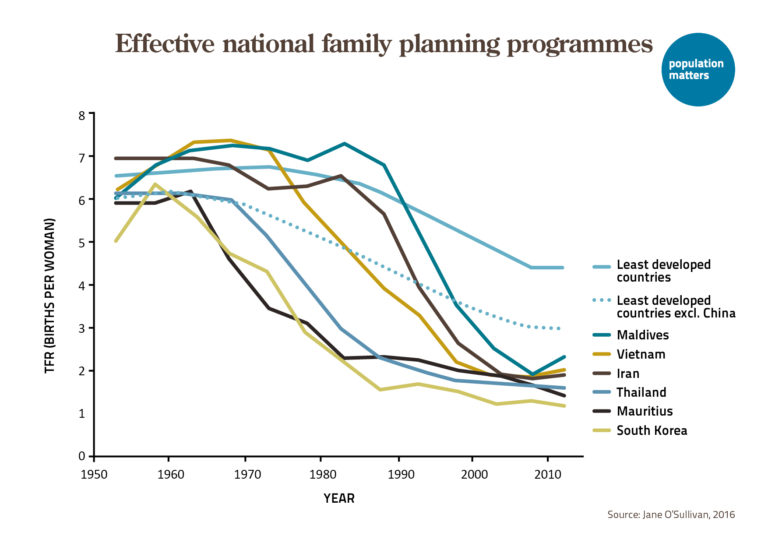
In the 1960s and 70s, South Korea experienced one of the fastest fertility declines in the world, halving the number of children born per woman from over 6 to less than 3 in just 18 years. In large part, this was due to early government recognition that fertility reduction is a component of development, a…
-
The Iranian miracle: The most effective family planning program in history?
In the second part of our Population Policy Case study series, following Indonesia, The Overpopulation Project Team examines the history of population policies in the Islamic Republic of Iran. Iran stands out for lowering its fertility in a very short time without coercion. The total fertility rate dropped from almost 6 in 1988 at the…
-
“Two Children Are Enough” – “Dua Anak Cukup”
Indonesia: Population Policy Case Study 1 By Jenna Dodson Population policies[1] of the late 20th century played a central role in the global decline in fertility rates1. These policies mobilized resources to enact policies aimed at reducing fertility by widening contraception provision and changing family-size norms. In the first of a series of Positive Population…
Explore the content and topics covered by TOP, search here
Recent blog posts
- The Progressive Left are the Bad Guys Too
- Reproductive rights: an unfinished project and an ecological imperative
- A shrinking population might actually be a good thing
- Cutting the global population in half to achieve sustainability
- Ceuta incident: Population growth threatens both poor Africans and climate stability
Blog categories
What we are reading, listening to and watching
- Women’s Equality Day by Population Connection Fund
- ‘My bloodline ends with me’: Why feminist ‘childfree icon’ wants fewer ‘white babies’ and more refugees by Frank Chung
- Trump’s Pronatalist Policy for GDP Growth by Kirsten Stade
- Bill Ryerson: A life with purpose by Population Media Center
- Achieve Sustainability by Easing Population to 4 Billion by 2200 by Keegan et al.
- Population growth and family planning are still important. Has UNFPA forgotten? by Götmark et al.
- In Defence of Overpopulation, Remembering Paul Ehrlich by Marcus Dredge
- Scientists’ Warning: Population as a Threat to Security by Jan Greguš
- Large mammal recovery in the wake of human population decline by Jensen et al.
- Population Connection at the Seventh Session of the Commission on the Status of Women by Melvine Ouyo
- American’s Rating of Environment Hits New Low by Megan Brenan
Gallery of infographics – Learn more about overpopulation and environment