The Overpopulation Project
TOP – Research and Outreach
Too many people consuming too much
Category: Environmental movement
-
The moral imperative of depopulation
Anthropocentrism is preventing humanity from dealing with the world’s cascading environmental crises. Stephen Williams reviews the work of Catholic historian Paul Collins who argues depopulation is an urgent moral imperative. By Stephen Williams A new discussion paper on population ethics written by Catholic historian Paul Collins is as radical as it is worthy. The paper…
34 comments on The moral imperative of depopulation -
Population growth has contributed 80% of ecological overshoot
William Rees is the originator of ecological footprint analysis, the influential approach to measuring sustainability. In a new article, he argues that humanity is deep into ecological overshoot and that we need to ratchet back our numbers and the size of our economies before nature does it for us. by Philip Cafaro William Rees has…
-
More like a dying planet report
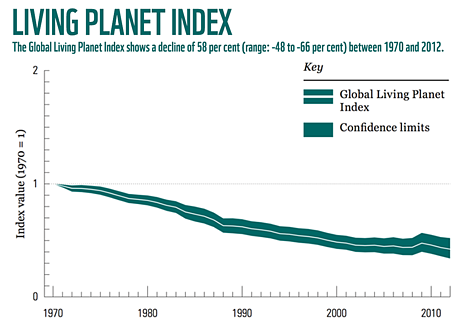
Earth continues to hemorrhage biodiversity, according to the latest Living Planet Report. Unfortunately, its authors cannot manage a clear statement of how to stop the bleeding. by The Overpopulation Project “You could think of it as a health check for the planet,” says the World Wildlife Fund, introducing its most recent biennial Living Planet Report,…
-
Is it wrong to explore the connections between overpopulation and biodiversity loss?
A recent letter in Biological Conservation criticizes TOP researchers for writing about how more people means less space for wildlife. We are curious what our readers think of the arguments and how you would respond. Please share your suggestions in the on-line comments below. by The Overpopulation Project This summer, TOP researchers published an article…
-
The Natural Synergy between Population Stabilization and Reproductive Rights
In the second essay we are featuring from the Great Transition Initiative’s forum The Population Debate Revisited, Céline Delacroix highlights the win-win relationship between elevating women’s health, rights and autonomy and minimising population growth. Why then is the topic so unwelcome in international policy discourse? By Céline Delacroix Reading Ian Lowe’s opening essay to this…
-
3 Women, 2 Countries, 1 Voice for World Population Day 2022
For those times when we feel worn down by the thanklessness of campaigning for population sustainability, it can be uplifting to hear the voices of veteran campaigners whose courage has never wavered. Michael Bayliss introduces us to a conversation to inspire. by Michael Bayliss In the most recent episode of Post-Growth Australia Podcast (PGAP) I…
-
New publication shows how overpopulation drives biodiversity loss
The concept of human overpopulation, once common, is now rarely used in the scientific literature. Yet overpopulation is a major driver of biodiversity loss and a key obstacle to fairly sharing habitat and resources with other species. A new publication from TOP explores the connections between human numbers and preserving wild nature. by The Overpopulation…
-
Two ways to argue for population’s importance
Here at TOP, we are often asked how we define overpopulation and whether it’s a helpful concept. Good questions! Below I propose a definition of overpopulation, after first considering the suggestion that it’s not necessary or helpful to deploy the term, even —or especially! — if we want to convince our societies to accept good…
-
A Foundation on the Right Track
One of the biggest obstacles to addressing overpopulation is the ignorance and timidity of most environmental funders regarding population issues. So we were happy to recently come across the following text on the website of the Colcom Foundation, a major environmental foundation out of Pittsburgh, Pennsylvania, USA. Particularly welcome are the direct links they draw…
-
Defining Overpopulation
A recent book introduces a new approach to the science of overpopulation. We Zijn Met Te Veel (Dutch for We Are Too Many) explores a new theoretical foundation for the concept of overpopulation and explains why a smaller human population is a necessary – but not sufficient – condition for a more hospitable world. by…
-
The Making of 8 Billion Angels
8 Billion Angels is a rare full-length environmental film focused on population issues. Producer Terry Spahr joins Phil Cafaro for a discussion of the making of this fascinating film in an episode from season two of The Population Factor. by the Overpopulation Project 8 Billion Angels is both visually stunning and thought-provoking. If you haven’t…
-
Move Upstream
Environmental organizations around the world are often stuck treating symptoms, rather than addressing the root causes of environmental problems. Author and naturalist Karen Shragg joins Phil Cafaro for a new episode of The Population Factor to discuss how “moving upstream” could reinvigorate a tired environmental movement. by The Overpopulation Project As representatives from the nations…
-
The Population Factor returns for a second season
The Population Factor, the show hosted by The Overpopulation Project’s own Phil Cafaro, returns with a second season, starting off with a discussion about the Nature Needs Half proposal. by The Overpopulation Project Wildlife populations are dwindling rapidly across much of the world and the number one cause is habitat loss, driven by excessive human…
-
The most ethical gift: Towards a sustainable demographic future
Demographic changes are not immediate, but rather take a long time to happen. In an article originally posted in The Ecological Citizen, Joe Bish argues that the population discussion needs to be reframed as an imperative to achieving a long-term sustainable civilisation, rather than an overriding priority for near term goals. By Joe Bish The…
-
An Environmental Impact Statement on US Immigration Policy
What impact does US immigration policy have on greenhouse gas emissions, habitat preservation, or water and air pollution? Episode six of The Population Factor on Earthx TV addresses these questions, while episode seven, the final episode of season one, discusses how declining human populations open up new opportunities for ecological restoration. by The Overpopulation Project…
-
Two radical ideas whose time has come
Increasing economic inequality and accelerating ecological decline are the two great political challenges facing nations today. In recent decades, many complicated efforts to address these problems have been proposed or tried, but the problems have continued to worsen. Perhaps it is time to address them more directly. by Philip Cafaro I came of age politically…
-
IUCN recognizes the importance of attending to population to preserve biodiversity
After decades of silence, the International Union for the Conservation of Nature has passed a motion reaffirming the importance of addressing population matters to achieving conservation success. This continues a welcome recent trend among conservation scientists to speak up about the potential benefits of reining in population growth. by Pernilla Hansson The International Union for…
-
Survey shows the general public is ready for discussions about population
A new survey from the Global Challenges Foundation shows wide concern about population growth and overpopulation in many parts of the world. by Pernilla Hansson In an attempt to assess the general public’s understanding of global catastrophic risks, the Global Challenges Foundation (GCF) recently carried out a large survey among people in 10 countries: Australia,…
-
Defending the nation-state
Imagine there’s no countries. It isn’t hard to do. Serving our corporate masters. And pasting smiles on our faces, too … Or better yet, imagine a world where citizens control their own destinies, within a peaceful and environmentally sustainable international order. That’s the real way forward. by the Honorable Kelvin Thomson I am a big…
-
Do countries consider population growth in their national plans to tackle climate change under the Paris Agreement? A new working paper from TOP
According to the IPCC, economic growth and increasing human populations are the two main drivers of global climate disruption. However, to date only efficiency improvements and technological changes have been seriously considered to meet the goals of the UNFCC’s Paris Agreement. In a new study, we examine how the parties to the agreement dealt with…
-
10:59 – time to address population?
The population crisis lies at the core of the first full-length novel by British author N. R. Baker, an eco-thriller called 10:59. Through a well-developed storyline, it details the destruction caused by our ever-growing population, following a compelling main character as he joins an organisation intent on saving the planet. Ms. Baker manages to balance…
-
‘A Life on Our Planet’: Attenborough’s recipe and human reluctance — Chronicle of a failure foretold
“Never let your sense of morals prevent you from doing what is right”I. Asimov In the outstanding film “A life on our planet”, Sir David Attenborough tells us which actions we need to implement to avoid a future catastrophe. His plan is feasible and affordable: we already have all the knowledge and technology required to…
-
Earth overshoot day and population
Too many people consuming too many resources and generating too much waste: that’s why humanity keeps pushing deeper into ecological overshoot. On Earth Overshoot Day, let’s not forget the P factor. by Lucia Tamburino & Philip Cafaro Every year on Earth Overshoot Day, a table like the one below makes the rounds, showing the number…
-
Lessons from a global pandemic
Covid-19 continues to take a great toll on societies around the world. As we struggle to respond appropriately, our societies can emerge ecologically and socially stronger—provided we learn the important lessons this tragedy has to teach us. by Kelvin Thomson In Australia, and I suspect in many other countries as well, there are three key…
-
Planet of the Humans: New Film Shakes Up a Complacent Environmental Movement
by Philip Cafaro and Jane O’Sullivan A full-length feature film from Michael Moore and long-time collaborator Jeff Gibbs, first screened last year, has just been released for free viewing on YouTube, garnering over 3 million views in less than a week. While flawed in several ways, it nevertheless makes a valuable contribution to the public…
Explore the content and topics covered by TOP, search here
Recent blog posts
- The Progressive Left are the Bad Guys Too
- Reproductive rights: an unfinished project and an ecological imperative
- A shrinking population might actually be a good thing
- Cutting the global population in half to achieve sustainability
- Ceuta incident: Population growth threatens both poor Africans and climate stability
Blog categories
What we are reading, listening to and watching
Gallery of infographics – Learn more about overpopulation and environment