The Overpopulation Project
TOP – Research and Outreach
Too many people consuming too much
Category: Economy
-
Housing affordability improves when population growth eases
Whether immigration fuels the housing crisis is hotly debated. Recent wide fluctuations in population growth have provided a natural experiment. The data are in: slowing population growth makes housing more affordable. by Jane O’Sullivan In the past two decades, many high-income countries have endured unprecedented increases in the cost of homes to buy or rent.…
21 comments on Housing affordability improves when population growth eases -
Major UN report highlights overpopulation and overconsumption, need for profound transformation
A major new review of the state of the environment by the United Nations Environment Programme (UNEP) provides a comprehensive and refreshingly honest exploration of the root drivers of environmental degradation, and stresses the urgent need to overhaul how we live on this planet. by Olivia Nater, originally published by Population Connection The 7th edition…
-
The argument from failure
After seven years of research and blogging here at TOP, it’s sometimes hard to think of new things to say about population matters. But recent events suggest a new argument for overpopulation that readers may not have considered. By Philip Cafaro The top global environmental stories of the past month have been the failure of…
-
Fears that falling birth rates in US could lead to population collapse are based on faulty assumptions
Pronatalistic alarmism about an oncoming economic crisis driven by a decline in birth rates is largely unfounded. In reality, the average number of children per woman in the US has stayed relatively consistent in recent decades, and technological advancements and increased workforce participation mean that the proportion of workers can remain stable at lower fertility…
-
Rethinking Population Shrinkage in the Nordic Countries
Population degrowth is a necessity to achieve a sustainable world. A new policy brief for the Nordic countries urges policymakers to rethink their commitment to continued growth and instead embrace the reality of demographic degrowth. By Pernilla Hansson Many countries around the globe are set to experience population decrease, with several dozen already doing so.…
-
Toward sustainable economies
Creating economies that do not devastate the natural world on which they depend is the economic challenge of the 21st century. An intriguing new book from Theodore Lianos explores different answers regarding what that might look like. by Anastasia Pseiridis Capitalism has fuelled unprecedented economic growth over the last three centuries. The emblematic phrase ‘grow…
-
What’s up with America?
Some see a recent upsurge of fascism, or a unique malevolence in the current President. The reality is less dramatic: the continued erosion of American institutions, a long-term trend furthered by bankrupt ideologies. by Philip Cafaro A few months ago in this space, I wrote that Donald Trump’s obvious character flaws disqualified him as a…
-
High fertility in low-income settings: the cruelty of unfettered capitalism
Abrupt as they may seem, recent changes to US aid policies are consistent with the neoliberal economic ideology long championed by many Republicans, and embraced by many Democrats, since the Reagan presidency. Family planning was one of its casualties, according to Colin Butler. by Colin Butler The re-election of US President Donald Trump appears to…
-
“America Needs More People”
That’s according to the editorial board of the New York Times, arguing for expanding immigration into the United States. Based on comments, most of their subscribers disagree. by Philip Cafaro By insisting that enforcing immigration limits is immoral, liberals in the U.S. have twice helped elect Donald Trump President. Facing a second Trump administration, some…
-
Reflections on the 2024 Nobel prize in economic sciences: What is prosperity and how did it come about?
How did modern prosperity come about, and why did it happen in some countries much more than others? The winners of the 2024 Nobel prize in economics argue social institutions play a vital role. But what about demography, science and nature? By Frank Götmark Recently, the ‘Sveriges Riksbank’ Prize in Economic Sciences in Memory of…
-
No sustainable paradigm is attainable without gradual population reduction
The Jus Semper Global Alliance is dedicated to building a better world based on democracy, sustainability and fairly sharing the world’s wealth. Its website gathers valuable material on a full range of issues regarding economic, social and ecological justice. As its founder and executive director reminds us here, “no matter how efficient and fair the…
-
A primer on economic growth and biodiversity for COP16
Many readers will be familiar with the good work of CASSE: the Center for the Advancement of the Steady State Economy. Here its executive director reminds us of the need to end growth if we hope to preserve biodiversity, a recurring theme at TOP (see here, here and here). by Brian Czech With the core…
-
Offsetting CO2 emissions from flights: a connection to population
Carbon offsets are always a compromise, not a substitute for avoiding emissions. However, if you have to fly, there are better options than the airlines’ voluntary offset programs. by Stephen Warren, Emeritus Professor of Atmospheric Sciences, University of Washington, Seattle, USA Airplanes are responsible for less than three percent of global CO2 emissions1, but aviation…
-
Why Modern Monetary Theory is good news for population policy
Why do governments pursue pronatalist policies and mass immigration in the face of majority voter opposition and the environmental crisis? The answer lies in blinkered, growthist economic ideologies linked to mainstream macroeconomics that predominantly benefit the rich and powerful. by Stephen Williams A relatively new macroeconomics – modern monetary theory (MMT) – has strong evidentiary…
-
Slow Down: The Degrowth Manifesto
Socialism or barbarism or … social democracy with a mature acceptance of limits to growth? That’s the question posed by Kohei Saito’s provocative new best-seller. by Philip Cafaro Let me admit right up front that I’m a little jealous. As a philosophy professor who’s written a few books but no best sellers (yet!), I can’t…
-
Kohei Saito’s Degrowth Manifesto: A nonviable solution to a misidentified problem
An obscure Japanese philosophy professor produces a surprise best seller, urging the world to slow down and shrink consumption via economic “degrowth.” Population Institute Canada’s president provides a critical overview. by Madeline Weld Until his book “Slow down: The Degrowth Manifesto” recently hit the market and became a surprise bestseller in Japan, I had never…
-
Can nature-based tourism offer additional protection of wildlife in developing countries with strong population growth?
Recently, a TOP blog emphasized the importance of addressing luxurious overconsumption, including the hypocrisy of rich people wanting to be seen as environmentally friendly. Is nature-based tourism merely pandering to this hypocrisy, or can sites with nature-based tourism or ecotourism be beneficial for wildlife in developing countries with increasing populations? By Oskar Lindvall and the…
-
Declining population and GDP growth
There is a general idea among businesspeople and mainstream economists that a decreasing population is not good for the economy. Our empirical work on countries experiencing population decline suggests that a declining population can bring about changes that reduce unemployment, increase wages, and lead to a larger real GDP per capita. by Theodore Lianos and…
-
Wealth Never Sleeps
Wishing away overconsumption without reducing population or affluence is a denial of math. By Brad Meiklejohn “It is easier to imagine the end of the world than the end of capitalism.” – Mark Fisher I am congenitally cheap. There is Scottish blood in my veins, which may explain why our family crest reads: “Fix it…
-
Procreation and Consumption in the Real World
The cause of global environmental decline is clear: an immense and rapidly growing human economy. In response, environmentalists should advocate policies leading to fewer people and lower per capita consumption, not one instead of the other. Addressing both provides our best hope of creating sustainable societies and preserving Earth’s remaining biodiversity. by Philip Cafaro There…
-
What you should know – but didn’t know to ask – about overshoot and the ‘population question’
William Rees explores the nature of humanity’s relationship with energy and the ecosphere, and reaches the unsettling conclusion that a population ‘correction’ is in the offing. By William Rees What would you think if someone called you out as a ‘dissipative structure’? Or better, claimed that you were a ‘thermodynamically far-from-equilibrium dissipative structure’? Chances are,…
-
Dangerous distraction or elephant in the room? The role of population growth during three decades of increasing carbon emissions
How often have you heard some version of this claim: “population growth is not a problem for climate change, because populations are growing in poor countries whose contributions to global emissions are negligible”? It gets repeated like a mantra, soothing words that banish thought. But what justifies a claim is not the number of times…
-
Plato and Aristotle on living well and optimal population
The ancient Greeks have exerted tremendous influence on western thought and culture, including in the realm of ethics. Yet few today realize that the founders of western political philosophy advocated a steady-state economy and limits to human numbers. by Theodore P. Lianos In the fifth century B.C., the Athenian philosopher Socrates (470-399) changed the course…
-
Global population has hit 8 billion
The world population has hit 8 billion, a milestone which has been widely discussed in the media. In this article originally published by The Hill, William Ryerson of the Population Media Center and Kathleen Mogelgaard of the Population Institute reflect on the economic and environmental effects of this milestone. By William Ryerson and Kathleen Mogelgaard…
-
Fertility decline in developing countries does not depend on economic growth but follows contraceptive use
Many politicians, the public, and some scientists still think that economic development is a major cause of reduced birth rates in developing countries. We tested this belief empirically in a recently published long-term study of many countries (1970-2014). We found no relationships between fertility and economic growth, but a strong association with modern contraception: birth rates…
-
Eight Billion – Our Greatest Mistake
According to the United Nations Population Fund, reaching a global human population of 8 billion is an achievement to be celebrated. In “a world of infinite possibilities,” they state, “imagine the boundless paths 8 billion can take.” Rather than taking refuge in irresponsible fantasies, it’s time our bloated societies reckoned honesty with demographic reality. By…
-
Herman Daly
TOP mourns the death of a giant: Herman Daly, co-founder of the discipline of ecological economics, champion of the steady-state economy and a long-time voice for sanity on population. We add our praise to the chorus. by The Overpopulation Project Herman Daly, Professor Emeritus of Economics at the University of Maryland, USA, passed away on…
-
More like a dying planet report
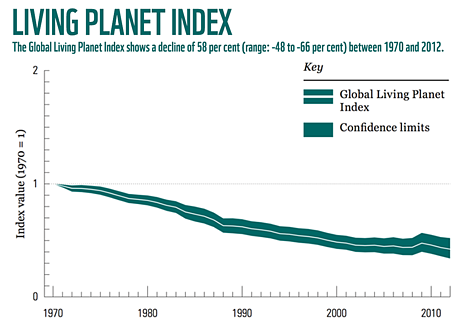
Earth continues to hemorrhage biodiversity, according to the latest Living Planet Report. Unfortunately, its authors cannot manage a clear statement of how to stop the bleeding. by The Overpopulation Project “You could think of it as a health check for the planet,” says the World Wildlife Fund, introducing its most recent biennial Living Planet Report,…
-
Population and Cheap Labour
Herman Daly has made more fundamental contributions to specifying a truly sustainable economics than any economist of the past half century. At 85, he is still contributing to the development of ecological economics and still tossing off more memorable phrases in a short essay than most of us could work into a book. An example…
-
“Decline and Prosper!” A review of a comprehensive book about fertility by Vegard Skirbekk
A new book by the productive demographer Vegard Skirbekk has the commendable title Decline and Prosper!. It is a valuable resource, presenting much research on fertility around the world. It also raises questions about how to deal with high fertility and population growth in many countries. By Frank Götmark The book, in paperback from Palgrave…
-
Elon Musk is wrong about population growth
Tech entrepreneur and multibillionaire Elon Musk claims that underpopulation rather than overpopulation is the greatest threat that faces humanity, despite current destruction of nature and the millions of people living in extreme poverty. Dr. David Walker examines Musk’s dangerous statements and sets the facts straight. By Dr. David Walker As a South African, I must…
-
3 Women, 2 Countries, 1 Voice for World Population Day 2022
For those times when we feel worn down by the thanklessness of campaigning for population sustainability, it can be uplifting to hear the voices of veteran campaigners whose courage has never wavered. Michael Bayliss introduces us to a conversation to inspire. by Michael Bayliss In the most recent episode of Post-Growth Australia Podcast (PGAP) I…
-
Population in the IPCC’s new mitigation report
A new IPCC climate change mitigation report confirms that population increase and economic growth are the main drivers of today’s historically high greenhouse gas emissions. But that scientific information has been censored and removed from the Summary for Policymakers distributed to the world’s press and the public. Does a problem disappear if we don’t mention…
-
Defining Overpopulation
A recent book introduces a new approach to the science of overpopulation. We Zijn Met Te Veel (Dutch for We Are Too Many) explores a new theoretical foundation for the concept of overpopulation and explains why a smaller human population is a necessary – but not sufficient – condition for a more hospitable world. by…
-
Lower birth rates and an aging population can help heal Asian economies
Slowing population growth can have broad benefits for society, including enhancing the many ways that older citizens enrich our communities. By Jane O’Sullivan and Susann Roth As the Covid-19 pandemic continues to disrupt people’s livelihoods through a second year, a lot of people are choosing to defer having children. Media stories lament a ‘baby bust‘…
-
Pandemic reduces migration, sky does not fall in
Political leaders often bray about the need for continued population growth to benefit “the Economy.” In Australia, Covid-19 has provided a real-world test of the impacts of reduced migration and decreased population growth. So far, those impacts appear largely positive. by Kelvin Thomson Population activists concerned about the damage that rapid growth is doing to…
-
From bodily autonomy back to family planning
In its recent report State of World Population 2021 the United Nations Population Fund (UNFPA) highlights bodily autonomy as a universal right. Of course, nobody in a civilised society would object against this position. However, by limiting the notion to the domain of gender-based violence and harmful practices such as child marriage, female genital mutilation,…
-
Australia’s Population Ponzi Scheme
The current economic system in Australia is a Ponzi scheme based on maintaining positive GDP through migration. Populations of native species are plummeting and people are faced with increased job insecurity and housing costs, all of which are side effects of the Australian government’s ongoing drive for an ever increasing population. by Kelvin Thomson In…
Explore the content and topics covered by TOP, search here
Recent blog posts
Blog categories
What we are reading, listening to and watching
Gallery of infographics – Learn more about overpopulation and environment