The Overpopulation Project
TOP – Research and Outreach
Too many people consuming too much
The views and opinions expressed in guest blog posts are those of the authors and do not necessarily reflect the position of The Overpopulation Project.
-
‘Climate refugees’ and the question of limiting immigration: a response to Migration in Hotter Times
A recent discussion paper on climate refugees, Migration in Hotter Times: Humanity at Risk, does much to muddy the water without presenting practical solutions. by Jane O’Sullivan and Philip Cafaro Immigration is a deeply divisive topic, even among population activists. It is not uncommon to have a strong commitment to global population stabilisation while believing…
18 comments on ‘Climate refugees’ and the question of limiting immigration: a response to Migration in Hotter Times -
Losing Our Minds
In the 1970’s the leading intellectuals in the United States were concerned about overpopulation. Fifty years later, the best and brightest minds in America now think we are running out of people. What the hell is going on? by Brad Meiklejohn “Growth for the sake of growth is the ideology of the cancer cell.” –…
-
World population revised upwards again
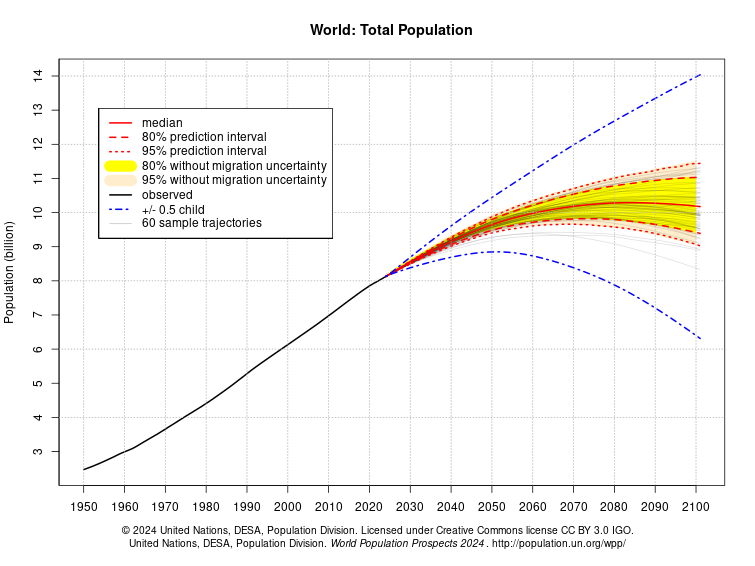
On 11 July, the United Nations published its new population estimates and projections. While trumpeting the promise of a lower global peak as “a hopeful sign [for] reduced environmental pressures” in the press release, they don’t mention there are now 43 million more people than they anticipated as recently as 2022. Not such a hopeful…
-
UN World Population Day 2024 focuses on anything but world population
This year for World Population Day, the United Nations champions data collection, because ‘everyone counts’. What they choose not to measure is more telling. by Jane O’Sullivan This World Population Day, we see the UNFPA celebrating 30 years of the International Conference on Population and Development (ICPD) Programme of Action. Yes, it’s been 30 years…
-
New US population projection tool under construction
TOP is developing a new population projection tool for the United States, based on US Census Bureau methodology and data. Check it out! You can run your own US population projections under different fertility and immigration scenarios — and help us improve the projection tool with your suggestions. by Philip Cafaro One of our more…
-
Songs about population and the environment – what’s your favorite?
Music is a rich source of inspiration for those of us who want to end population growth and improve environmental conditions. TOP looks at some classic hits and new songs recently sent to us and asks for more. By The Overpopulation Project A few weeks ago, two readers contacted us regarding their own songs. Kelvin…
-
Green parties lose big in EU parliamentary elections by ignoring the relationship between immigration and environmental damage
Green and left-wing parties lost ground in recent elections to the European Union Parliament, in part by neglecting and even denying the relationship between population growth by immigration and environmental stress. They could have used the topic to their advantage, but failed to do so. Instead it became the flagship issue of the right. By…
-
Religion affects birth rates
The global human population will increase by 2.4 billion to 2088, according to the UN. Birth rates are high in some parts of the world, leading to continued population growth. In Africa and parts of Asia, and within Muslim countries and communities, religiosity promotes high birth rates. This role of religion could, however, potentially be…
-
Time to vote!
Immigration is proving to be a hot topic in the run up to EU parliamentary elections. While the focus has been on immigration’s cultural and social effects, changes in immigration policy could also impact future population numbers across Europe. This has consequences for citizens, the environment and ecosystems. by Philip Cafaro According to the European…
Explore the content and topics covered by TOP, search here
Recent blog posts
Blog categories
What we are reading, listening to and watching
Gallery of infographics – Learn more about overpopulation and environment