
Since 1970, birth rates have been falling in most developing countries. An earlier study by TOP researchers found that Swedes generally think that improved living conditions, including economic and educational progress, are the cause for declining fertility. What do Nigerians, living in a developing country, think about declining fertility in their country?
By Frank Götmark and Nordhild Wetzler
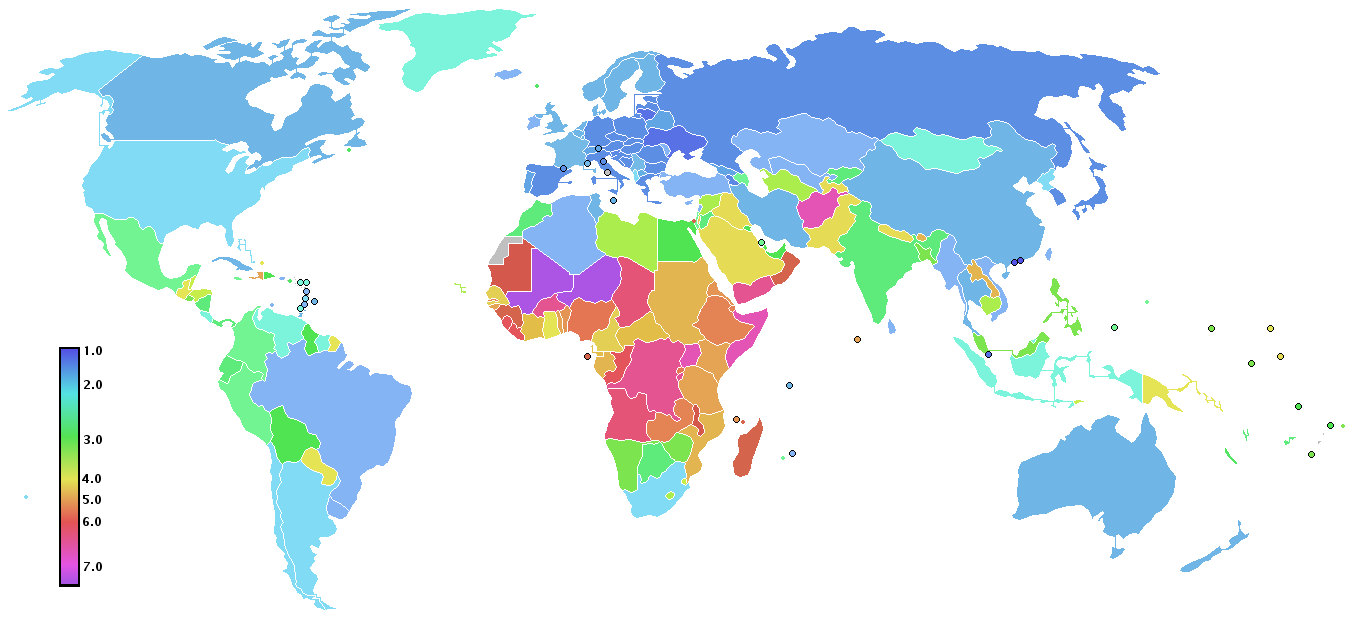
The answer to our question can be found in a new publication in the Journal of Population and Sustainability. In an on-line survey we posed the following question to a sample of 1500 well-educated Nigerians: “For Nigeria, which factor do you think is most important for decline in birth rates (decrease in number of children per woman)?” We shared the following information with the respondents: “The average number of children per woman is decreasing in the world, though slowly. In Nigeria, the average number of children per woman was 6.7 in 1985, and it had decreased to 5.4 in 2020.”
In his introduction to the journal issue, the editor Dr David Samways describes our study as follows: “Although no consensus exists about their relative significance, the multiple determinants of falling fertility in developing countries are well known to demographers. However, if fertility transitions are to continue and accelerate, the public understanding of the determinants may be critical, argue Götmark and Wetzler. This is the case for citizens in both developing and developed countries.”
As Samways also noted, regardless of which policy instruments are the most effective, in democratic countries, public understanding and support for population policies can influence the actions governments choose to take. Public awareness of fertility and its determinants can also influence personal reproductive choices. Yet little is known about public perceptions of the causes of fertility decline.
Our study aimed to investigate what educated people in a developed country (Sweden) and a developing country (Nigeria) understand about the causes of falling fertility in developing countries. As noted in our previous blog, we found that the vast majority (72%) of Swedish respondents believed that positive economic and social development were responsible for declining fertility in developing countries, including improved education and a reduction in infant mortality. In contrast, Nigerian participants believed almost the opposite to be true: that declining birth rates were the result of poverty, bad socioeconomic conditions, and poor health. The educated respondents should be aware of social norms in Nigeria (including large family) but their reasoning, and suggestions to improve the situation, can only be clarified by more research.

Swedish opinions might reflect the present international aid program that favors economic and social progress. Between 1960 and 1990, Sweden was a leading champion of family planning programs, but in recent decades (in line with the UN’s changed position) fertility decline is presented as an indirect outcome of general development and education.
The disparity in beliefs about fertility decline between citizens in developed and developing countries is an interesting finding that deserves more research. It is particularly important due to the dependence of family planning programs on international aid. A common understanding would make for better collaborative efforts between donor and recipient countries.
Interestingly, few Swedes or Nigerians suggested family planning or contraceptive use as major contributors to fertility decline. Family planning was named by 1.9% of Swedes and 5.9% of Nigerians, while contraception was mentioned by 10.3% of Swedes and 3.7% of Nigerians. Note that the proportion of Nigerians that stated family planning as a reason for falling birth rates was three times larger than for Swedes, who were (and are) unaware of the importance of family planning historically, and today.
Given the desperate situation for many young men and women in Nigeria, it is increasingly urgent to build public support for fertility decline, and for the promotion of family planning as an enabler of economic development. According to a 2021 article, 53% of young Nigerians are unemployed and 41% of the citizens live in extreme poverty. Many young people try to escape by emigration, often illegally. Another article from 2023 reported that 53% of the adults would like to leave Nigeria.
Nigeria seems to be a classic case of serious overpopulation where large families have been, and still are favoured by patriarchy, religion and ethnic competition. Despite official policy and proclamations by the Nigerian government, family planning programs have been weak and not widely promoted. This might explain why few of our respondents mentioned them as a reason for declining fertility. Is the government accepting emigration as “solution” for the country, or will it be forced to increase family planning efforts? The latter would require international pressure from other countries and the UN, which for now does not seem to be in sight.
If you live in a developed country, ask some friends or relatives why they think birth rates have declined in developing countries. If you live in a developing country, ask some friends or relatives why they think birth rates have declined in their country. We are curious to know what the public thinks about this question! Let us know their answers in the comments section below.















Leave a Reply