Cutting the global population in half to achieve sustainability

A recent paper documents the role population growth has played in driving global ecological overshoot and advocates gradual population decline by encouraging low birth rates to help reverse it. “Malthus was wrong, Ehrlich was wrong, and these idiots are wrong,” wrote one annoyed commentator on X. Yet it has gotten a surprisingly thoughtful hearing in the mainstream media, including Britain’s Daily Mail and the Independent.

by Philip Cafaro

Achieve Sustainability by Easing Population to 4 Billion by 2200.” That’s the provocative title of an article recently published in the academic journal Sustainable Development. Columbia University’s Mark Keegan led an international team of authors that included Jane O’Sullivan and myself from TOP (with Frank Götmark contributing as well). Predictably, many commentators have invoked Thanos from the film Avenger’s Endgame in criticizing the piece which, just for the record, does not propose culling half the current global population.

What the paper does propose is improved education for girls and young women, universal access to contraception, and full freedom for couples to use it. It encourages societies to embrace population decline as key to genuine sustainability, rather than fighting it with pronatalist campaigns, as many are doing.

The Past Fifty Years

The paper is grounded in the truism that human population levels and per capita impacts multiply together to produce our total impact on the Earth’s systems. The global picture for any particular resource use, pollution level, or other environmental impact can be expressed by a simple formula: Total Impact = Population X Per Capita Impact. This is the original form of the IPAT equation described over half a century ago by Paul Ehrlich and John Holdren, and the form Holdren later re-embraced.

In its first half, the paper graphs data for eight areas of global resource use, pollution and environmental decline against global population increase, for the period 1970-2020. These graphs show very strong correlations between population growth and recent negative environmental trends.

More people has helped drive increased total energy use:

And increased mineral extraction:

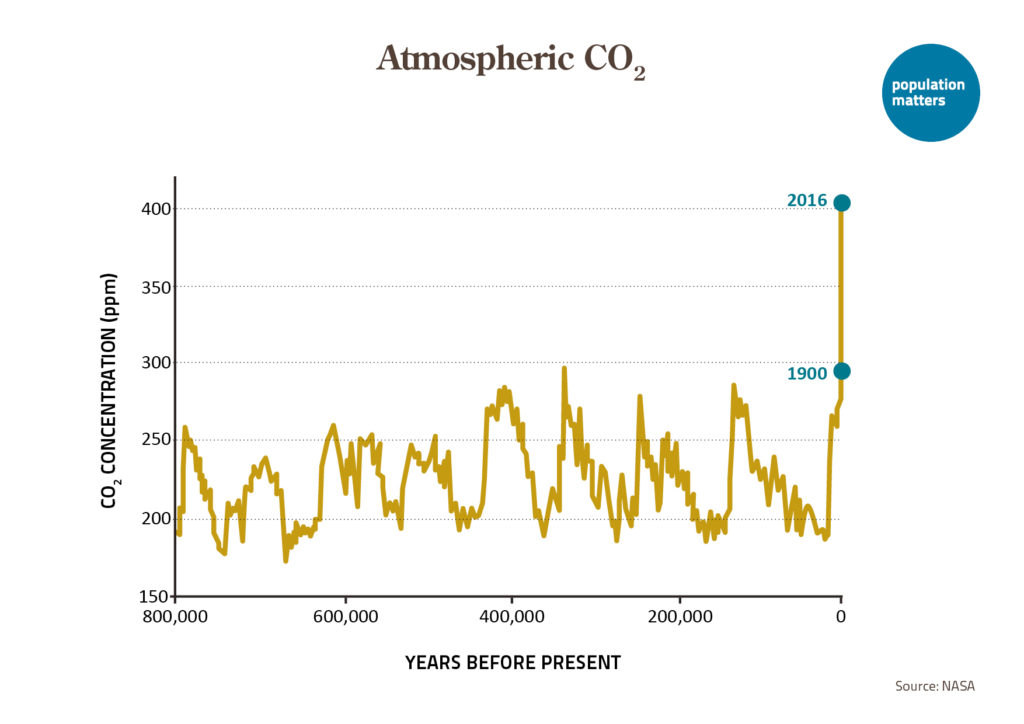
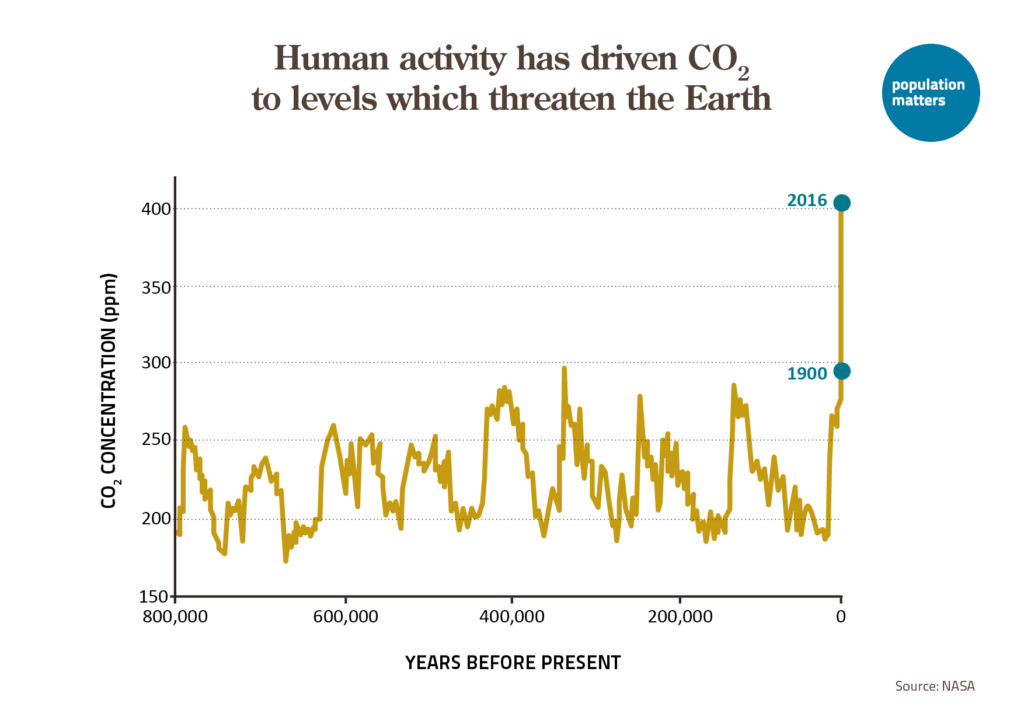
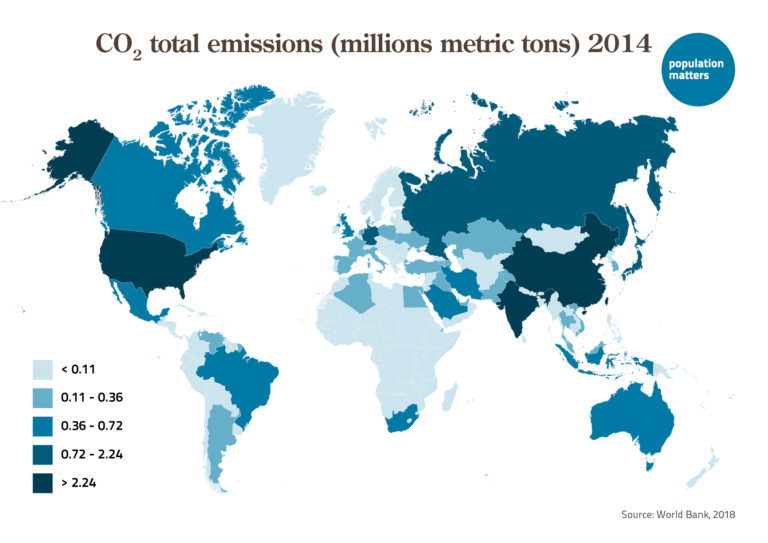
These increases in human resource use, in turn, have led to increased CO2 emissions:

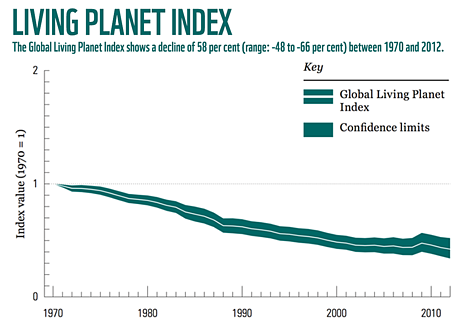
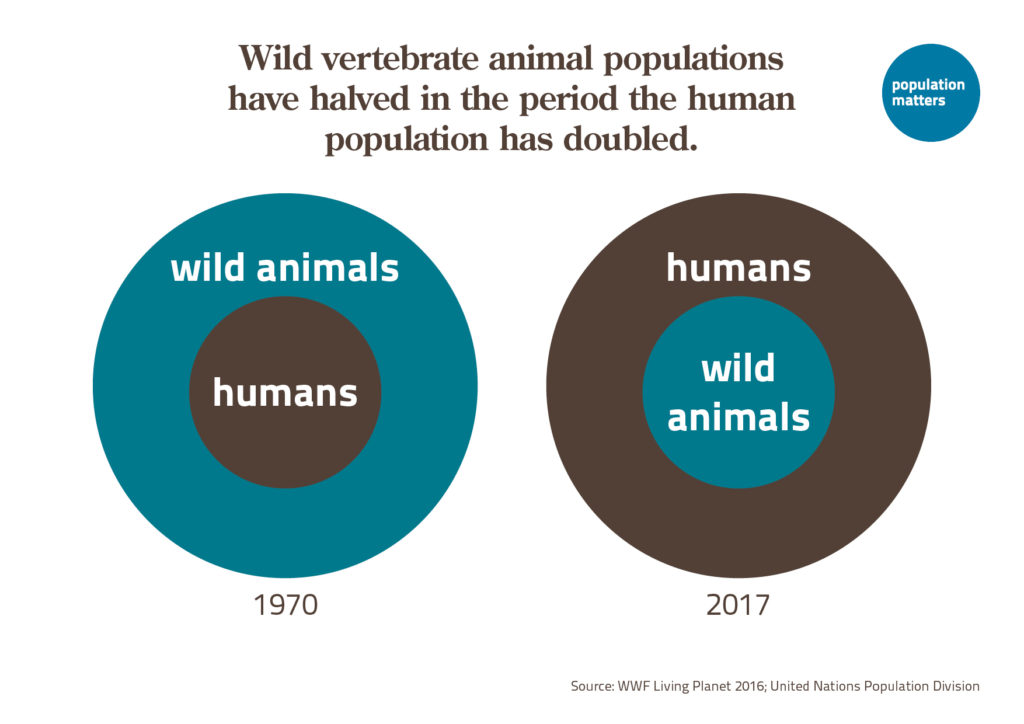
And declining wildlife populations:

Similar strong correlations were found between population growth and increased freshwater use, pesticide use, plastics production, and overall ecological footprint. Over the past half century, population growth increased resource use and pollution across the board.

This may seem like stating the blindingly obvious. But in the face of rampant population denial, it’s important to reiterate the basic fact that more people cause more resource use and pollution.

How Important Was Population Growth?

Population growth wasn’t the only cause of increased environmental impacts during this period, our study found. Per capita impacts also increased, due to increased wealth and the deployment of more powerful and destructive technologies. The paper goes on to quantify the relative strength of population growth and changing per capita impacts between 1970 and 2020.

We found that population growth was the main driver for five of eight important environmental impacts (wildlife decline and increases in CO2 emissions, total energy use, ecological footprint, and freshwater use). For two of these (ecological footprint and freshwater use), per capita impacts actually declined between 1970 and 2020, but population growth drove total impacts significantly higher. For two other metrics (mineral extraction and pesticide use), population growth and per capita consumption increases were approximately equal drivers of the total increases. And for the huge global increase in plastics production and pollution, increased per capita use was the main driver.

 One way to summarize these results is to say that between 1970 and 2020, population growth was more important than growth in our per capita impacts in driving increases in humanity’s overall environmental impacts. But we should not draw the wrong conclusion from this. For all eight major environmental impacts studied, both human numbers and per capita impacts were and remain important factors.

The Next One Hundred and Seventy-Five Years

If population growth increases resource use and pollution, population decline can decrease them. Going forward, how big a difference might smart population policies make in efforts to lower humanity’s global environmental impacts? That depends both on how successful the policies are at lowering our numbers and how successful societies are at lowering per capita environmental impacts.

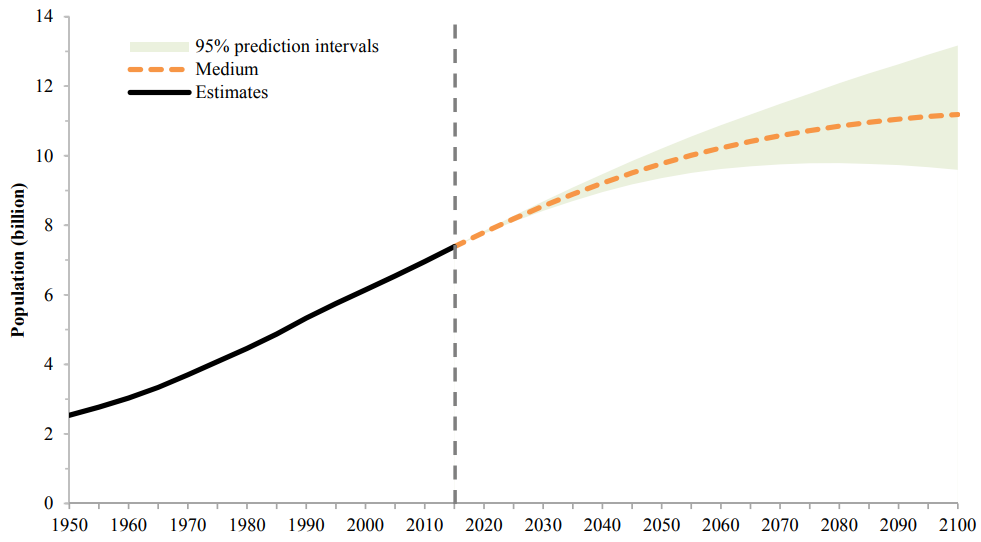
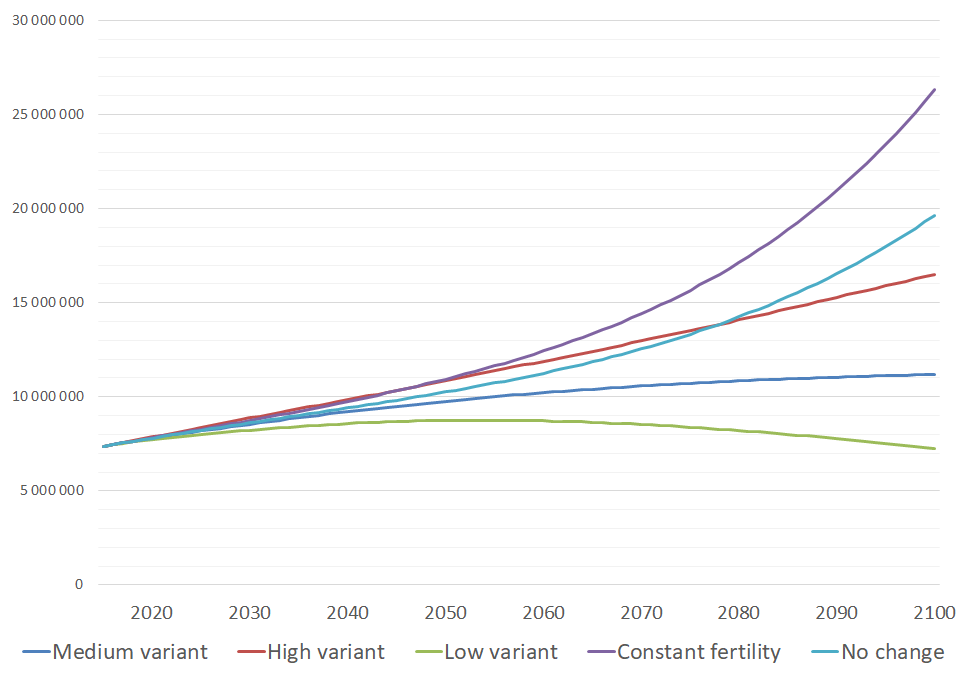
Our study imagined per capita impacts holding steady at current levels and showed what total impacts for our eight key areas would look like in 2100 and 2200 under three different demographic scenarios: the UN’s most recent high and low fertility trajectories and a “fastest progress” scenario of increased contraceptive availability and use developed by the Institute for Health Metrics and Evaluation. The average fertility rates in these three scenarios differ by less than a single child per woman (2.25 versus 1.60 TFR). Yet they lead to large differences in resource use and pollution by 2100 and immense differences by 2200, as shown in the table below.

For example, total energy use under the lowest fertility scenario is only 55% of what it would be under the highest fertility scenario in 2100 — and in 2200 it is only 14% as much. By 2200, humanity would use three times as much freshwater under the highest fertility scenario compared to the lowest one, discharge six times as many CO2 emissions, and use thirteen times as much agricultural pesticides. These figures show the cumulative benefits of good population policies and the folly of poor-mouthing them for not immediately solving all our environmental problems.

Of course, one could always hope that some of these per capita impacts would be driven so close to zero that large differences in human numbers would not make much difference to our total environmental impacts. But that seems highly unlikely. As our study showed, the trends in most areas have been for increased per capita impacts.

Even with much greater effort and self-sacrifice than people have exhibited so far, our per capita environmental impacts will remain high enough that the number of capitas will remain consequential. Whatever numbers future scholars eventually fill in for actual per capita environmental impacts for 2100 and 2200, more people will increase our total impacts while fewer people will decrease them.

A Caveat

If we are serious about avoiding ecological collapse, we cannot ignore the population factor. At the same time, our new study shows that we must also work to reduce per capita impacts, particularly among the wealthy whose impacts are the largest.

One of the most oft-repeated criticisms of our paper on X was that focusing on population was a ruse to avoid addressing overconsumption among the wealthy.

“This is what they’ll propose instead of just cutting the excesses of capitalism and reining in the military,” complained one person. “They’ve been banging the ‘overpopulation’ drum for decades, and the solution is always for poor, and usually non-white people to not have kids.”

“We must address the top 10%,” tweeted another, with an illustration of Oxfam’s champagne flute for CO2 emissions.
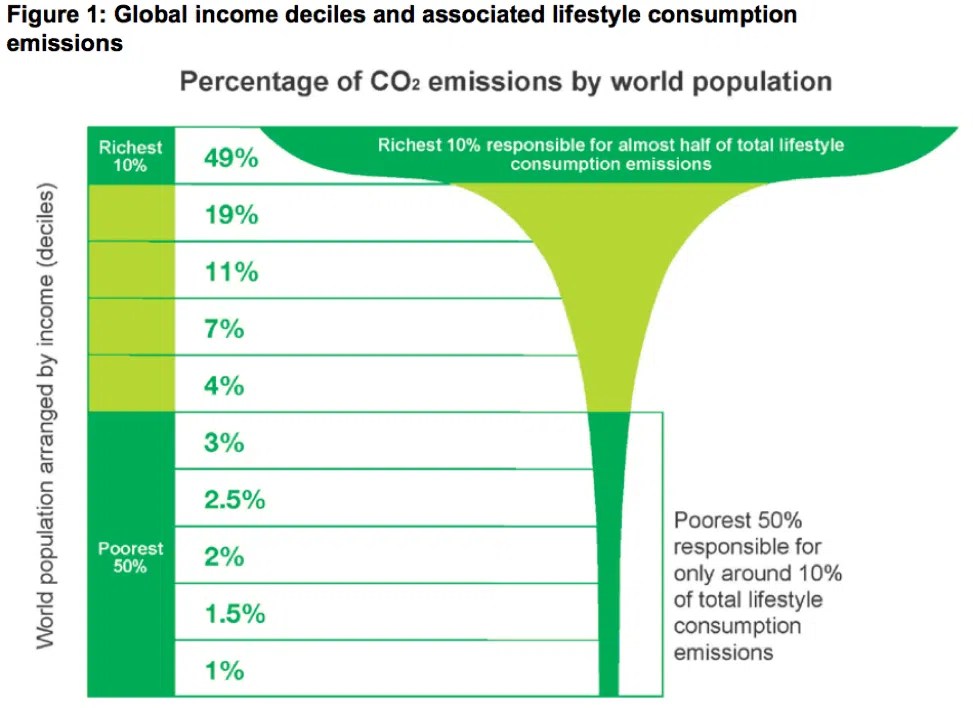
Source: Oxfam

The Oxfam diagram is long out-of-date, failing to accurately reflect the recent growth of a one to two billion-strong global “consumer class.” Still, it’s true that wealthy people generate more than our fair share of carbon emissions and other environmental impacts. We also model lifestyles that serve as examples to billions of poorer people. Reducing unnecessary consumption among the wealthy (of whatever race or ethnicity) should be part of reducing humanity’s average per capita environmental impacts. A world serious about mitigating climate change would outlaw private jet ownership and limit personal air travel (which is largely the province of the world’s richest 10%).

That said, reducing the average environmental impacts of the wealthy, like reducing the average environmental impacts of the middle-class, will be hard to do. If the past is any guide, efforts to do so will be partly successful at best. However successful they are, it will make a big difference environmentally whether the world’s wealthiest 10% number 400 million in 2200, as they would under the IMHE’s low fertility scenario, or 2.1 billion, as they would under the UN’s high fertility scenario.

Critics are right that overpopulation in rich countries must not be overlooked. Each person added to Canada or Australia, whether through births or immigration, adds far more environmental impact than an extra Ugandan or Bangladeshi. At the same time, residents in poor countries face exceptional risks due to continued population growth. We believe “targeting” them with support for voluntary birth control is a moral imperative to minimize poverty and economic deprivation. For all these reasons, and above all because we share one world, our paper advocates reducing human numbers across the board, slowly and humanely, in richer and poorer countries alike.

Another Caveat

While the Oxfam diagram stresses that consumption by the rich is too high, it also suggests, plausibly, that consumption by the lowest 50% is too low. To bring half of humanity out of poverty will take a lot more energy and resources. In a world already deep into ecological overshoot, we cannot hope to do so without a much smaller overall population.

Indeed, some scientists argue that four billion people is still too many to achieve sustainability. Several well-reasoned estimates put the global human carrying capacity somewhere between half a billion and three billion, aiming for a reasonable standard of living for everyone. We are sympathetic to such arguments. However, if humanity sets sail for four billion, there is nothing in the way of continuing beyond that benchmark to two billion, or fewer.

The important point, at this moment in history, is to embrace population decline and take measures to enable it. The sooner and faster we retreat from ecological overshoot, the less damage to Earth’s essential life support systems. What number we stabilize at is not a practical question for the current generation, but for our descendants.

The Upshot

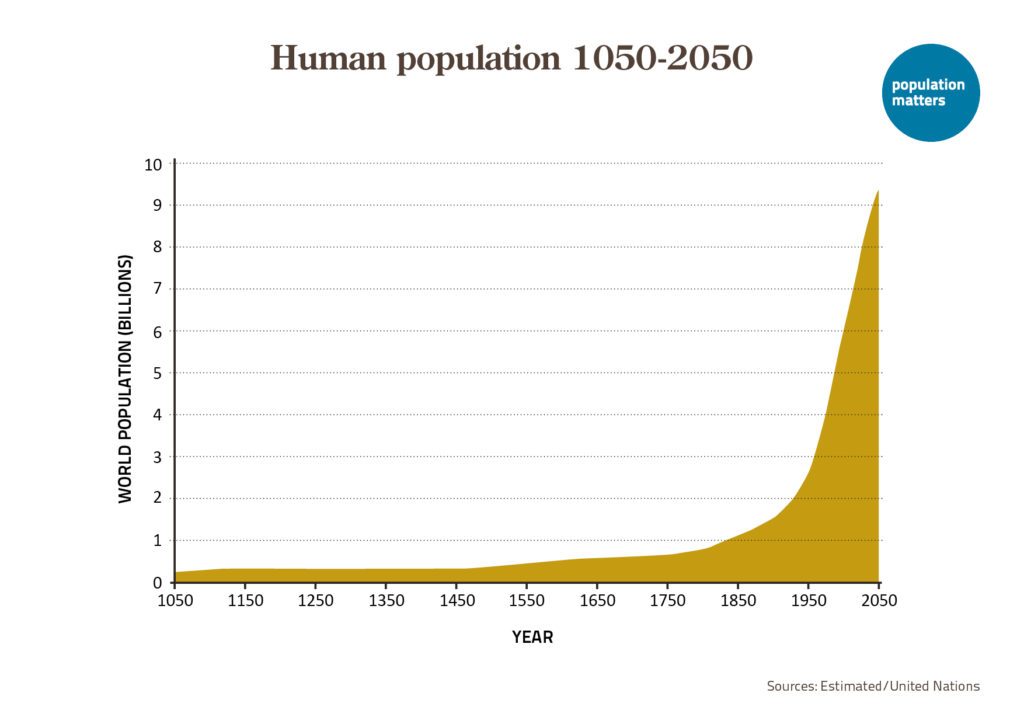
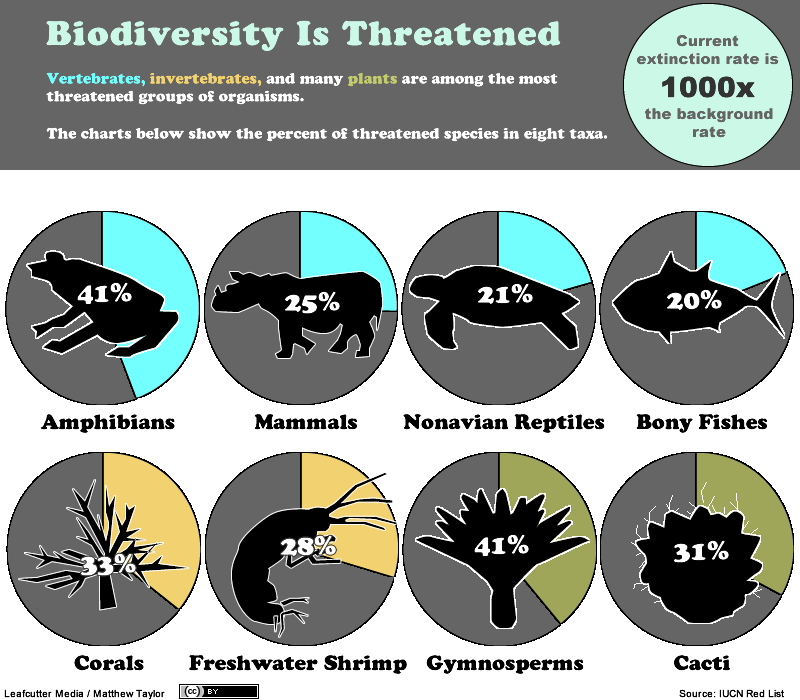
Reducing human numbers will ease pressure on natural resources and reduce pollution. It will lessen poverty in high fertility regions and improve quality of life in densely populated ones. A more modest human population of four billion (the same number we had around 1974) will help preserve ecosystem services essential to human well-being and allow us to share the world more generously with the ten million other species who currently inhabit it.

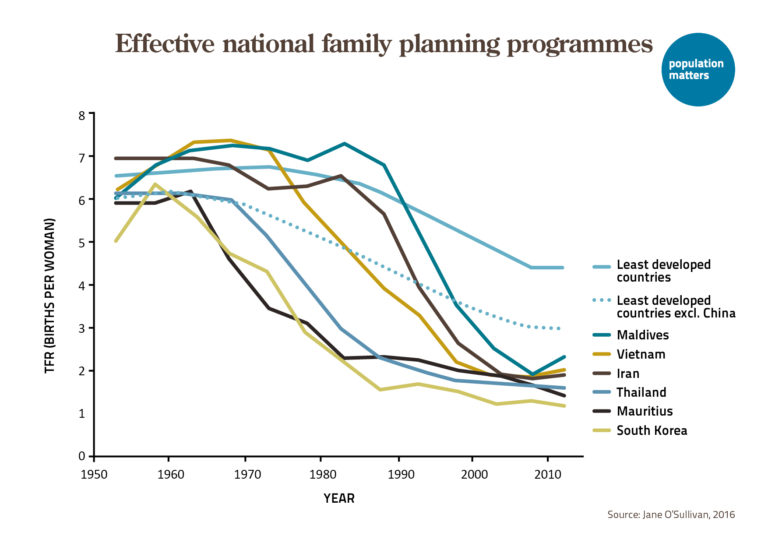
Such a world is possible. There is overwhelming evidence that sub-replacement fertility can be achieved quickly and non-coercively in a wide range of societies. We are already slowly progressing toward population decline globally by the sum of billions of individual choices. This can and should be accelerated with the right policies.

Published

13 responses to “Cutting the global population in half to achieve sustainability”

  1. Jack McQueen Pedigo Avatar

    One item not listed but, to me, is a very important one is a global Euthanasia program like that practiced in Switzerland and the Netherlands (sort of like the Soylant Green movie without humans being made into food). Most places don’t even have a viable Compassionate Choices program which only makes matters often horrible for those suffering from a death process full of suffering and expenses (my late partner opted for this as it’s part of the whole West coast and Canada).
    As far as fertility goes it should be made illegal (or strongly shamed) for those above a certain age to have children (especially the wealthy). My late partner was from Iran and she said there, at one time, the tax code allowed for the 1st child to get a deduction, the 2nd no deduction and the 3rd incurred an increase in tax. Right now, as far as I know, the only country to make family planning a goal is Thailand. Will enough country’s wake up before it’s too late. Don’t hold your breath.

    1. Philip Cafaro Avatar

      Note: there are many countries besides Thailand that do a good job of making family planning widely available. Unfortunately, in my own country ,the current administration is moving in the opposite direction

  2. Steven B Kurtz Avatar

    While the direction is correct, the number for long term sustainability is closer to a tenth of the current global population according to some system biologists and ecologists. Nature will see to it the hard way.

  3. David Polewka Avatar

    CALCULATE THE LEVEL OF HUMAN POPULATION FOR SUSTAINABILITY
    A sustainable global human population is widely estimated by scientists to be
    between 2 billion and 4 billion people, assuming current standards of living
    and resource consumption.
    SOURCE: Wikipedia
    Why Estimates Vary
    Calculating a single number for Earth’s carrying capacity is difficult because
    sustainability depends on many changing factors:
    SOURCE: Population Connection +1
    ***Per capita consumption: Higher resource use and energy demands per person
    lower the total number of people the Earth can support.
    ***Technology: Advanced, clean technologies and efficient food production can
    increase capacity, while reliance on fossil fuels creates an artificial and
    temporary overshoot.
    ***Standard of living: Aiming for higher global wealth and resource access
    results in a lower optimal population limit.
    SOURCE: The Overpopulation Project +3
    Key Scientific Studies
    ***Optimal Carrying Capacity Study: Recent ecological models published in
    Phys.org suggest an optimum sustainable population of about 2.5 billion when
    living within true ecological limits.
    SOURCE: ScienceAlert +1
    ***Pimentel and Lianos: Independent calculations from researchers like Pimentel
    and Lianos place the sustainable maximum between 3 billion and 3.1 billion
    based on arable land and soil conservation needs.
    SOURCE: The Overpopulation Project
    ***The 4-Billion Threshold: Analyses highlighted by groups like Population Matters
    suggest easing the global population down toward 4 billion through voluntary family
    planning and education can protect the climate and natural habitats.
    SOURCE: YouTube·Paul Beckwith +1
    Because the current global population exceeds 8 billion, studies argue that humanity
    is running an ecological deficit supported by drawing down finite resources and fossil fuels.
    SOURCE: Phys.org +1

    1. kurtklingbeil Avatar

      The post is directionally reasonable—population, consumption, technology, and ecological limits all matter—but it overstates the scientific consensus. There is no scientifically established single “sustainable global population,” and the claimed 2–4 billion range is a cluster of selected normative estimates, not a settled carrying-capacity calculation.

      Bottom line
      The quoted post should not be treated as a calculation that establishes a true planetary limit. It is an environmental advocacy argument assembled from selected studies, some of which are serious but all of which rest on contestable value choices and modelling assumptions.
      The defensible conclusion is narrower: a world that provides decent lives, maintains ecological integrity, and avoids dependence on continued fossil-fuel extraction would likely be easier to sustain with fewer people than today—but the evidence does not establish one authoritative number, and population policy must remain voluntary and rights-based

  4. Steven B Kurtz Avatar

    These estimates are anthropocentric to the max. And they assume getting to a steady state planetary environment which has already declined tremendously from the pre-FF days (including coal). Even earlier, agriculture began greatly altering soil health and biodiversity. Irrigation changed water flows. A slow increase in human population was impelled at that time, and technologies increased the speed over time. Humans are not exempt from: https://en.wikipedia.org/wiki/Maximum_power_principle

    If wildlife is to recover, if rivers are to flow plentifully and unpolluted, if seas are to be free of plastic and other debris…human activities must be reduced far more than those estimates suggest. See for example:

    https://www.ourendangeredworld.com/ocean-plastic-crisis/
    “The United Nations Environment Programme estimates that 19–23 million tonnes of plastic waste leak into aquatic ecosystems each year, including lakes, rivers, and seas. It also estimates that 75–199 million tonnes of plastic are already in the ocean. ”

    And that is just plastics!

    1. Philip Cafaro Avatar

      You are right. When we factor in leaving sufficient habitat and resources for other species, the number of humans that are “sustainable” declines considerably.

  5. kurtklingbeil Avatar

    A serious sustainability program should pursue both demographic justice and consumption justice, but in the right order:
    Guarantee reproductive autonomy everywhere: voluntary contraception, maternal care, girls’ education, equal legal status, and freedom from coercion.
    Reduce child mortality, poverty, and insecurity: universal health care, nutrition, schooling, pensions, secure livelihoods, and social protection reduce the rational pressure to have large families.
    Cut high-consumption impacts first and fastest: fossil fuels, aviation, oversized homes and vehicles, luxury consumption, meat-intensive diets where relevant, planned obsolescence, and high-carbon investments.
    Use consumption-based accounting: attribute imported emissions and ecological impacts to the end consumers and corporations that drive them, not only to the countries where factories, mines, plantations, and waste sites happen to be located.
    Transfer technology and finance without imposing extractive dependency: poorer countries need room to provide electricity, housing, sanitation, mobility, nutrition, and health care without copying the North’s fossil-intensive development path.
    Restore ecosystems and reform production: protect land rights, reduce waste, decarbonize power and industry, improve agriculture, curb destructive extraction, and make trade supply chains accountable.
    The coherent position is: population matters over long time horizons, but affluent consumption and the unequal international organization of production are the dominant and immediately actionable sources of many ecological harms. Treating voluntary fertility decline as a supplement to justice-centered development is defensible. Treating reduced births among poor, brown populations as the headline solution while avoiding high-consumption responsibility is myopic at best—and easily becomes a continuation of ecological colonialism.

    1. Steven B KurtzS Avatar

      If the odds of successfully implementing what you suggest were even 50-50, I’d say go for it. According to the developer of Ecological Footprint analysis and system scientist, in an informal e-list discussion, wrote an hour or so ago in response to the quoted question from another list member:

      “How do we remove or bypass the structural web that keeps humanity acting as a parasite on its host, rather than as a cooperative organism within it?”

      Bill Rees:

      IMHO, this is not possible. It assumes ‘humanity’ has a choice which we, in the aggregate, do not.

      More generally, all species ‘act as parasites’ on their hosts. Green plants ‘feed’ on the sun. All animals freed on green plants or on other animals that feed on green plants; bacteria and fungi feed on dead (or sometimes living) plant and animal biomass. All species are competing for the limited flow of exergy through the ecosphere.

      While there are numerous examples of mutualism which appear to be cooperative relationships, these relationships are not ‘choices’; they evolve to enhance the competitive advantage of participants in their acquisition of energy and resources, i.e., they increase the capacity of the participants to exploit their host or resource species.
      Normally, in non-human species, excessive exploitation is held in check — the host or prey species evolve defences or the predator/’parasite’ is knocked back by negative feedbacks (disease, scarcity, competition for space, etc.). However, human cultural evolution (technology) has temporarily overwhelmed normal negative feedbacks so our ‘parasitism’ on the ecosphere has been running on techno-steroids, totally out of control.

      While individuals may be able to choose moderation, our naturally evolved inter-specific superiority in exercising the maximum power principle and the intra-specific competitive relationships among groups of people (tribes, nations, religions, etc.) all reinforced by — or reflected in — the socially-constructed human exceptionalist and perpetual growth ethics, disable global society from holding back.

      The structural impediments to human cooperation with the ecosphere at scale are firm and unyielding.

      ================

      SK:

      The odds in his view are minuscule. If the goal is to minimize sulfuring in the future by humans and other sensate species, reversing human population growth as rapidly as is humanely possible clearly deserves top priority. Women’s empowerment globally, free contraception, and fighting patriarchy are positive, non-coercive actions to take.

      The blame game is easy, but in a hierarchical species it is never-ending. The vast majority of those living simple (mostly poor) lives do so INvoluntarily. They, like all life, follow the Maximum Power Principle which I referenced in my first post. Given the opportunity, nearly all would increase their matter-=energy throughput, and who can blame them! The rare exceptions of a tiny minority who practice voluntary simplicity simply prove the rule.

  6. Dag Lindgren Avatar

    The scenario is rather realistic and it is good that it is done to get a better understanding of how factors interact even it the future beyond 2100 can be claimed to be unpredictable. But the problems are relaxed too slow. A faster reduction of population would probably mean a better life for humans living around 2100. The fertility in many countries is now below UN low 2100 and with sufficient tools and cooperative governments it ought to be possible to get it lower before 2100, so the population 2100 get lower than today. Thus the study should not be used as an argument for Mankind to make less for reducing earth fertility faster than today.

  7. Winthrop R Staples III Avatar

    Congratulations for presenting a goal that society can strive for as opposed to status quo drifting toward a biosphere collapse while our growth obsessed corporate bosses rack up a few more 100’s of millions in their stock portfolios. And it just occurred to me that we should also inform the public of the likely consequences for the 90% if for example the global oligarchy represented by those who write books titled “1 Billion Americans” get their way. And so increase the global population by billions more in future decades. We need to inform the majority that those who will be forced to ‘sacrifice’ in a predictable global biosphere emergency when we reach 10 or 12 billion will for example – be living in 100 square foot ‘coffin apartments’ (like people have to in overpopulated cities now), and never be able to travel or go anywhere to conserve energy, and will only be able to eat a few grams of some soymeal survival ration once a day. These are real likely consequences that will be inflicted on the majority. While the 10% or 5% or 1% will and plan to carve out exceptions for themselves as they do now … in regard to the negative consequences of all the destructive policies they presently inflict on the majority of common citizens.
Leave a Reply

This site uses Akismet to reduce spam. Learn how your comment data is processed.
NOTE: Comments with more than one link will be held in wait and will only become visible on the site after an admin has approved it.

Please keep a civil tone in the comments section. Excessively rude comments will be removed.

Explore the content and topics covered by TOP, search here

Blog categories
Gallery of infographics – Learn more about overpopulation and environment

Discover more from The Overpopulation Project

Subscribe now to keep reading and get access to the full archive.

Continue reading