
The recent dismantling of USAID bodes ill for women’s health in some of the world’s poorest countries. America can and should do better.
by Jenny Goldie
For several decades, there were major gains globally in access to family planning and reproductive health services. The US Government contributed significantly to this progress through its Agency for International Development (USAID), the largest funding agency for humanitarian and development aid in the world. Indeed, USAID listed the benefits of family planning on its website. These included protecting women’s and children’s health by reducing high-risk pregnancies and allowing sufficient time between pregnancies, advancing individuals’ rights to decide their own family size, improving women’s opportunities for education, employment, and full participation in society, decreasing abortion and reducing poverty by contributing to economic growth at the family, community, and household levels.
All these factors are worthy in their own right, but are also integral in efforts to reduce population growth rates.
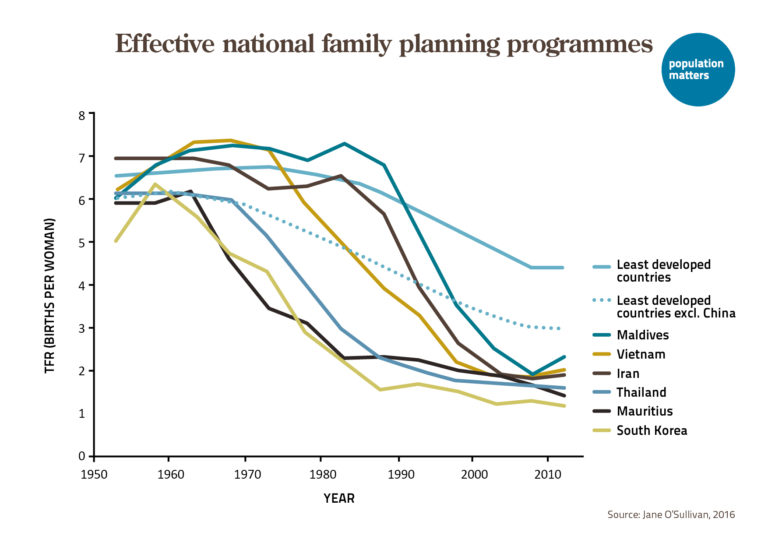
USAID proudly noted that it was involved in developing nearly every modern contraceptive method available today, benefitting both women abroad as well as those in the US. In the 41 countries it supported, modern contraceptive prevalence increased from less than 10% in 1965 to 34% in 2023 and family size fell from more than 6 to 3.9. USAID estimated that it would reach up to 24 million women and couples with contraceptive services and supplies, helping to prevent 14,000 maternal deaths and 8.1 million unintended pregnancies in 2023.

And then came Trump and the demolition of USAID. First, Elon Musk’s unofficial department of government efficiency (DOGE) erased 83% of USAID’s programs, and then, in June, Secretary of State Marco Rubio ordered the abolition of the agency’s entire international workforce.
In April, the International Planned Parenthood Federation responded to the initial cuts to USAID’s programs: “These funding cuts are expected to have severe consequences on people’s lives for the communities we serve. If all funding at risk is indeed cut, IPPF estimates this will result in an additional 3844 maternal deaths, over three million unintended pregnancies, and 756,010 unsafe abortions. These impacts will also place a heavy financial burden on national health systems.
“The impact of the Trump administration’s actions is particularly severe in Africa and South Asia, where many IPPF Member Associations depend on international funding to provide contraception, maternal healthcare, and HIV prevention services.
“In Malawi, US funding cuts will slash nearly half of the Family Planning Association of Malawi’s 2025 budget, jeopardising 27% of sexual and reproductive health services …
“In Afghanistan … the closure of 18 family health houses and 15 mobile clinics is already limiting access to maternal and reproductive healthcare, particularly for women in rural and conflict-affected areas who have no alternative options.
“In the US, independent reports … indicate the Trump administration intends to freeze funding for affordable contraception and reproductive healthcare for low-income individuals who rely on Planned Parenthood health centres.”

Earlier, on 6 March, a number of national organisations, including the Guttmacher Institute, Planned Parenthood Federation and the Population Institute, wrote a letter to Congress in which they urged Representatives and Senators to preserve foreign assistance for global health that includes investments in international family planning. “Family planning is fundamental, time sensitive, life-saving health care for millions of women and families,” they wrote.
“Congress must insist that the administration immediately release the funds they appropriated for international family planning and we urge you to continue appropriating funds for these important programs in all future spending bills,” the letter said.
It concluded: “It is imperative Congress … continue(s) to invest in comprehensive, evidence-informed family planning as part of foreign assistance appropriations. Congress has supported investments in international family planning — with bipartisan and bicameral support — for six decades and over 11 presidential administrations, recognising that this is lifesaving work. Don’t stop now.”
Trump’s latest attack on women in need came in mid-July. According to a report in the Guardian, his administration was planning to destroy US$9.7 million worth of contraceptives rather than send them abroad to women in need. The contraceptives were primarily long-acting, such as IUDs and birth-control implants, and were purchased to support women in crisis settings, including war zones and refugee camps, almost certainly in Africa.
Let us hope Congress finds a backbone and stops such egregious acts.
This article was first published in the August 2025 edition of the newsletter of Sustainable Population Australia.
An American responds
I fully agree with Jenny Goldie’s criticisms above. In terms of the amount of good achieved for the amount of money spent, USAID’s budget represents some of the most effective U.S. government spending in recent decades. It is ironic that a supposed effort to improve government efficiency was used as a pretext to dismantle its programs.
Unfortunately, the beneficiaries of this spending do not vote for members of the U.S. Congress, leaving it particularly vulnerable to such an attack. With the passing of the Cold War, instrumental arguments for the benefits of foreign aid have become less persuasive, leaving moral and humanitarian arguments. These should prevail. America is a wealthy country, and the need is great. But as Benjamin Franklin advised political advocates long ago, “Would you persuade, speak of interest, not of reason.”
The demolition of USAID is tied to larger trends in a United States in political decline. On the one hand, we have a Republican party actively hostile to political norms upholding effective representative government and the rule of law. This supposedly conservative party finds nothing worth conserving in America’s political and cultural traditions, no values it would not sacrifice to divert more power and wealth to the already powerful and wealthy. Republicans recently passed federal legislation that will strip health insurance from 12 million of their fellow citizens, while Republican officials in numerous states are working to depress opposition voter turnout in the next elections.
The conclusion is inescapable: the leaders of one of America’s two major political parties do not believe in justice or the rule of law. They believe in force. They do not believe in government as rational policymaking in service to the common good, or as self-government by a free people. They believe in government as a tool for the enrichment of those who have grabbed the levers of power, and their cronies. They do not believe in science or morality, but in wishful thinking and naked self-interest. Such people are impervious to the kinds of rational arguments Jenny Goldie deploys.
On the other hand, we have the Democrats, a sclerotic party that has thoroughly lost its way. My parents and grandparents knew what Democrats stood for: security and prosperity for working people. But the party of Franklin Roosevelt long ago gave up challenging American capitalists for a fair share of our nation’s wealth, instead diverting itself with minor reforms and pointless identity politics skirmishes. Five decades of failure have increased Americans’ economic precarity and undermined the very idea of government as an effective tool for benefiting common people, playing right into their opponents’ hands.
Democrats’ weakness and confusion, their inability to deliver benefits to their own supporters, has become a self-defeating doom loop. In a perverse way, it supports claims that foreign aid is a riddled with waste and corruption (“probably inefficient, just like all government programs”) and that the U.S. doesn’t have the resources to spend on such luxuries (“how can government spend money in Africa when we have people right here with unmet needs?”). Such claims are bogus: the U.S., like other developed nations, can and should devote a reasonable amount of our surplus wealth to help people in the developing world. But such moral claims only gain purchase in the context of belief in an effective government that is working for the common good. We don’t believe in that anymore in America. Because we don’t have it.
I don’t know how my country extricates itself from the slime of Trumpism and rebuilds a better politics — although I’m committed to trying. In the meantime, people in other countries should not bet their safety and well-being on Americans turning this around anytime soon. Goldie hopes the U.S. Congress will “find a backbone” and reverse course. But Republicans control Congress for another year and a half, at a minimum, and they aren’t changing course. Even if Democrats return to the majority at the end of 2026, past failures mean they cannot make restoring foreign aid a priority. In any case, Donald Trump holds office for another three and a half years.
For the foreseeable future, the American government will not be restoring anything like previous levels of family planning aid. But African political leaders have many good reasons to provide their fellow citizens with family planning support, through increased national health care funding. European political leaders worried about excessive immigration have good reasons to support such efforts through increased foreign aid. These leaders should act now to fill the space left by USAID’s demise.
— Philip Cafaro












Leave a Reply