The Overpopulation Project
TOP – Research and Outreach
Too many people consuming too much
Category: Success stories
-
Family planning in Mexico – success against the odds
Within a few years, Mexico went from a staunchly pro-natalist country with high birth rates to having the strongest family planning programme in Latin America. As the latest in our series on successful family planning programmes, Mexico provides a case study for how family planning advocates managed to succeed despite a pro-natalist government, and how…
8 comments on Family planning in Mexico – success against the odds -
New study shows what is possible with strong family planning funding
Access to voluntary, informed family planning should be the right of all people. In the past, only those with health insurance or who were well-to-do were likely to be able to access good family planning care. A new study by Franciele Hellwig and colleagues shows family planning equity has improved in five developing countries they studied, thanks…
-
A call for donations to complete films of pioneers in family planning
TOP released a 1-hour film interview of Carl Wahren on 24 April that has been praised by eminent experts and demographers. We are now working on two more films about pioneers in the field of family planning. But to finish these films we need a few more donations. By The Overpopulation Project The interview of…
-
A Decreasing Population Furthers Rewilding Efforts in Romania’s and Ukraine’s Danube Delta
Since the fall of the Eastern bloc, both Ukraine and Romania have seen their populations shrink. Driven by rural to urban migration, low fertility rates, and substantial emigration, the depopulation in the Danube Delta region has opened up large areas to rewilding efforts. With a history of irrigation and altered river dynamics, restoration and reintroduction…
-
Fewer People = More Wild Nature in Croatia’s Velebit Mountains
In the Croatian alps, declining human populations have gone hand in hand with expansions of protected lands and resurgent wildlife populations. Large predators are finding their way back to the region now that the anthropogenic pressures have lightened, and rewilding efforts have ensured the comeback of both mountain-dwelling herbivores and large grazers on the adjacent…
-
Restoring Abandoned Land in the Oder Delta Gives New Opportunities for Wildlife in Germany and Poland
With decreasing populations in parts of rural Europe and marginal agricultural lands being abandoned, Europe is in a strong position to return land to wilderness. At the northern end of the border between Poland and Germany lies the Oder delta, where rewilding efforts on land and in water have contributed to a quick recovery of…
-
Fewer people leads the way to rewilding in Portugal
Depopulation has led to abandonment of less fertile agricultural lands throughout Europe. Portugal, with its declining population, is a prime example. In the Côa Valley, the abandonment of farmland has been turned into an opportunity for rewilding efforts to create new wilderness. Already the valley has seen the return of many endangered species, such as…
-
Thailand’s success story – Family planning with creativity and humor
Promoting contraceptives in fun ways achieved tremendous success towards breaking taboos and clarifying misconceptions. Together with creative community development programs, family planning programs increased the wellbeing of all Thais.
-
Introducing The Overpopulation Project Video Series # 2: Family Planning: Past Lessons for the Future
The Overpopulation Project presents the second video in our four-part interview mini-series, an interview with Carl Wahren, a population professional with more than 30 years of experience with various multilateral organizations. Carl was a pioneer in introducing family planning programs in developing countries in the 1960’s, programs supported by the government and agencies in Sweden.…
-
Rwanda: A pioneer of family planning in Sub-Saharan Africa
Rwanda has experienced a 40% increase in contraception use within only the past 15 years. The country is located in Sub-Saharan Africa, a region typically known for its high population growth.1 Despite the large rural population, traditional large family norms and strong influence of the religious institutions, Rwanda is slowly becoming known for its efficient, ongoing…
-
The first population policies implemented in Africa: the case of Tunisia
In the early 1960s, Tunisia became the first country on the African continent to significantly improve women’s status and launch a voluntary national family planning (FP) program. Today, Tunisia has some of the most progressive family planning policies in Africa, and it is the most progressive of all Arab countries in terms of gender equality…
-
Family Planning for forests and people – the success story of Costa Rica
Costa Rica is a country of exceptionally rich and well-protected biodiversity. It is a solid democracy where people live long, relatively healthy and happy lives while leaving a small ecological footprint. Together with its good and improving environmental performance and overall well-being, the country is characterized by a below replacement fertility level, the lowest in…
-
Low fertility in South Korea: a springboard for social change and conservation
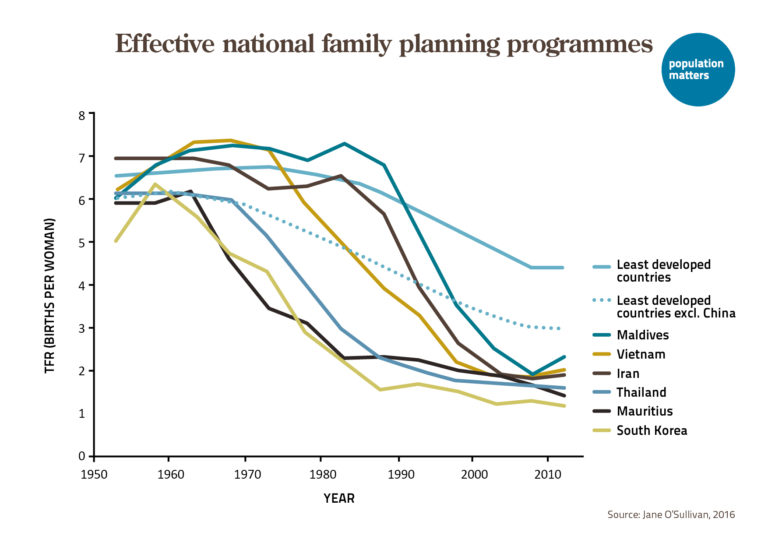
In the 1960s and 70s, South Korea experienced one of the fastest fertility declines in the world, halving the number of children born per woman from over 6 to less than 3 in just 18 years. In large part, this was due to early government recognition that fertility reduction is a component of development, a…
-
The Iranian miracle: The most effective family planning program in history?
In the second part of our Population Policy Case study series, following Indonesia, The Overpopulation Project Team examines the history of population policies in the Islamic Republic of Iran. Iran stands out for lowering its fertility in a very short time without coercion. The total fertility rate dropped from almost 6 in 1988 at the…
-
“Two Children Are Enough” – “Dua Anak Cukup”
Indonesia: Population Policy Case Study 1 By Jenna Dodson Population policies[1] of the late 20th century played a central role in the global decline in fertility rates1. These policies mobilized resources to enact policies aimed at reducing fertility by widening contraception provision and changing family-size norms. In the first of a series of Positive Population…
Explore the content and topics covered by TOP, search here
Recent blog posts
- The Most Appropriate Response to Falling Birthrates? Embrace Them
- New paper defends a pragmatic definition of overpopulation
- Because everyone else is (not) doing it: How social pressures may be the key to understand family size preferences
- The Psychology of our Strange Overpopulation Taboo
- Goodbye Paul Ehrlich
Blog categories
What we are reading, listening to and watching
- Global human population has surpassed Earth’s sustainable carrying capacity by Bradshaw et al.
- Spatial Spillover and Differential Impacts of Urban Shrinkage on Air Pollutants: Implications for Sustainable Urban Futures by Ma et al.
- Overshoot and procreative ethics: at an ecological crossroads by Rees and Szocik
- The Educational Differentiation of African Birth Timing by Frye and Lopus
- EU says member states may use existing funds for abortion travel by Reuters
- Fading Melodies: Intact tropical forests are seeing mysterious bird declines. Is another “silent spring” brewing? by Warren Cornwall
- Resources Depletion, Ecosystem Destruction and Overpopulation by Liu and Li
- New Demographis and Health Survey Programs by the DHS Program
- Keeping Abortion Access Safe by Richard Grossman MD
- The effects of environmentalism on fertility in the United States: changing trends and causality by Traylor and Chae
Gallery of infographics – Learn more about overpopulation and environment