The Overpopulation Project
TOP – Research and Outreach
Too many people consuming too much
Category: Education
-
Rethinking Population Shrinkage in the Nordic Countries
Population degrowth is a necessity to achieve a sustainable world. A new policy brief for the Nordic countries urges policymakers to rethink their commitment to continued growth and instead embrace the reality of demographic degrowth. By Pernilla Hansson Many countries around the globe are set to experience population decrease, with several dozen already doing so.…
25 comments on Rethinking Population Shrinkage in the Nordic Countries -
Religion affects birth rates
The global human population will increase by 2.4 billion to 2088, according to the UN. Birth rates are high in some parts of the world, leading to continued population growth. In Africa and parts of Asia, and within Muslim countries and communities, religiosity promotes high birth rates. This role of religion could, however, potentially be…
-
Meet the Nigerian Teacher Who Advocates for Family Planning
Coming from a family of seven children, Chidera Benoit knows better than anyone how challenging it is to grow up in a big family in Nigeria and achieve a good living standard. Convinced that Nigerian women and men should be free to decide their family size, this young and motivated teacher and Executive Director of…
-
Global population has hit 8 billion
The world population has hit 8 billion, a milestone which has been widely discussed in the media. In this article originally published by The Hill, William Ryerson of the Population Media Center and Kathleen Mogelgaard of the Population Institute reflect on the economic and environmental effects of this milestone. By William Ryerson and Kathleen Mogelgaard…
-
Advocating for the Education She Did Not Have
Education is important for girls and women to be able to control their own lives. To celebrate International Day of the Girl this Tuesday, Population Media Center highlighted their article about education and overcoming social barriers in Nepal, which we have republished here. Read about Binita and her determination to advocate for her sister-in-law’s continued…
-
“Decline and Prosper!” A review of a comprehensive book about fertility by Vegard Skirbekk
A new book by the productive demographer Vegard Skirbekk has the commendable title Decline and Prosper!. It is a valuable resource, presenting much research on fertility around the world. It also raises questions about how to deal with high fertility and population growth in many countries. By Frank Götmark The book, in paperback from Palgrave…
-
What do citizens of a donor country think drives fertility decline in low-income countries?
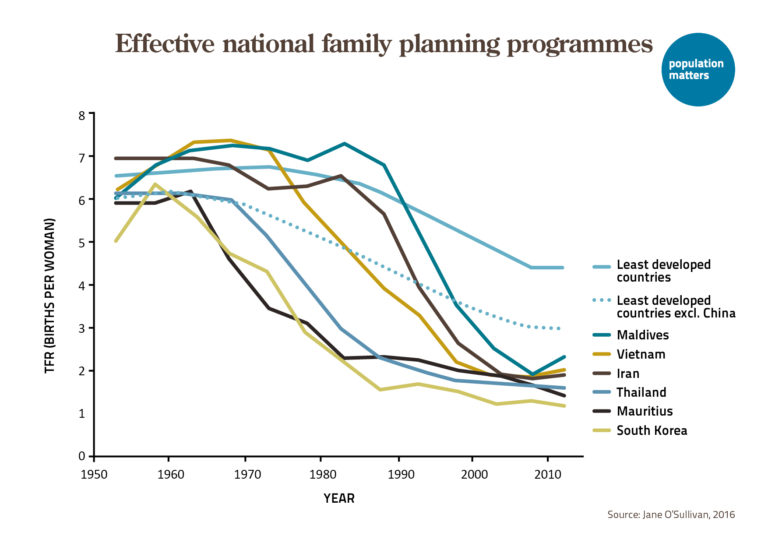
In TOP, we have researched what causes the birth rate and family size to fall in developing countries. A major factor has been voluntary family planning programs in countries like Costa Rica, Iran and South Korea. In current academic literature, the dominating paradigm is increased education of women. In developmental aid, “reproductive health” is often…
-
What have you learned in school about population? Please tell us!
Many of our readers may have memories from their school years of lessons about population growth – or perhaps memorable situations when population talk was avoided. As far as we know, there are few studies regarding how population is taught around the world. TOP wants to know more about this, whether your memories are from…
-
Nine strategies to stop short of 9 Billion – ten years on
In 2012, as the human population reached 7 billion, Robert Engelman, President of the Worldwatch Institute, advanced 9 strategies to halt global population growth. He suggested that humanity had to stop short of 9 billion to accomplish environmentally sustainable prosperity. Ten years later, we have added 800 million people, corresponding to an annual increase of…
-
Honouring World Population Day with Women’s Personal Stories
A new initiative aims to draw attention to stories about population and consumption from women around the world to mark World Population Day. The focus lies on personal experiences and encourages a greater discussion about the links between population, consumption, and protecting nature. By Pernilla Hansson World Population Day is held every year on the…
-
From bodily autonomy back to family planning
In its recent report State of World Population 2021 the United Nations Population Fund (UNFPA) highlights bodily autonomy as a universal right. Of course, nobody in a civilised society would object against this position. However, by limiting the notion to the domain of gender-based violence and harmful practices such as child marriage, female genital mutilation,…
-
Human Rights and Population Policy
Like all government policies, population policies should respect human rights. But what does that mean in practice? Putting reproductive rights in the larger context of creating just and sustainable societies provides the best framework for answering that question correctly. by Philip Cafaro Issues concerning human rights loom large in population debates. On the one hand,…
-
Fertility levels in global regions and countries: what is the role of religion?
Population growth depends strongly on fertility rates, so it is important to study factors that determine fertility. Despite much research, there is no consensus about the most important factors involved, except that contraceptive use can be effective. Factors correlated with declining as well as increasing or high fertility should be studied simultaneously. Religiosity is potentially…
Explore the content and topics covered by TOP, search here
Recent blog posts
Blog categories
What we are reading, listening to and watching
Gallery of infographics – Learn more about overpopulation and environment