The Overpopulation Project
TOP – Research and Outreach
Too many people consuming too much
Category: Biodiversity
-
Housing growth threatens biodiversity – are we ignoring fundamental causes?
By Patrícia Dérer The primary cause of the global biodiversity crisis is human-induced alteration and loss of natural habitats1. One of the most important causes of habitat destruction is housing growth, manifested both in rural and urban sprawl. The impacts of housing growth derive from both building human dwellings and their associated infrastructure such as…
5 comments on Housing growth threatens biodiversity – are we ignoring fundamental causes? -
WWF Living Planet Report 2018 – “aiming higher”, but not on target
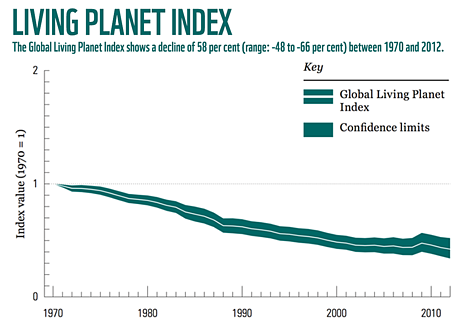
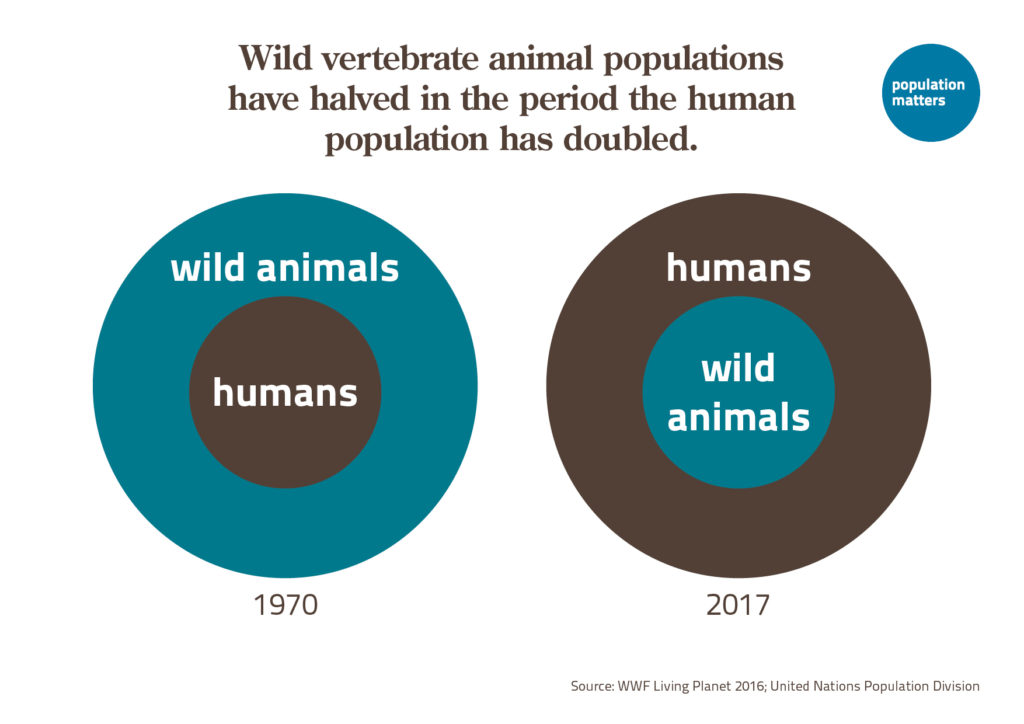
By Jane O’Sullivan Why would an organisation dedicated to protecting natural areas and to saving wild animals turn its back on arguably the biggest threat? WWF used to highlight human population growth, but not anymore. Populations of wild animals have declined, on average, by 60% since 1970. This alarming statistic was announced in WWF’s 2018 Living…
-
People and Planet – Sir David Attenborough’s take on overpopulation
TOP believes there is no better video presentation on the consequences of overpopulation than Sir David Attenborough’s RSA (Royal Society for the encouragement of Arts, Manufactures and Commerce) President’s Lecture. The well-known British naturalist delivers an impressive speech explaining why population growth is a multiplier of every evironmental problem. Given that the Earth has physical limits,…
-
Announcing the new Human Overpopulation Atlas
The Overpopulation Project announces the Human Overpopulation Atlas, written by João L.R. Abegão. The Atlas is the extended masters thesis of the author in Ecology and Environment at the Department of Biology of the University of Porto in Portugal. This broad review work synthetizes knowledge about the past, present and future of human overpopulation. In…
-
Can the book “Factfulness” be improved?
Our blog about Factfulness led to comments, discussion and finally a response from one of its authors (note: the book is written in Hans Rosling’s voice and is the joint work of Hans Rosling, Ola Rosling, and Anna Rosling Rönnblad; Hans Rosling died in February, 2017). Ola Rosling states that he welcomes our criticism and…
-
Space for Nature
by Jenna Dodson How much of the planet should we leave for other forms of life? How much of the planet can the 7.6 billion present-day human inhabitants utilize without sacrificing the well-being of future generations? These are important questions with far reaching implications for all species, Homo sapiens included. People are placing unprecedented demands…
-
Rethinking depopulation and land abandonment – the opportunity of rewilding
By Patrícia Dérer Thirty countries around the world have declining human populations. With the exception of Japan, these are European countries that, along with the rest of Europe, have successfully undergone the “demographic transition”. Impressive achievements in health care, education and economic development have resulted in lower child mortality and longer life expectancy, leading to…
-
”Factfulness”: a more accurate title for this new book would have been ”Selecting Facts to Make You Happy”
by Frank Götmark This year Hans Rosling, Ola Rosling, and Anna Rosling Rönnblad (below the “Rosling team”) published “Factfulness” (Note: H.R. died in February 2017.) As the book to a large extent is about global population and as Bill Gates is giving free copies of it to college graduates in the US, we need to…
-
High human population density eliminates the positive effect of forest protection in a tropical biodiversity hotspot
By Patrícia Dérer Sri Lanka and the Indian Western Ghats (also known as Sahyadri Mountain Range) make up one of 36 Biodiversity Hotspots. These areas are the Earth’s most biologically rich—yet threatened—terrestrial regions; they were designated in order to preserve the most species. The Western Ghats belong to the eight “hottest hotspots” based on their…
-
A key driver of the biodiversity crisis is poorly evaluated: population size
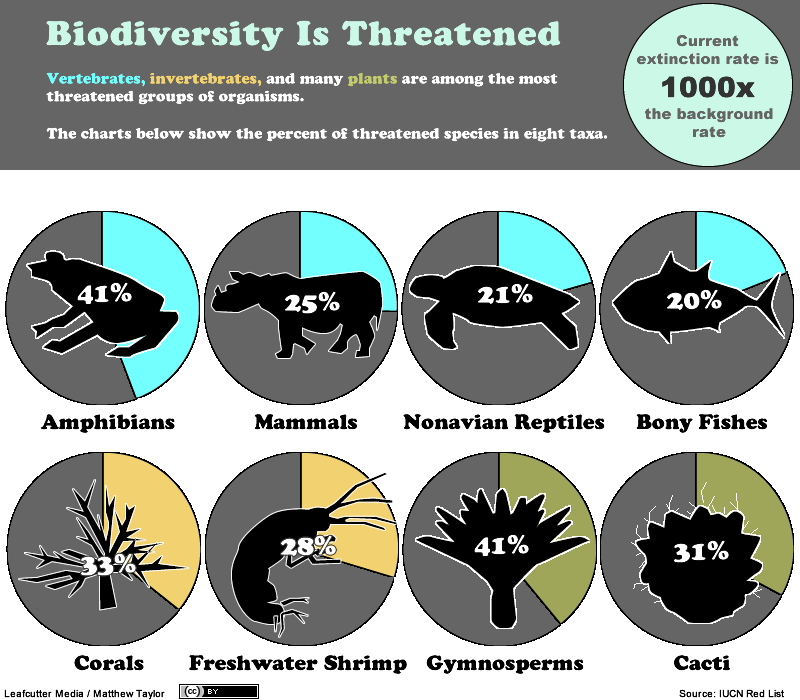
By Patrícia Dérer We are entering the sixth mass extinction of life on Earth, the first to be caused by humans1. Extinction rates are several orders of magnitude above normal. Humanity has managed to exterminate more than 300 vertebrate animals in modern times, the IUCN estimates that half the globe’s 5,491 known mammals are declining in…
Explore the content and topics covered by TOP, search here
Recent blog posts
Blog categories
What we are reading, listening to and watching
Gallery of infographics – Learn more about overpopulation and environment