World population revised upwards again

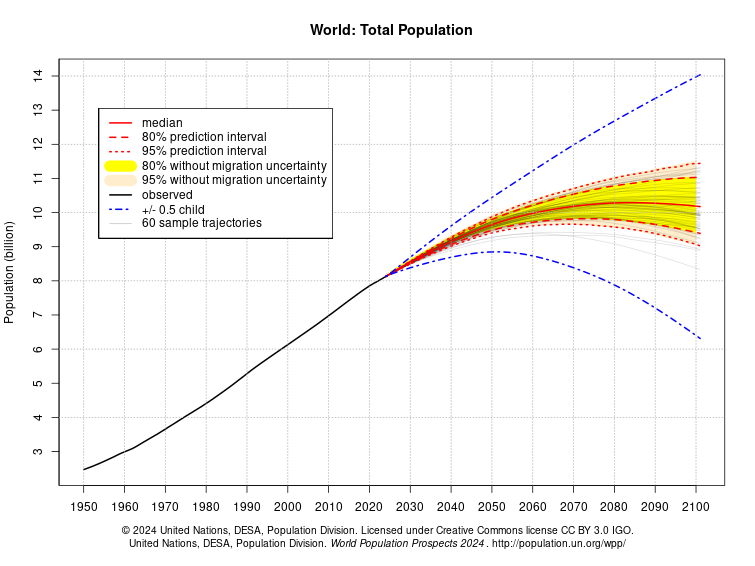
On 11 July, the United Nations published its new population estimates and projections. While trumpeting the promise of a lower global peak as “a hopeful sign [for] reduced environmental pressures” in the press release, they don’t mention there are now 43 million more people than they anticipated as recently as 2022. Not such a hopeful sign.

By Jane O’Sullivan

The United Nations released its 2024 revision of world population estimates and projections on 11 July, World Population Day. These statistics are updated every two or three years and published under the title World Population Prospects, which I will abbreviate to WPP hereafter.

Media headlines uncritically announce the report’s key finding of earlier and lower peak in world population as “a hopeful sign” for the global environment. While a 1% reduction in the peak (from 10.4 billion projected in WPP2022 to 10.3 billion in the 2024 revision) is hardly going to avert environmental catastrophes, it would infer a sooner and more rapid population decline thereafter, reducing the period of ecological overshoot. That is, if we can believe this finding.

So, what has happened in the past couple of years to indicate we could be on this lower trajectory? Let’s look at some data.

Firstly, the new revision actually tells us there are 43 million more people alive today than the UN anticipated only two years ago. That’s like adding an extra Poland, Iraq or Afghanistan. This is not mentioned in the UN’s press release. Once again, world population has outstripped the UN’s near-term projection. In 2022, they thought 1 July 2024 would see 8,119 million people, but the 2024 revision tells us it was 8,162 million. Given the 2022 revision expected an increase of 144 million between 1 July 2022 and 1 July 2024, that’s a 30% error!

Figure 1 shows that the UN’s pattern of underestimating future global population continues unabated. If their projections can be that wrong over two or three years, the errors would only magnify the further into the future they project. This chart shows the world population as it was estimated in each revision from 2010 to 2024. The pink line connects each revision’s estimate of the current population, i.e. the mid-2010 population as estimated by WPP2010 connected to the mid-2012 population as estimated by WPP2012, etc. The blue dashed lines show the projection made in each of those revisions. The 2022 revision, while reporting a higher current population than expected in 2019, anticipated a rapid deceleration, narrowing the gap by 2024. Instead, we have seen a larger than ever upward correction. We now exceed the 2010 projection by 226 million people.

This trend is illustrated in the alarming advance of the date on which we passed 8 billion human inhabitants of this precious planet. Table 1 lists the date estimated in each revision of the UN’s medium projection since 2010. Remember all the media attention for 8 Billion Day in November 2022? Now it appears we had missed the event by 8 months!

Table 1: The Day of 8 Billion as projected by successive revisions of the United Nations World Population Prospects (estimated by interpolation).

Commenting on the slightly lower projected peak population, Claire Minoti, an author of the new UN report, said, “it signals that we have come to the end of a process of rapid growth on a global scale that began in the second half of the twentieth century” (launch event video at 12:40 min). Well, we might be able to see light at the end of the tunnel (or have simulated the light by way of modelling assumptions) but it is surely premature to say we have come to the end. The mid-2024 population reported in WPP2024 is 187 million higher than the mid-2022 population reported in WPP2022. That would be a record-breaking 93.4 million per year!

However, the UN’s model downplays this increase by distributing it over more years. In Figure 2, we can see that the higher current population is attributed to a million or so more people than previously thought being added each year over the past 40 years, rather than dramatically more people being added in the past two years. Figure 2 shows the number of people added to the global population annually in each UN revision since WPP2010. The gap between the pink line (WPP2024) and the darkest blue (WPP2022) all the way back to the 1980s accounts for the extra 43 million people. Note that the dramatic dip in 2020 was due to deaths associated with the Covid-19 pandemic, obviously not anticipated in earlier projections. But, whereas the UN expects mortality rates to return to their previous trend quickly, the increment of growth does not, as they expect fertility rates to fall more rapidly.

The UN’s explanation for the lower future peak population is that fertility has fallen lower in some of the biggest countries, particularly China. However, this should translate into fewer people present now, not more. How could the future growth be smaller than previously expected, if the past growth was greater? It’s possible, if the fertility rate is in fact falling faster than anticipated in 2022, but life expectancy has risen even more sharply above expectations. This would keep the death rate lower for now, but increase it in the future as the proportion of elderly people would rise a little faster than previously anticipated. However, given that death rates are still readjusting after the pandemic, it would seem premature to adjust their projection on the assumption of a recent improvement in the underlying trend in longevity.

Figure 3 shows annual numbers of births and deaths, as estimated (solid lines) and projected (dashed lines) in WPP2010 and WPP2024. It shows the 2024 estimates do show slightly fewer deaths over the past 30 years than the 2010 version, but the difference is bigger for births, particularly the size of the baby-boom in the first two decades of this century. Remember Hans Rosling telling us we passed ‘peak child’ (the number of children aged under 5 in the world) in the 1990s? How wrong he was! All those extra children will become parents around 2040, hence the extra hump in births in the 2024 UN projection. But, thereafter, births are expected to drop much more rapidly than anticipated in 2010, as high fertility countries are assumed to reduce fertility faster.

The steep drop in births from around 2018 is more than a little speculative: many high-fertility countries don’t have good birth records, so their actual births can only be estimated some time in the future after a census of people (and by guessing what proportion of people the census missed!). Time after time, we see large revisions in estimates of fertility in these countries a decade after the fact. This is the problem with the UN’s projections: they are projecting forward on the basis of a change they assume has happened very recently, but long before they have good data to prove that it actually happened. When that change is such a dramatic shift from past trends, we have a right to be sceptical.

To its credit, the UN acknowledged that some countries still experience rapid population growth and this is problematic for those countries. In the words of Navid Hanif, assistant secretary general in the UN’s Department of Economic and Social Affairs (which contains the Population Division), “Rapid growth in some countries is likely to magnify the scale of investments and efforts required to eradicate hunger and poverty and malnutrition, and ensure universal access to health care, education and other essential services in countries that are already facing severe economic, social and environmental impediments.” Note that they never admit that the severe impediments experienced in those countries today are largely due to past population growth magnifying their challenges. He advocates “investing in the education of young people, especially girls, and increasing the age at marriage and first child bearing” as well as greater attention to achieving the Sustainable Development Goals. Nowhere is the promotion of smaller families advocated, despite being the most effective approach in the past.

More worrying in this instance is their failure to mention that the world population is bigger than they previously led us to believe. If a hundred million fewer people in 2084 (10.3 instead of 10.4 billion) is hailed as “a hopeful sign” for reduced environmental pressures, why is nothing said about the environmental and social strains of an extra 226 million present now, on top of the expected growth since 2010? There would seem to be a conspiracy of silence.

Tagged:

Published

16 responses to “World population revised upwards again”

  1. Robert Wyman Avatar

    This article is masterful. Exactly what is needed. Ever since Cairo, UN has been hobbled and blinkered into never saying that high birth rates are a disaster.

    1. Barbara Rogers Avatar

      Yes, it looks as if the pronatalists have established a foothold in the UN’s statistics work. I imagine there is a fair amount of argument going on there.

    2. Alan Ditmore Avatar

      City abortion funding saves city school tax, so much so that cities can then fund country abortions as well, all without answering to country voters.
      In this way, my guess is that 10 cities can cover the USA and 25 can cover the world, coordinating via the World Council of Mayors and ignoring state and national governments completely. Think globally act locally.
      https://www.facebook.com/groups/4992336894196490

  2. Kathleene Parker Avatar

    Well, the UN maybe be “hobbled and blinkered” but it’s numbers (including U.S. population data) are a heck of a lot more honest and trustworthy than U.S. Census Bureau data, where (I have it on good authority.) there has long been political pressure to keep the focus OFF our exploding population and detract from the staggering increases of 27 million to 30 million per-decade, which is mostly immigration driven. (They must remain politically correct, I guess.)

    Be that as it may, I love it–as CORPORATE-OWNED MEDIA love that it’s the narrative those who own them want–that, yet again, we’re being told that somehow, at some mythical date in the future–the planet will reach whatever number (now over 10 billion) and, somehow, magically stop growing. Anyone who understands exponential growth or numbers knows that’s hogwash.

    While it is down somewhat from the over 90 million a year, not that long ago, the planet is still growing by over 80 million people a year, so do the math. It’s highly unlikely we’ll “only” be the 10 billion they predict–that is unless wars, climate disasters, earthquakes, etc., take an accelerating toll. Or what Norman Borlaug warned against, “Nature’s way (of reducing population) is never very kind.”

  3. gaiabaracetti Avatar

    There’s also a possibility that all these projections are rubbish because a population of 10 billion humans will simply be impossible, no matter the fertility rates. This is what the famous Limits to growth – Business as Usual model predicts, and based on what I’ve read, all its predictions have proven to be accurate so far. If they are correct, the human population peak is only a few years off from now, and the way it goes down is people die because they can’t eat or don’t have access to healthcare – and this is without mentioning armed conflicts over resources:
    https://donellameadows.org/archives/a-synopsis-limits-to-growth-the-30-year-update/
    The peak is before mid-century: https://1a0c26.p3cdn2.secureserver.net/wp-content/userfiles/Picture-71.png?time=1721242919

    1. Edith Crowther Avatar

      Thanks Gaia.  The link works fine.  Today, the UK Daily Mail carried an astounding article about the amount of electricity and water databanks use, and how that use is increased exponentially by A.I. requirements.  [“The dried-up lake in Mexico fuelling fears AI technology is an environmental catastrophe in the making.”] Both in the First and the Third World, databanks are literally draining groundwater from under the feet of humans and other species, and only fossil fuels can generate enough electricity to feed their rapacious appetite (which also creates “heat islands” at the location of each databank, hence the need for water to try and keep them cool).  Thus google’s carbon footprint expands daily – and I use google a lot, as do many of us.
      Water depletion does not only make you thirsty – it destroys any form of agriculture you may be trying to achieve, even low-tech small farming.  Intensive agribusiness of course uses far too much water in its right – not as much as a databank, maybe, but still far too much – and it also pollutes rivers and aquifers with runoffs from biocides, vet drugs, manure, etc.  This all sounds very “negative”, but I prefer it to the “toxic positivity” now polluting global “civilization” like an algal bloom.  In the end, a complete End is the only solution – and we have left it too late for it to be anything but brutal.  It still remains the only solution, though.

      1. gaiabaracetti Avatar

        You are absolutely right about the high energy consumption – not just water – of the internet and now AI. I don’t think we need to go without, just use it a lot less and for the more serious stuff. For (a super small) example, I always send heavy files separate from emails so that I can then delete them and just keep the text, taking up less space on a server. For a while, to bring things back offline and not be so reliant on “the cloud”, I tried to convince friends to send letters instead of emails. Didn’t work! And paper of course also uses up resources.
        Here as far as I know we have no data centers, but still waste a lot of electricity and A LOT of water through things like unnecessary corn production, unnecessary lawns and private pools, of course industry, and even things like the flushing toilet. But the worst I can think of is the pressure washer gun. You are too lazy to use a broom so you waste untold quantities of water to do what? Blast a leave off your driveway?
        We don’t respect water enough, starting with the small things.

  4. gaiabaracetti Avatar

    Oops sorry I had no idea the link was going to show up like that. I don’t know what to do to fix it!

    1. gaiabaracetti Avatar

      I don’t know what happened with my comment but it was a link to the Limits to Growth business as usual projections, according to which the human population starts going down in a few years from now due to lack of food and healthcare. They’ve been fairly accurate on the other things so far…

  5. David Polewka Avatar

    Jay Forrester was born on a farm, where “his early interest in electricity was spurred, perhaps, by the fact
    that the ranch had none. While in high school, he built a wind-driven, 12-volt electrical system using
    old car parts—it gave the ranch its first electric power.” He received his MS at MIT. Forrester was the
    founder of system dynamics, which deals with the simulation of interactions between objects in dynamic
    systems. Industrial Dynamics was the first book Forrester wrote using system dynamics to analyze industrial
    business cycles. Several years later, he wrote Urban Dynamics, which sparked an ongoing debate on the
    feasibility of modeling broader social problems.
    ‘Counterintuitive Behavior of Social Systems’ also sketched a model of world dynamics that correlated
    population, food production, industrial development, pollution, availability of natural resources, and
    quality of life, and attempted future projections of those values under various assumptions. Forrester
    presented this model more fully in his 1971 book World Dynamics, notable for serving as the initial basis
    for the World3 model used by Donella and Dennis Meadows in their popular 1972 book The Limits to Growth.
    Forrester met Aurelio Peccei, a founder of the Club of Rome in 1970. He later met with the Club of Rome
    to discuss issues surrounding global sustainability.
    https://en.wikipedia.org/wiki/Jay_Wright_Forrester
    ———-
    Dennis Meadows was born in 1942. He received a PhD from MIT. From 1970-72 at MIT he was director
    of the “Club of Rome Project on the Predicament of Mankind”. In a 2004 interview, Meadows said:
    “In 1972 it was inconceivable to most people that the physical impact of humanity’s activities could ever
    grow large enough to alter basic natural processes of the globe. But now we routinely observe, acknowledge,
    and discuss the ozone hole, destruction of marine fisheries, climate change and other global problems.”
    In their 1972 publication Limits to Growth, their recommendations were focused on “how to slow growth”.
    In the 2004 Limits to Growth: The 30-Year Update, the message has changed. Meadows explained: “Now
    we must tell people how to manage an orderly reduction of their activities back down below the limits
    of the earth’s resources.” In 2014, research at the University of Melbourne confirmed that the predictions
    from the book Limits to Growth were largely correct. Presently we are very close to tracking the
    “business-as-usual” scenario from the book.
    https://en.wikipedia.org/wiki/Dennis_Meadows

  6. Stable Genius Avatar

    To get their population “projections”, the corrupt UN starts from the answer they want, and works backwards. The same is true of their emissions “projections”.

    In the real world, population, consumption, GDP, and emissions, keep on increasing, more or less in straight lines. In UN fairytale, “net” emissions can bend it like Beckham, to “save” the environment. This rainbow is irresistible to greenies and corporates alike.

  7. stevemckevittda604d1b36 Avatar

    The UN should be asked to review the past 30 years of its population reporting and the making of its population projections. Along with its global recommendations about population. The generally poor job that the UN people have done speaks to the reality of their problem. That is: that they are (and have been) unduly influenced by private economic and social (religious) interests. This has ruined their ability to do an honest and useful job.

  8. […] population above previous projections. World population is apparently still growing by about 90 million a year. Yet the media would have us believe an imminent population peak and decline is the bigger […]

  9. […] World population revised upwards again, by Jane O’Sullivan […]

  10. Stephen Willey Avatar

    Whaat? I have been concerned with the ever growing population since 1950s. But just the past months there are stories of SHRINKING population, even on NPR news website today and other times and places. Yes fewer averge babies born to couples… but where ever hane they come up with population shrinkage? Just worried economically? Whaat evidence?

Leave a Reply

This site uses Akismet to reduce spam. Learn how your comment data is processed.

NOTE: Comments with more than one link will be held in wait and will only become visible on the site after an admin has approved it.

Explore the content and topics covered by TOP, search here

Blog categories
Gallery of infographics – Learn more about overpopulation and environment

Discover more from The Overpopulation Project

Subscribe now to keep reading and get access to the full archive.

Continue reading