
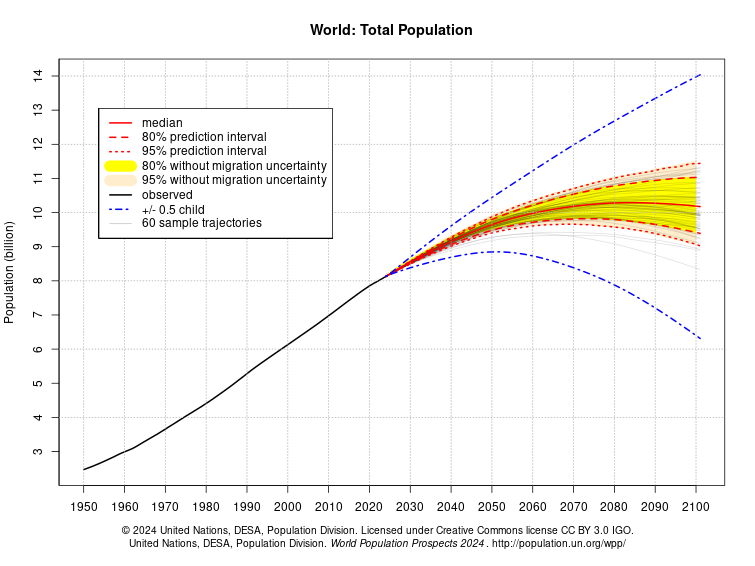
Low birth rates are often regarded as problematic by major media, which overlook the perils of population increase. Here we show that unsustainable long-term population growth prevails in developing countries, despite historical family planning and gradually sinking birth rates. One lesson is that further reduced rates are urgently needed in high-fertility countries, in Africa and elsewhere.
By Frank Götmark
Alarmistic reports in the press, radio and TV about low fertility and declining family size are frequent. In June, the Economist reported that “fertility has collapsed”, with “dire” consequences. However, there are good reasons to welcome low fertility, which has many benefits for people, ecosystems and wildlife.
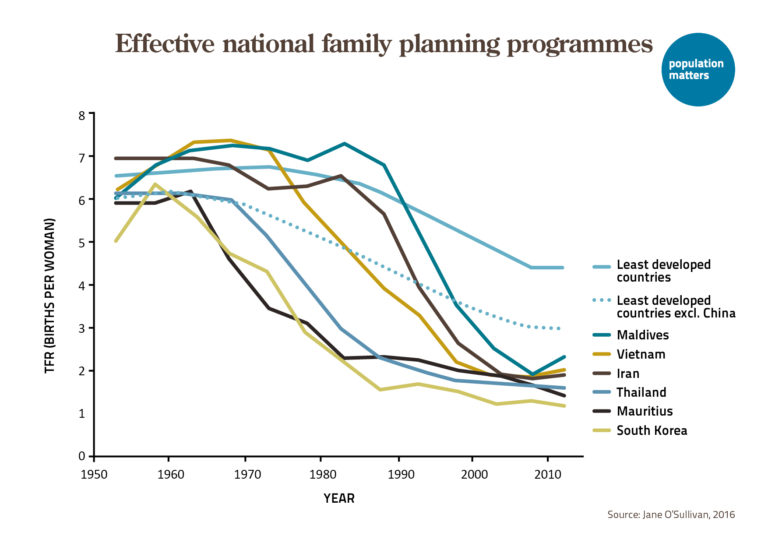
Family planning (FP) programs include education about contraceptives and the benefits that smaller families and populations usually bring. Historically, FP programs in many developing countries have markedly contributed to lowering birth rates. Many governments have established coordinated FP programs, down to municipality or village level. TOP has published a series of articles about successful historical FP programs. Here we examine changes of the populations in seven countries after their FP programs started. We summarize FP programs based on the TOP articles (links are given below, for more details).
FP programs, fertility and population changes
In the early 1960’s the fertility rate in Costa Rica, a small progressive Central American country, was high, 6-7 children per woman. Although this country has never had a formal population policy intended to reduce birth rates, the government tried to provide contraception and sex education from the late 60’s. Also important in spreading the benefits of small families were the Christian church and radio talk shows. As a result the total fertility rate (TFR) began falling in the late 60’s, reaching about 2.1 children per woman in 2005, and 1.76 in 2021. Yet, Costa Rica’s population is still growing rapidly in 2021 (graph from Our World in Data below):

We can compare Costa Rica, a small country, with Brazil and its large population. As in Costa Rica, the government had no FP-oriented birth control, but contraception was affordable and soap operas (telenovelas) featuring small families on TV and radio were influential. The TFR decline over time was very similar to that of Costa Rica, but as in that country, the population of Brazil has grown strongly up to the present:

A third country, Tunisia, was the first country in Africa to launch a voluntary FP program. Already in 1962, experimental FP was set up, and the full national FP program began in 1966. It offered free contraceptive services, focusing on advice and contraception such as IUDs, the pill, sterilization, and abortion (fully legalized 1973). The decline in TFR was slower than in Costa Rica and Brazil, being 2.3 in 2000, and 2.2 in 2020. Tunisia’s population increased strongly 1960-2021:

Beside Tunisia, several other Muslim countries had early voluntary FP programs. The most remarkable case is Iran, between 1988 and approximately 2012. TFR dropped from 6.5 in 1985 to as low as 1.8 in 2010. The country had a (weak) FP program 1967-1979, before the Islamic Revolution. In 1988, the fundamentalist regime started a substantial and voluntary FP program. Policymakers within the country, educated in the West, were important for the program (Peter McDonald, pers. comm.). Unfortunately, the FP program reversed after about 24 years to pronatalism, under Ayatollah Ali Khamenei. From 1970 onwards, apart from a short period in the early 1990s, there is a strong population growth in Iran:

In Indonesia, the Family Planning Association (private) introduced FP already in 1957. In the late 1960’s the government published a pamphlet, “Views of religion on family planning”, with leaders of Islam, Hinduism and Christianity together backing national FP. In 1970 the government formed the National Center for Coordination of Family Planning. In the 30 years that followed, TFR fell from 5.6 to 2.6 (2.2 in 2022). The increase of the Indonesian population, the fourth largest in the world after China, India and USA, is shown below:

In Thailand, women on average had about 6 children in the 1960’s. Initiatives then showed that rural couples in Thailand wanted to limit their family size if given the possibility. A strong Ministry of Health supported this interest in 1968-1970 by FP services. An official National Family Planning Program started in 1970, strengthening these efforts. In addition, influential persons, such as Mechai Viravaidya (“Mr Condom”) made contraceptives popular. In 1990, TFR was 2.0, and at present slightly above 1.3. The graph below indicates a possible population peak in the near future, but it is also clear that Thailand’s population increased markedly 1960-2021:

Finally, in South Korea, a voluntary program and FP efforts started already in 1961, earliest among the seven countries. TFR fell rapidly from 6 to 3 children in 18 years, second only to Iran where the decline took 10 years. Political leaders, including the president and prime minister, were deeply involved in the program, which was also supported by foreign agencies (the USA and Sweden, mainly). Decentralization down to village level was an important component of the program. This led to South Korea between 1960 and 1983 having the fastest drop of fertility to 2.0 ever observed. In 2001, TFR had dropped to 1.3, and to 0.88 in 2022. Yet it took about 65 years for the population to peak:

Why such population increases?
Despite relatively strong voluntary family planning in these seven countries over the past half century, their populations increased markedly. There are at least three reasons for such increases. Firstly, ‘population momentum’, whereby large young age classes move towards the top of the population pyramid, producing children over several decades. As John Weeks notes in his textbook Population (2021), “a heavy freight train takes longer to stop than a light commuter train”. In South Korea for instance, the number of women of childbearing age increased from 11.1 to 12.6 million between 1985 and 2015.
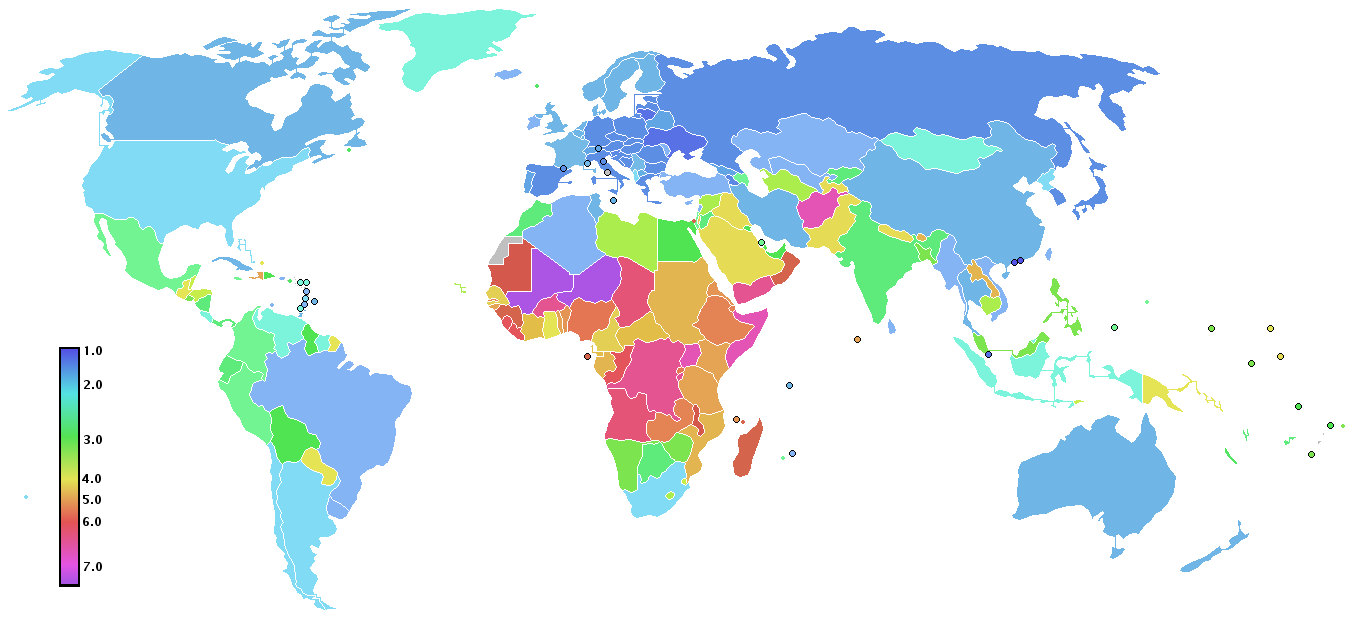
Secondly, reduced mortality of children and older adults, due to improved sanitation, medical care, food quality and other general living conditions. This is reflected in increased life expectancy in these countries (see map with data in Our World in Data). Finally, in some of the countries, the mean number of children per woman remained higher than ‘replacement level’, required for stabilization of population size in the long run.
To halt rapid population growth in these countries, strong support for FP programs would have been valuable. But family planning received lower international and national interest and support from the mid-1990’s and onwards. Whether this was the case in the seven countries deserves further study (as already noted, the program ended in Iran, and possibly programs declined in Tunisia and Indonesia).
Comparison of countries having and lacking FP programs
Over a 50-year period, 1970–2020, the populations of the seven countries with early FP programs increased on average by 154% (range 108 – 214 %, the highest value for Iran where the strong program started later, in 1988). This is a strong increase; however, their FP programs almost surely slowed population growth during the period. This is indicated by comparison of seven countries nearby which had no (or weak or non-existent) FP programs: Guatemala, Venezuela, Algeria, Iraq, Afghanistan, Malaysia, and Philippines. Their mean population increase is substantially higher during this period (243%) than the increase among the countries with FP programs. This is clear from the graph below:

Moreover, a comparison of Bangladesh (FP program from the 1980’s) and Pakistan (weak or no FP during the period) by Bongaarts & O’Neill in 2018, including population projections up to 2100, shows that a good program may have substantial positive effect on future population numbers, even leading to a possible population decline. The difference between the countries is shown below:

Bangladesh and Pakistan, well matched geographically and by religion and other factors, had similar population growth up to about 1980 but thereafter began to diverge. In 2023, Pakistan’s population was reported to be larger than indicated by the projection (256 million, growing at a rate of 3.1%). The population of Bangladesh in 2023 was 173 million (growing at a rate of only 1.0%) according to Worldometer, close to the projection (for assumptions in the projection, see Bongaarts & O’Neill’s paper). This is good evidence for the positive effect of FP programs. Comparison of Costa Rica and Guatemala tells a similar story (see changes of fertility rate and population numbers over time in Our World in Data).
Conclusions
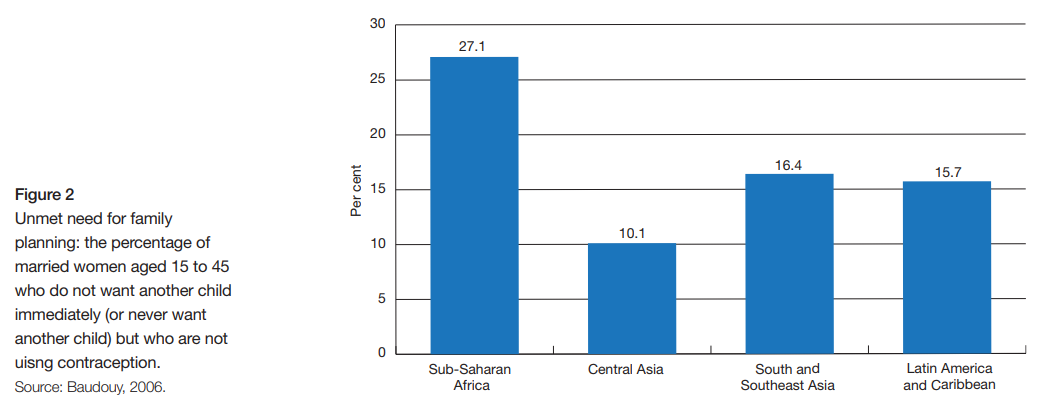
The lesson is clear: long-term voluntary family planning programs are today urgently needed in many countries in Western Asia and Africa, especially in Sub-Saharan Africa. Even with such strong programs, these countries likely face many decades of continued population increase, devastating to people, natural ecosystems and other forms of biodiversity. Leaders and policymakers in these countries can gain important insights from the case studies we present above, and by examining their own population history and conditions, when setting goals for the future.











Leave a Reply