
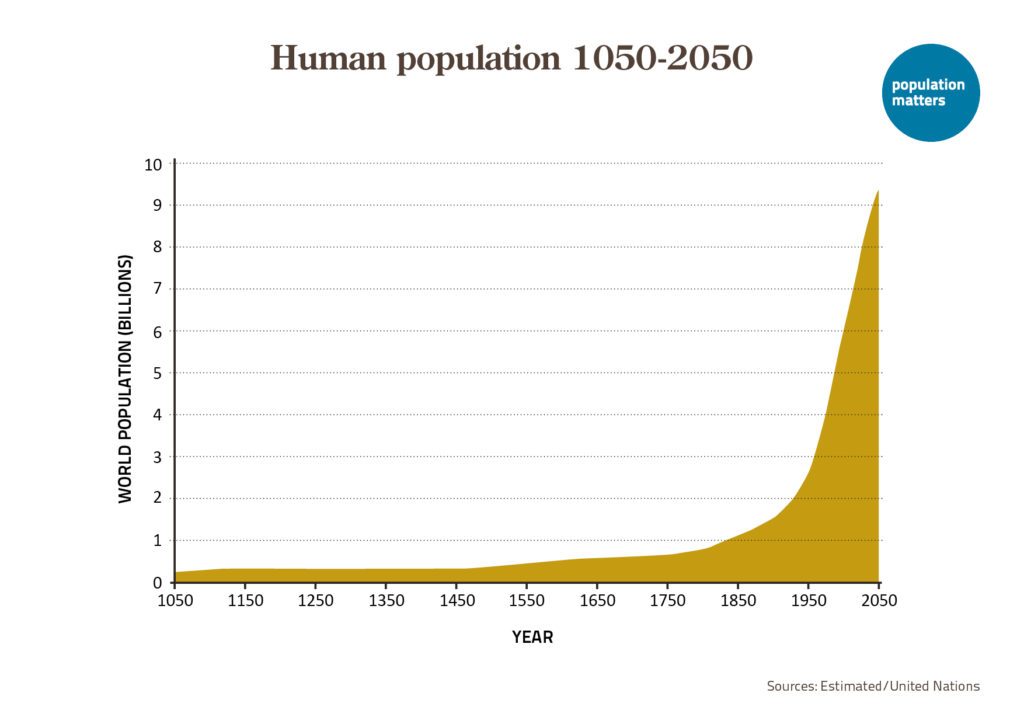
Then again, neither is anything else. The long lag time between fertility reduction and population stabilization is a key reason we need to address excessive human numbers sooner rather than later.
by Phil Cafaro
There’s an argument one often hears that goes like this: “sure, population is important. But we need to reduce our environmental impacts (particularly carbon emissions) so fast that action on population just won’t cut it. We need to focus on other things to make a difference NOW.”
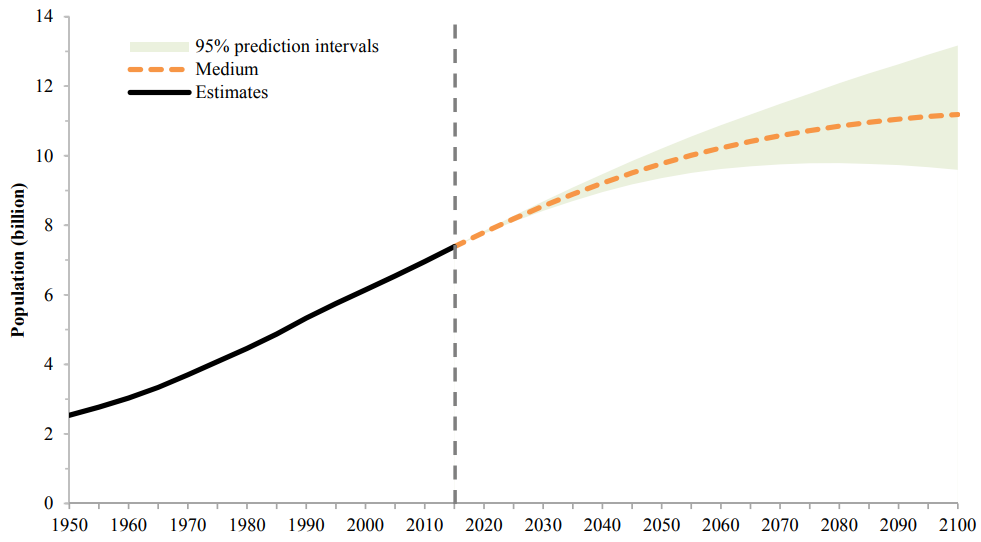
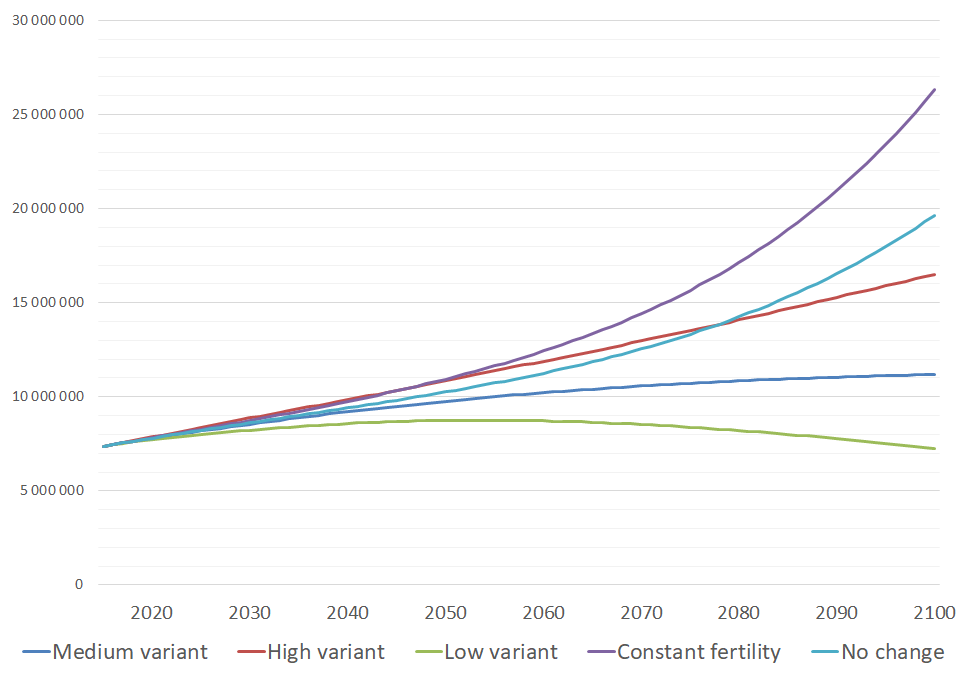
Corey Bradshaw and Barry Brook provide a version of this argument in their influential article Human population reduction is not a quick fix for environmental problems. “Humanity’s large demographic momentum means that there are no easy policy levers to change the size of the human population substantially over coming decades,” they write. True, “some reduction could be achieved by midcentury and lead to hundreds of millions fewer people to feed.” But “more immediate results for sustainability would emerge from policies and technologies that reverse rising consumption of natural resources.”
Reduced fertility, they say, “is a solution long in the making from which our great-great-great-great grandchildren might ultimately benefit, rather than people living today.” For that reason, Bradshaw and Brook argue that “society’s efforts toward sustainability would be directed more productively toward adapting to the large and increasing human population by rapidly reducing our footprint as much as possible through technological and social innovation, devising cleverer ways to conserve remaining species and ecosystems, encouraging per capita reductions in consumption of irreplaceable goods, and treating population as a long-term planning goal.”
The projections presented by Bradshaw and Brook have been criticized for underestimating the impact of fertility reduction efforts on global population. Nevertheless, they are right that barring war, epidemic disease, or other demographic catastrophes, there is no way to shift quickly from rapidly growing populations to stable or declining ones. But they are wrong to assume new technologies, clever management, or decreases in per capita consumption can reduce overall human environmental impacts any more quickly. They provide no evidence that such efforts have led to rapid decreases in human demands on nature in the past, or reasons to think they are likely to do so in the future.
In truth, there are no quick or easy fixes for humanity’s global environmental problems, period. People will need to work hard for a long time, and make fundamental changes, to have any hope of creating ecologically sustainable societies. Even if we do, we are so far into ecological overshoot that things will get worse before they get better, and many other species won’t make it with us into the next century.
Bradshaw and Brook are also wrong to say only our distant descendants will benefit from good population policies today. Women and couples today benefit from living in countries with universal contraceptive availability and the freedom to use it to determine their family sizes. Children today will immediately benefit if their parents choose small families and can better ensure their health, education and wellbeing. Their children will benefit if we have hundreds of millions fewer mouths to feed at midcentury, particularly with climate change threatening agriculture in many parts of the world.
Indeed, whole national economies are benefiting now, only a few decades (not generations) after adopting small families, through lower unemployment, better educated workers, and better housing and infrastructure provision. Many have moved rapidly into middle-income status, while countries with persistent high fertility have stayed poor.
Still, the likelihood that “our great-great-great-great grandchildren” will benefit from smart population policies today is true, and a strong reason to endorse them. Given the many demands people put on the natural world, and how technofixes in one area often lead to greater impacts in others, fewer people has to be part of the equation for long-term sustainability. Bradshaw and Brooks emphasize this in their article, as do many others.
Act now, if not sooner
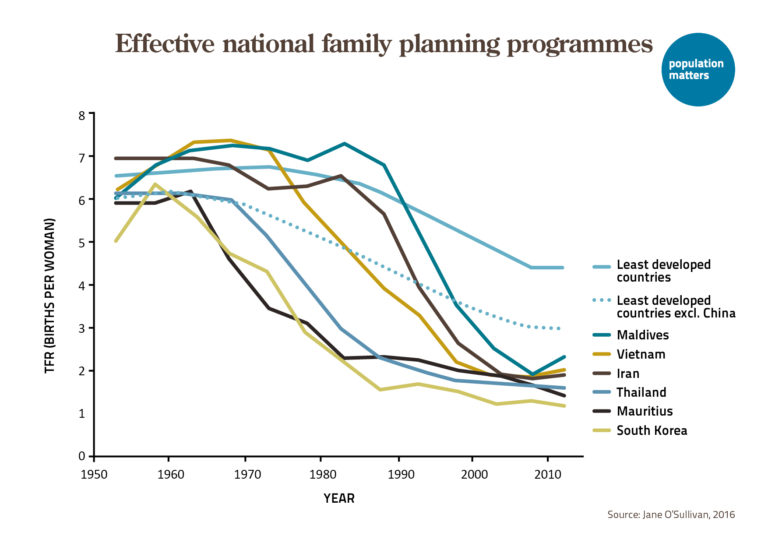
It is true that the fruits of addressing population take time to manifest (see our blog on the topic from last month). But over time they cumulate and become ever more important. Consider several comparisons between countries that created successful family planning programs over the past half century and countries that failed to do so (the following graphs were generated at Our World in Data, a valuable resource we gratefully acknowledge).
Costa Rica initiated family planning (FP) efforts in the late 1960s and continued them in following decades, while Guatemala did not. This led to the following changes in fertility (TFR) in the two similar Central American countries:

Today Costa Rica and Guatemala are on very different population trajectories going forward:

Costa Rica is in much better shape to provide for its citizens and preserve its remaining forests today and in the future, in large part because of far-sighted FP policies that began half a century ago.
Similar points could be made by comparing Bangladesh and Pakistan. Although both countries are likely to be greatly harmed by climate change, Bangladesh’s successful FP policies over the last four decades should help it limit the human suffering that is coming. Compare the two countries’ changes in fertility rates and population, and especially their population projections out to 2100:


It has taken decades for Bangladesh to reduce its TFR to replacement rate, and it will take more decades for its population to peak and then, hopefully, decline. But peak population is within sight. Meanwhile, Pakistan’s failure to provide FP and gender equality to its citizens has locked in immense population growth in the coming half century (barring demographic disasters), even if it changes course now. It’s not clear the country will be able to provide food for hundreds of millions more people, much less healthy and enjoyable lives.
Finally, compare South Africa and its regional neighbor Tanzania. South Africa has taken strong steps to provide FP to its citizens in recent decades, although its fertility remains well above the ‘replacement rate’. Meanwhile, Tanzania’s support for FP has been weak and inconsistent. The results can be seen in the following graph:

While South Africa’s population continues to grow, peak population is within reach this century, according to UN demographers. Tanzania, meanwhile, with one of the youngest national populations in the world, is set to detonate an immense population bomb during the rest of this century, with no end in sight to population growth:

Based on these projections, South Africa appears much more likely than Tanzania to be able to feed its population and preserve its remaining biodiversity in coming years. Failure to initiate FP programs in a timely manner means Tanzania faces the threat of mass starvation. Still, starting such programs now would be better than continued demographic irresponsibility.
It’s only by looking at the long-range population projections for these six countries that we fully see the importance of addressing population matters sooner rather than later. Yes, the populations of Costa Rica, Bangladesh and South Africa are much higher than they were 50 years ago. Yes, they continue to grow. But they would have been much higher without strong FP programs, and an end to growth is within reach. The same cannot be said for Guatemala, Pakistan and Tanzania. Citizens in these three countries are likely to face worse conditions than their neighbors going forward—perhaps a lot worse.
Human population reduction is not a quick fix for environmental problems. But in a world with no quick fixes, its contribution should not be downplayed. To say society’s efforts would be directed more productively elsewhere is to imply a trade-off between lowering birth rates and rolling out better technologies. This is a false dichotomy; we can and must do both. For these reasons, giving all women and couples the means to avoid unwanted births, and the motives to want small families, should be at the top of the global sustainability agenda.










Leave a Reply