The Demographic Struggle Over International Migration

A large percentage of people want to emigrate to another country, but many people in destination countries are opposed to accepting large numbers of immigrants. International migration is a highly difficult issue with no simple solution.

by Joseph Chamie

Approximately 1.3 billion people, or 16% of the world’s population, wish to leave their country permanently, while over a billion people believe that fewer or no immigrants should be allowed into their countries. This demographic struggle between the two sides over international migration is causing significant social, economic, and political repercussions for nations and their citizens.

The 1.3 billion individuals desiring to emigrate to another country is over four times the size of the estimated total number of immigrants worldwide in 2025, which is around 305 million. If all the people desiring to emigrate could do so, the global number of immigrants would increase to about 1.6 billion.

While an estimate of the total number of immigrants in the world is readily available, estimating the total number of unauthorized immigrants is much more challenging, with few reliable estimates available on a global scale.

If the percentage of unauthorized immigrants among all immigrants in the United States, approximately 25%, applies to the global immigrant population, the estimated number of unauthorized immigrants worldwide would be around 75 million (Figure 1).

The graph shows the number of unauthorized immigrants in the world as 75 million, the number of total immigrants in the world as 305 million, and the number of people in the world who desire to emigrate as 1.3 billion
Source: United Nations and Gallup Polls.

The global proportion desiring to emigrate permanently to another country has increased significantly in recent years, rising from 12% in 2011 to 16% in 2023.

Additionally, the desire to emigrate varies greatly across the different regions of the world. In 2023, Sub-Saharan Africa had the highest proportion desiring to emigrate at 37%, a significant increase from its 29% in 2011 (Figure 2).

Figure 2 shows the percentage of the population desiring to move  permanently to another country in 2011 and 2023. Most regions have seen an increase, apart from the EU and som Independent States.
Source: Gallup Polls.

In almost all major regions, the proportion desiring to emigrate permanently saw a substantial increase between 2011 and 2023. For instance, the proportions for the regions of the Middle East and North Africa, as well as Latin America and the Caribbean, rose from approximately 18% to 28%.

The desire to emigrate is not exclusive to developing regions. In the European Union, nearly 20% of the population in 2023 expressed a desire to emigrate. Similarly, in the United States and Canada, around 18% of their populations in 2023 desired to emigrate, a significant increase from the 10% reported in 2011.

The number of people desiring to emigrate permanently exceeds the number of immigrants countries are willing to admit, leading many individuals to migrate without authorization.

For example, while approximately 170 million adults wish to emigrate to the United States, the country’s annual number of immigrants granted legal permanent residence has ranged from 1 to 2 million, with net immigration expected to average just over 1 million annually in the future. Similarly, in Canada, about 85 million people desire to emigrate, but the annual number of immigrants admitted ranges from 400,000 to 500,000.

The significant imbalance between the desire to emigrate and the number of immigrants countries are accepting is a major demographic factor contributing to unauthorized migration. Thousands of migrants die annually on migration routes in their attempts to reach their desired destination country.

In addition to the demographic imbalance, other important factors contributing to unauthorized migration include poverty, unemployment, low wages, harsh living conditions, violence, crime, persecution, political instability, armed conflict, lack of health care, limited education opportunities, and climate change.

Many migrant destination countries are experiencing record-high numbers of unlawful border crossings, unauthorized arrivals, and visa overstays, leading to millions of individuals living unlawfully within those countries.

*

Human rights regarding international migration are relatively straightforward. Article 13 of the Universal Declaration of Human Rights states that “Everyone has the right to leave any country, including his own, and to return to his country”. While all people have the right to leave and return to their country, they do not have the right to enter another without permission nor to overstay a temporary visit.

However, Article 14 of the Universal Declaration also states that “Everyone has the right to seek and to enjoy in other countries asylum from persecution”. As a result, many migrants entering a country without authorization claim asylum to escape persecution.

To be granted asylum, an individual must meet the internationally recognized definition of a refugee.

The 1951 Convention Relating to the Status of Refugees and its 1967 Protocol relating to the Status of Refugees codified the right of asylum. The right to asylum is for anyone with “a well-founded fear of being persecuted for reasons of race, religion, nationality, membership of a particular social group or political opinion.”

The Convention and its Protocol, however, do not require governments to grant asylum to those who qualify.

By claiming asylum, migrants lacking legal authorization to enter are in principle permitted to remain in the destination country while their asylum claims are being adjudicated. Typically, the adjudication process takes several years and the large majority of asylum claims are denied.

For example, in the United States, approximately 70 percent of asylum claims have been denied over the past several years. Similarly, high levels of asylum claim denials, often exceeding 70 percent in first-instance asylum applications, are reported among many European countries, including France, Hungary, Italy, Poland, and Sweden.

Many destination countries, especially wealthy, more developed nations, view the extensive use of asylum claims by unauthorized migrants as a means of avoiding deportation. Although most claims are judged to lack merit, the large numbers of claims overwhelm the ability of countries to review them in a timely manner and enforce negative rulings to send people back to their home countries.

*

To address the large number of asylum claims, some countries are adopting various policies. For example, some countries are requiring unauthorized migrants to wait abroad while their asylum claims are being considered. Other countries are mandating that unauthorized migrants seek asylum in another country and have also implemented policies to transfer the migrants to different third countries for processing their asylum claim or for resettlement.

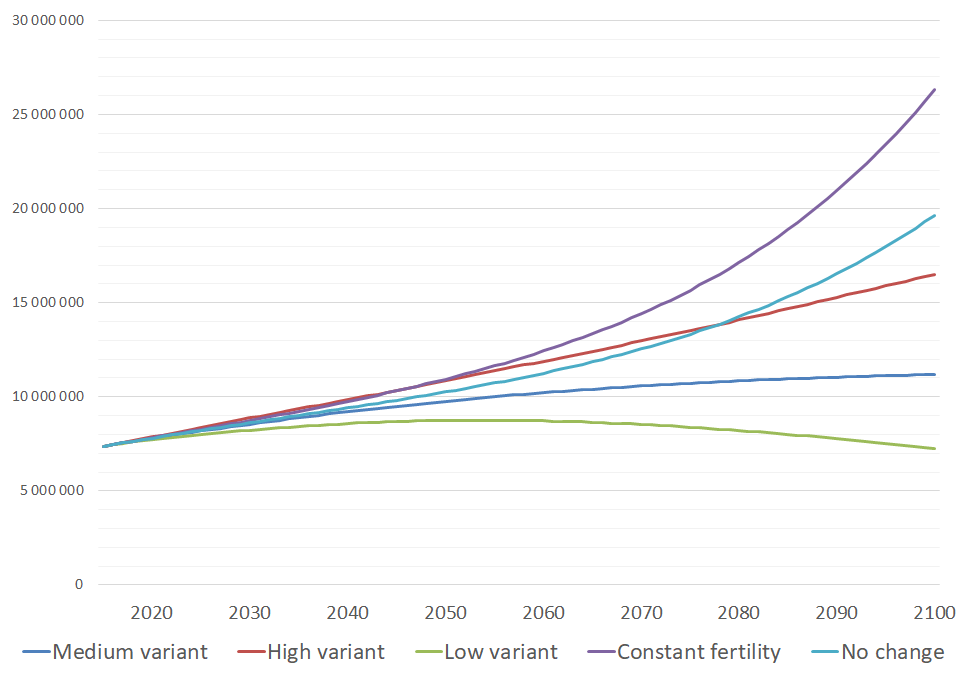
Looking towards the future, the world’s population, currently at 8.2 billion, is expected to increase by another two billion people over the next fifty years. During this time, the population of more developed regions is projected to decline by around 70 million.

In contrast, by 2075, the population of less developed regions, excluding the least developed countries, is projected to grow by close to 700 million. This significant population increase is about half the level expected for the least developed countries, which as a group are expected to increase by about 1.4 billion (Figure 3).

Figure 3 shows the population growth of the world. The majority (almost 1.5 billion of the expected 2 billion increase) is expected in the least developed countries
Source: United Nations.

While countries are addressing unauthorized migration, many of them are also experiencing or anticipating population decline. Despite the current and expected decreases in population size, countries are not ready to accept large numbers of immigrants.

Instead of increasing immigration numbers, countries are focusing on raising their low fertility rates, which have dropped and remain well below the replacement level.

Business leaders, employers, various non-governmental organizations, families, and some government officials acknowledge the benefits of international migration and may even tolerate some unauthorized migration.

However, many citizens in destination countries, particularly those on the political far right, increasingly view newcomers, especially those living in the country without authorization, as a threat to jobs, cultural integrity, national security, and a financial burden on public funds. Consequently, many governments in these countries have implemented policies and actions to deport migrants, especially those who are unauthorized.

Furthermore, opponents of increased immigration are worried that it will negatively impact their traditional culture, shared values, and national identity. They believe that immigration, particularly unauthorized migration, undermines their way of life, national security, ethnic heritage and social cohesion.

*

In conclusion, international migration has always been a fundamental, defining demographic phenomenon with significant economic, social and political implications worldwide. Currently, the global population of over 8.2 billion people is grappling with an escalating struggle over international migration.

On one side of this struggle are approximately 1.3 billion people desiring to emigrate, with many choosing to do so without authorization and often risking their lives to reach their destination. On the other side are over a billion people in destination countries attempting to prevent this emigration, reduce the rising numbers of immigrants, and deport those living in their territories without authorization, including many who are seeking asylum.

Given the demographics, significant differences between the two sides, and the current situations in various countries, it is likely that the struggle over international migration will persist throughout the 21st century.

Joseph Chamie is a consulting demographer, a former director of the United Nations Population Division, and author of many publications on population issues, including his recent book, “Population Levels, Trends, and Differentials”.

Originally published by IPS News on 30 June 2025.

Published

12 responses to “The Demographic Struggle Over International Migration”

  1. Esther Phillips Avatar

    Shame the author makes no analysis of carrying capacity of a given territory. The demands on already overstretched natural resources does not get a mention, neither does pollution, loss of bio-diversity, quality of life, access to clean water, clean air, clean soils. All in all a very incomplete analysis. Surely the above factors come into play when people resent ever more people arriving in countries that are already completely overstretched ie in overdraft with their countries “bank of nature”. I wouldn’t have used this expression normally, however, most Humans seem to translate everything into financial terms.

    1. Philip Cafaro Avatar

      Carrying capacity, and sharing the landscape fairly with other species, is of course a main focus of TOP. But I don’t think that is an important concern for most opponents of mass migration into developed nations. It SHOULD be, but I’m not sure it is!

  2. Kathleene Parker Avatar

    Speaking on the topic of migration to the United States, I have long been concerned that our now DEREGULATED media (and others) have silenced discussion of the impacts–social and environmental–of the immigration-driven population explosion that has swept the U.S. since President Johnson (apparently working for Wall Street and corporate interests) threw the gates open to the world.

    Since, we have added a staggering 30 million (plus or minus) people a decade, meaning that when he opened the gates, the U.S. was roughly only 200 million people and we now bump up against being 350 million with that having a staggering effect, particularly in the rapidly growing American West where the “wide open spaces” are rapidly becoming only a memory and no one even vaguely wants to consider the water limitations or the likely collapse of the Colorado River system.

    Francis Burnett was inspired to write “America the Beautiful” while sitting on Pikes Peak looking down on the “fruited plains” and “amber waves of grain” (Incidentally, likely, some of them, my ancestors’ fields of grain outside of Fountain, Colorado.) Today, from Pikes Peak one will instead see not fields but endless sprawling subdivisions, freeways and the ever-present brown cloud of too many people now living on Colorado’s Front Range. And of course, a low mostly non-function “news” media ignore that former Colorado Governor Dick Lamm warned in the 1970s that cities could soon stretch from Fort Collins to Pueblo, something today close to reality. (Incidentally, those ancestors are now buried in a cemetery where the ground vibrates from thousands of passing cars on I-25, and no one seems to want to answer, as we have endless growth, just how much more we think we CAN grow (to satisfy the oligarchy’s endless thirst for profit) before a collapse.

    As a long-time immigration-reduction advocate, it is not that I “resent” people from other countries. To the contrary, I’m highly empathetic, but I am wise enough to know that the U.S. has already UNTHINKINGLY accepted tens of millions of immigrants (most of the outside our system of law) with no thought, for example, of the impacts on the environment or to resident poor and minorities.

    While corporate DEREGULATED media have successfully buried the narrative, open-border advocates have forgotten that United Farm Workers founder Cesar Chavez felt so strongly AGAINST open borders, he put the UFW at the southern border to stop illegals from entering because Big Ag used them to break his strikes. (He did not do so kindly or gently.)

    We’ve forgotten that Coretta Scott King lent her name (and was more influential than most) to stopping an effort to make it legal for illegals to work in the U.S., as she expressed concern that immigrants were endlessly taking jobs from blacks.

    And we’ve forgotten (as corporate DEREGULATED media have succeeded in helping us forget she ever existed), that black, liberal Congresswoman Barbara Jordan, who headed Bill Clinton’s commission on immigration in the 1990s (back when Democrats cared about immigration consequences), warned that high immigration means low wages and that, if not stopped, “over immigration” would break all of the progress of the civil-rights movement. To roughly paraphrase her condensed summation, sounding astoundingly like today’s Trump narrative, “Those who should be here should be allowed to stay. Those who should not, should be forced to leave.”

    In short, she was a liberal Democrat from a time that recognized that there is no free ride, even on inviting in the world, and I often ponder what she would say today about our inner-city schools with leaking roofs and without heat and continuing to fail minorities, as many of us continue to ignore that, just as Booker T. Washington warned after the Civil War, we’d rather hire illegal immigrants (quite profitably off the books) than direct our attention to hiring resident Blacks and other minorities.

    1. gaiabaracetti Avatar

      “while sitting on Pikes Peak looking down on the “fruited plains” and “amber waves of grain”” – this was already the result of mass migration and economic development. To a Native American, this might have been as disheartening a sight as suburbs and highways now to you. They would have remembered the wilderness that had existed before and their freedom to live in it.

      1. Philip Cafaro Avatar

        OK, but what follows from this? That we shouldn’t try to preserve what’s left of the “other tribes” of wild creatures? That we shouldn’t try to create sustainable societies?

      2. Kathleene Parker Avatar

        In my writing, I have often made that reference, including that today’s wildlife are like Native Americans: being pushed onto nature reserves that one might more accurately be called reservations, and with that unsatisfactory because of lack of habitat, blocked migration routes and that even on reserves wildlife die from car encounters and other creatures. (Ever see a new highway come online? When one outside of Santa Fe opened–to accommodate the town’s exploding population–the wildlife carnage was horrendous.)

        So, that part of your observation is accurate, but for Johnson (Course, I never forgave his part in Vietnam.) to depict that some Americans were demanding open borders (Hockey puck!) and use it as an excuse to invite in the world absent a discussion of the consequences, well, it’s just another example of failed leadership in our nation over the last 60 or so years. (For the Democrats to continue to keep that happening, even after Black, liberal Barbara Jordan’s “Jordan Commission Report” to Bill Clinton, tells me they are working for someone, but it sure isn’t minorities or the environment.)

        But to further address your point, most U.S. growth until the late 1960s or early 1970s or 1980s was from our birthrate, which PLUMMETED about that time because women had the choice, other opportunities and, like me, they decided they had other aspirations besides just childrearing. (I had one child; she now has two and no plans for more, because she’s concerned about population.)

        I submit that Wall Street and other powerful economic forces saw the consequences of this not far out: a labor shortage and, gosh, employers forced to pay a living wage, benefits and, gosh, the rich not getting as rich. I submit that Johnson and a lot of other leaders opened our borders (mostly in violation of our laws or any legal progress that should have happened) to keep population growing (by about 30 million a DECADE) and a flooded work force going strong and staying CHEAP, and that, thanks to our now solely “corporate” owned media, with no discussion about the why of our “disappearing middle class.”

        So, politically correct or not, those disappearing fields around Fountain are very much a product of immigration, since over 80 percent of our growth post 1980 has been immigration, most of it ILLEGAL immigration. And whether Native Americans (Do you think Colorado’s exploding population post 1980 has benefited them?) or wildlife (A tragedy that has haunted me as I watched it!) the open U.S. border over the last 50 years has exploded our population, harmed the environment, harmed minorities (when it displaced them from housing or jobs paying a living wage) and most of all wildlife and endangered species.

        If you disagree with that premise, I suggest you research the population of every city in the region (or state), remember that over 80 percent of that growth was immigration (in the Biden years, 93 percent of it!), look up the population today, and consider how on Earth that really benefitted any of is, including Native Americans (who have disappeared from the Dem’s social agenda) and wildlife. BTW, the Animas Valley north of Durango, Colorado–today filled with houses, even in the floodplain–used to be so filled with deer and elk on spring evenings, it was a major social activity for humans to go out and watch them and visit (with other humans). Last I heard, newcomers in booming Durango were demanding the Division of Wildlife “thin” the deer and elk population because they were eating their gardens. Hmmmm, sounds like an “eradication” similar to that of the Native Americans!

  3. Stable Genius Avatar

    With so much work undone on birth control, overpopulation, conflict for land and resources, and over-migration, it’s amazing the UN can splurge 30 years on futile “climate-action for net-zero”. That “expected” addition of 2 billion more is a disaster, to be headed off at any cost, not just ho-hum.

  4. gaiabaracetti Avatar

    The “struggle over international migration” will probably not continue much longer. History shows that after a certain threshold, mass migration naturally becomes invasion.

  5. Jan van Weeren Avatar
    Some countries in the world are in ecological overshoot, some are not. Countries in especially high overshoot attract people from abroad who will immigrate both legally and illegally, tempted by employment and the level of welfare these countries have to offer. These immigrants add many new feet to the national footprint, often in situations where strong population decrease is the only possibility left to restore eco-balance . This forces these countries to reconsider the necessity and desirability of immigration, to put it mildly.

    1. Philip Cafaro Avatar

      Yes, there are strong incentives to move to wealthier countries where immigrants and their family members can live materially better, but more ecologically damaging, lives. But I don’t think those wealthier countries are without means to limit immigration, despite the huge demand. Just like a think they can set limits to unnecessary and environmentally damaging overconsumption.

      At least in theory! In practice, those working for sustainability are fighting powerful forces, including their own governments’ policies, which generally work to scale up population and per capita wealth and consumption.

      1. gaiabaracetti Avatar

        It’s also very hard to decide who gets to stay and who doesn’t, and to enforce it, without plunging the country into chaos. I keep reading articles about people who voted for Trump only for someone close to them or they themselves to be targeted with deportation, so they protest: “oh, but we didn’t mean US!”
        In Europe it’s a bit different, for some reason, but it’s still very hard to enforce migration rules where 1. you’ve built a whole legal/economic/political architecture based on letting people in 2. people (rightly) don’t want to see massive abuses against migrants

  6. gaiabaracetti Avatar

    Philip and Kathleene, of course – I wasn’t claiming that we shouldn’t do anything about it now, only because damage was done in the past! We all inherit one crime or the other, the choice is about what to do moving forward.
    Ironically, it seems that there is a very odd alliance – white supremacists against migration vs big chunks of the left, I believe including many indigenous people, against mainstream society and sympathetic with immigrants. It’s one example out of many of how humans tend to think in “tribal” or “team” terms, rather than applying principles uniformly. You either believe that the inhabitants of a territory get a say on who comes in, or you don’t.

Leave a Reply

This site uses Akismet to reduce spam. Learn how your comment data is processed.

NOTE: Comments with more than one link will be held in wait and will only become visible on the site after an admin has approved it.

Explore the content and topics covered by TOP, search here

Blog categories
Gallery of infographics – Learn more about overpopulation and environment

Discover more from The Overpopulation Project

Subscribe now to keep reading and get access to the full archive.

Continue reading