The Overpopulation Project
TOP – Research and Outreach
Too many people consuming too much
The views and opinions expressed in guest blog posts are those of the authors and do not necessarily reflect the position of The Overpopulation Project.
-
“Karin Kuhlemann on Overpopulation”: Associated Researcher of TOP Team Featured Guest on Podcast
Karin Kuhlemann and host Thomas Hornigold tackle the complex discussion of overpopulation in a recent episode of Physical Attraction. In a refreshingly comprehensive dialogue, Thomas Hornigold and Karin Kuhlemann approach the conversation from a practical perspective, focusing on the best way to frame the overpopulation discussion, with an emphasis on potential solutions. Using helpful analogies,…
1 comment on “Karin Kuhlemann on Overpopulation”: Associated Researcher of TOP Team Featured Guest on Podcast -
Reproductive biology of abortion
By Max Kummerow “What would you say of the learned here, who…. have steadfastly refused to cast a glance through the telescope? Shall we laugh, or shall we cry?” Letter from Galileo Galilei to Johannes Kepler The Catholic Church has admitted that forcing Galileo to recant in 1633 was a serious mistake. Insisting the sun…
-
The first year in The Overpopulation Project ends after much activity and with clever work by all team members – We now look forward to 2019!
by Philip Cafaro and Frank Götmark 2018 has been an exciting year at The Overpopulation Project (TOP). Highlights included our overpopulation conference in Stockholm in June, the many blog texts showing that much good research and outreach exist on population matters, the publication of “Aging Human Populations: Good for Us, Good for the Earth” in…
-
New policy-based population projections for the European Union, with a consideration of the environmental implications
by The Overpopulation Project Team Researchers at The Overpopulation Project are pleased to present new population projections out to 2100 for the countries of the European Union and for the EU as a whole, in a new working paper (that turned into a published paper in October 2019 – the editor). These projections differ from…
-
TOP researcher featured guest on Overpopulation Podcast: “Dropping birth rates are good news”
By The Overpopulation Project In the latest Overpopulation Podcast produced by World Population Balance, worries about an aging population go under the microscope with our very own Phil Cafaro in an episode focused on TOP’s recent publication, “Aging Human Populations: Good for Us, Good for the Earth.” In the episode “Dropping Birth Rates are Good…
-
Whose freedom of choice?
By Jan van Weeren Last month, the United Nations Population Fund (UNFPA) presented its report The Power of Choice, declaring that every woman should have the right to decide freely and responsibly whether, when and how often to have children. This right complies with article 16 of the Universal Declaration of Human Rights (UDHR) stating…
-
WWF Living Planet Report 2018 – “aiming higher”, but not on target
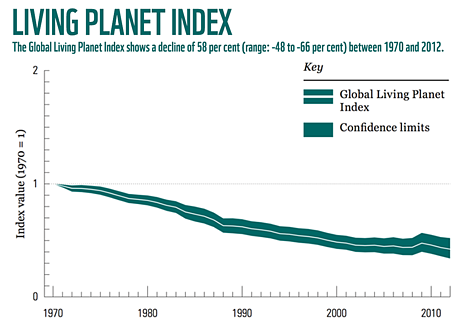
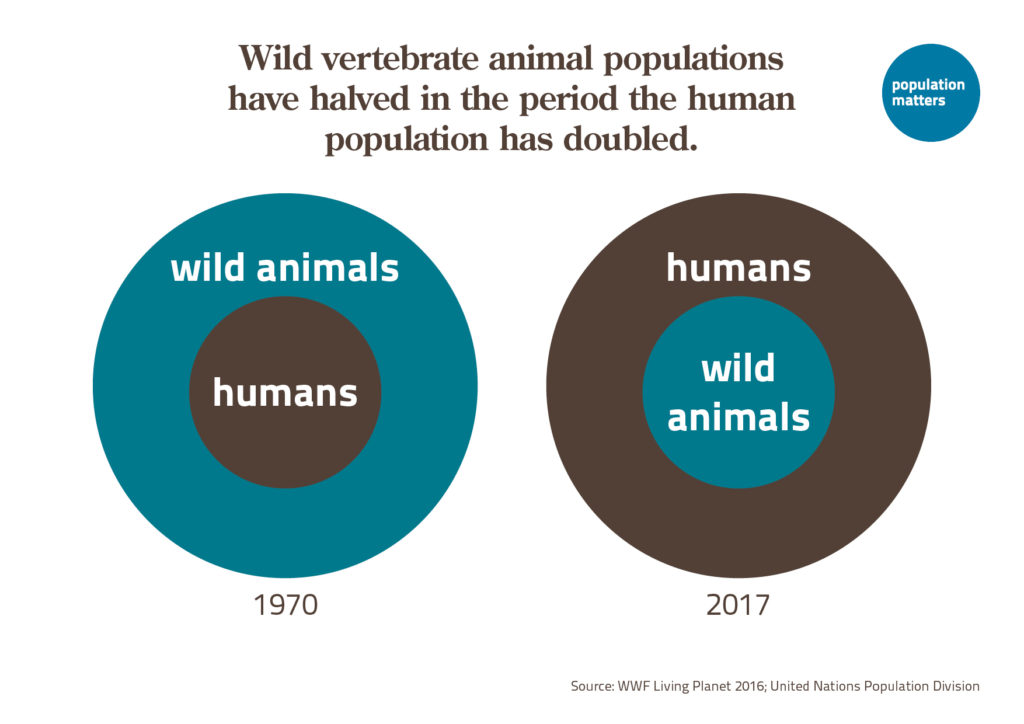
By Jane O’Sullivan Why would an organisation dedicated to protecting natural areas and to saving wild animals turn its back on arguably the biggest threat? WWF used to highlight human population growth, but not anymore. Populations of wild animals have declined, on average, by 60% since 1970. This alarming statistic was announced in WWF’s 2018 Living…
-
Population growth will make it harder to meet EU climate goals, while stable or declining populations will help cut greenhouse gas emissions in the EU
By Patricia Dérer In the following exercise, we demonstrate how different migration and fertility-influencing policies can lead to large differences in future annual greenhouse gas emissions, and in cumulative emissions throughout the century in the European Union. We present nine scenarios representing migration and fertility policies leading to stable, declining, or growing populations. The scenarios…
-
People and Planet – Sir David Attenborough’s take on overpopulation
TOP believes there is no better video presentation on the consequences of overpopulation than Sir David Attenborough’s RSA (Royal Society for the encouragement of Arts, Manufactures and Commerce) President’s Lecture. The well-known British naturalist delivers an impressive speech explaining why population growth is a multiplier of every evironmental problem. Given that the Earth has physical limits,…
-
Announcing the new Human Overpopulation Atlas
The Overpopulation Project announces the Human Overpopulation Atlas, written by João L.R. Abegão. The Atlas is the extended masters thesis of the author in Ecology and Environment at the Department of Biology of the University of Porto in Portugal. This broad review work synthetizes knowledge about the past, present and future of human overpopulation. In…
Explore the content and topics covered by TOP, search here
Recent blog posts
- The Progressive Left are the Bad Guys Too
- Reproductive rights: an unfinished project and an ecological imperative
- A shrinking population might actually be a good thing
- Cutting the global population in half to achieve sustainability
- Ceuta incident: Population growth threatens both poor Africans and climate stability
Blog categories
What we are reading, listening to and watching
Gallery of infographics – Learn more about overpopulation and environment