
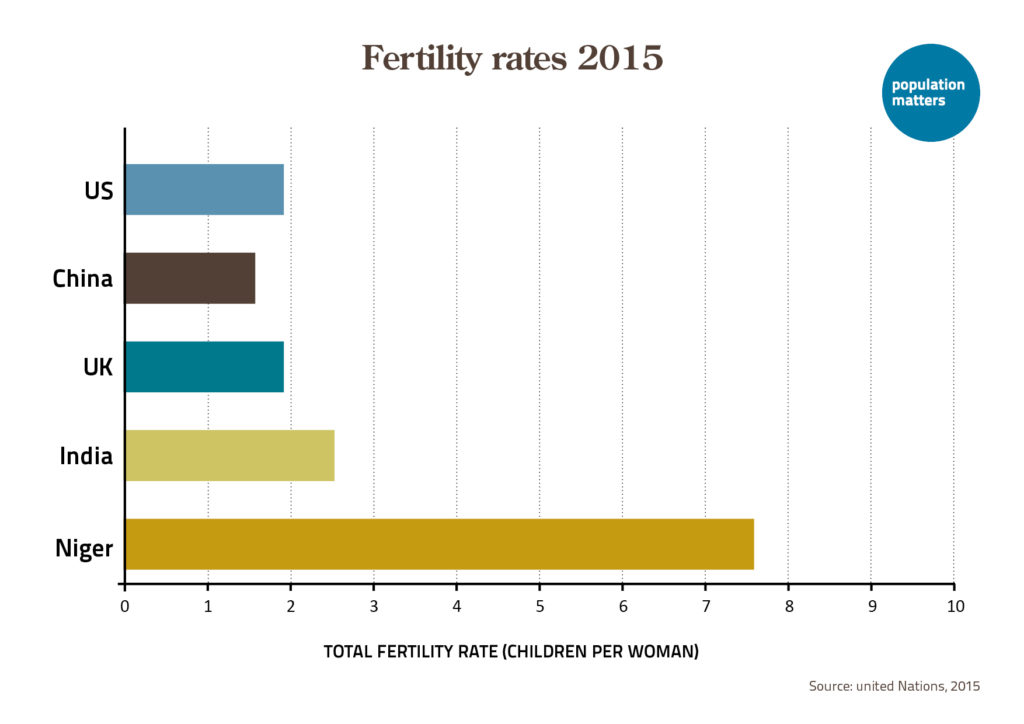
Many politicians, the public, and some scientists still think that economic development is a major cause of reduced birth rates in developing countries. We tested this belief empirically in a recently published long-term study of many countries (1970-2014). We found no relationships between fertility and economic growth, but a strong association with modern contraception: birth rates in developing countries declined linearly with increasing contraceptive use. This suggests adequate funding for family planning is important to lower birth rates in countries with unsustainably high fertility.
By Frank Götmark & Malte Andersson
There are few studies of what politicians and the public in the West think about high birth rates in developing countries. Many of TOP’s readers are probably aware that declining birth rates in these countries are related to family planning programs and increased education of women. But our impression is that politicians, and the public, have quite different views.
The long-standing quote that development is the best contraceptive comes from Karan Singh, speaking as an Indian delegate at the UN’s World Population Conference in Bucharest in 1974. On Google today, you get 15 million hits for these words. For instance, the title of a newspaper article from India last year reads “Development best contraceptive, says national health survey report”. It dealt with income levels and contraceptive use. Another example comes from Germany. In response to population growth in Western Asia and Africa and immigration to Europe in 2015-16, Angela Merkel visited African leaders in October 2016. What is needed in Africa, she emphasized, is “real economic development”. Globally, development is strongly associated with economic growth; governments are happy when they can report to citizens and voters that “we can look forward to future economic growth”.
In a survey in Sweden last year, TOP investigated the public’s views about birth rates in developing countries. We asked, “Which factor do you think is most important for falling birth rates in developing countries?”. Respondents could suggest one factor only. The most common was “better economy” (25% of respondents), followed by increased education (19%) and contraception (10%).
Empirical evaluation
In a recently published long-term study of changes in fertility rates in developing countries, our aim was to test whether decreasing total fertility rate (TFR) is associated with rising economy. We related changes in TFR between 1970 and 2014 to changes in gross domestic product (GDP) and household consumption per capita, using graphical analysis. In addition, we analyzed changes in TFR and contraceptive prevalence rate, for which historical data also were available (see the open-access paper for details about datasets and methods). Below, we first summarize the results for TFR versus GDP per capita, where in total 110 countries were included in the analysis.
TFR and GDP per capita
The graph below shows that in four country groups at different levels of economic development, TFR declined on average by about 1.5–2.5 child per woman during the first 30 years (1970–1999). This large decrease took place although GDP per capita remained almost constant in developing countries in three groups, at Very low, Low and Intermediate GDP levels. In the Relatively high GDP country group, results depended strongly on two outliers, the rich oil states Qatar and Kuwait. When they are included (dashed line), mean GDP per capita declined markedly 1970–1984 during the global oil crises, and so did TFR.

GDP per capita in the Very low group remained low over the entire period 1970–2014 (see graph). Yet its mean TFR declined from 6.8 to 4.8. TFR declined greatly also in the Low and Intermediate groups 1970–1999, although GDP per capita stayed almost constant. On the other hand, 2000–2014 when GDP per capita increased in these two groups, there were only modest declines in TFR. This was so also in the Relatively high group. Most of its TFR decline took place 1970–1999, as in the other three groups.
These results show that TFR declined strongly in spite of little change in GDP per capita 1970–1999. In all four groups, TFR declined markedly even during periods when GDP per capita decreased. Moreover, when GDP increased markedly, 2000–2014, there was only modest decline in TFR. Economic growth (in GDP per capita) therefore was not a major cause of the great reductions in TFR that occurred among developing countries 1970–2014.
TFR and consumption per capita
We next related TFR to changes in household consumption per capita. Fewer countries were available in this analysis, so we used three country groups instead of four: Very low/low, Intermediate, and Relatively high consumption. For the first two groups, results were similar to those in the analysis of GDP: TFR declined although consumption stayed almost constant. In the Relatively high group, however, TFR declined with increasing consumption – or one could state the reverse: consumption increased as TFR declined. See Figure 3 in the online version, here.
TFR and contraceptive prevalence
Finally, we related TFR to changes in contraceptive prevalence rate (CPR), also in this case using three country groups. As the graph below shows, falling fertility is consistently associated with increasing contraceptive use 1970–2015. In all three country groups, TFR declined almost linearly with increasing CPR.

Was the increasing use of modern contraception a consequence of a better economy? To test this possibility, we plotted CPR in relation to GDP. The graph below shows that CPR increased largely independently of GDP 1970–1999. When CPR rose strongly during that period, GDP per capita even declined in the Very low/low group, and it increased only modestly in the two other country groups. Increasing use of modern contraceptives therefore was not mainly a consequence of economic growth. Whether this was so also after 1999, when GDP as well as contraceptive use increased, is not clear from our analysis.

Interpretation and conclusion
At the level of country groups, our results show that economic growth does not explain the fertility drop that took place between 1970 and 2014, particularly for the period 1970–1999 when fertility fell the most in poor countries. Instead, fertility decline tended to precede economic growth, which can increase as a consequence of lowered fertility: a so-called demographic dividend, according to many demographers. Economic growth can be enhanced when the working part of the population increases relative to the part outside working age. But in the long run GDP growth, like population growth, needs to be restricted for a sustainable future.
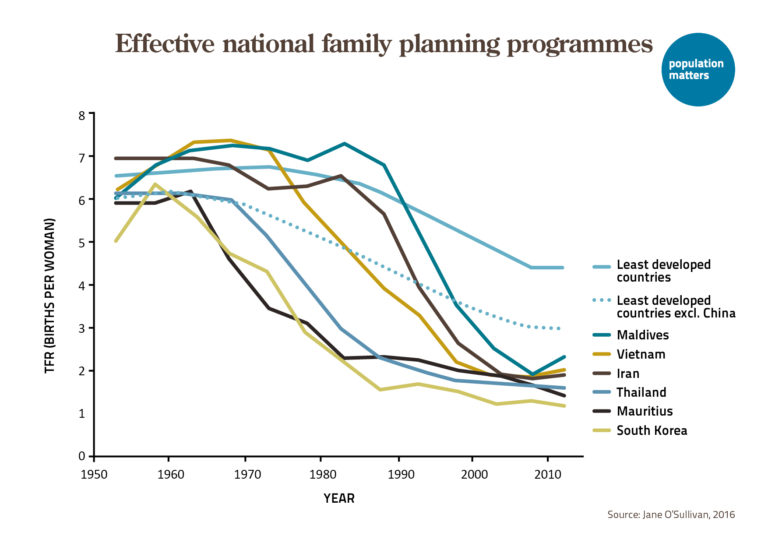
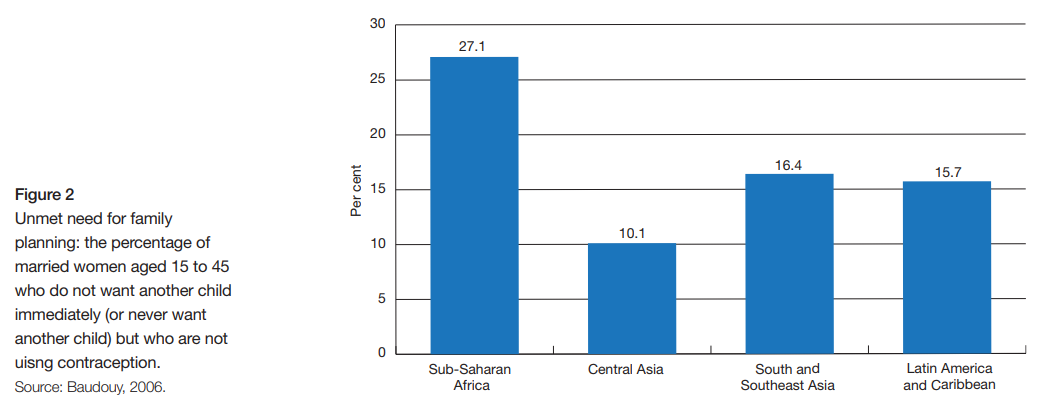
The clear linear relationship between fertility and contraception in all country groups is encouraging. Increased contraceptive use was an important part of international family planning programs 1965-1995. Family planning and modern contraception received attention through global media and ‘soap operas’ on radio and TV, which also contributed to declining fertility in many developing countries (see Manon Parry, Broadcasting Birth Control, and the Population Media Center). But contraceptive prevalence is still low, around 20%, in many countries in Sub-Saharan Africa and other areas where fertility remains high. Making contraceptives available and encouraging their use, through education and changes in family-size norms, should therefore be a high priority.













Leave a Reply