Our blog about Factfulness led to comments, discussion and finally a response from one of its authors (note: the book is written in Hans Rosling’s voice and is the joint work of Hans Rosling, Ola Rosling, and Anna Rosling Rönnblad; Hans Rosling died in February, 2017). Ola Rosling states that he welcomes our criticism and seeks a dialogue. This is good. However, we wish to repeat our main points. First, that this book does not give the reader a balanced overview of global problems and challenges. Second, it presents an anthropocentric worldview and ignores many environmental problems, including the threat to biodiversity, especially through the survey questions posed in the book—questions that we think mislead readers about the situation for both people and wildlife. Third, it is unlikely that it will lead to more action to improve things, since people tend to devote less attention to serious problems if they only receive an overview of positive achievements.
Ola Rosling welcomes more questions from us, and from the public, to help balance the book, stating that Factfulness is not intended to be biased towards optimism. It is not clear how questions on negative trends (that would be needed for a balanced worldview) can be used afterwards, when the book is already widely circulated to American as well as Swedish students. Nevertheless, we present here some questions that, in our opinion, more accurately describe global environmental trends than the two nature-related questions they used (a simple question about the existence of climate change, and a question about change in the conservation status of pandas, tigers and black rhinos). The latter question celebrates that these flagship species did not become more endangered than they were in 1996, due to extra attention and expensive conservation programs. Even with these efforts, these species are still balancing in one of the the “threatened” IUCN red list categories. We have no reason to celebrate that half the subspecies of the still critically endangered black rhino became extinct, due to excessive hunting and habitat destruction, in the 19th and 20th centuries.
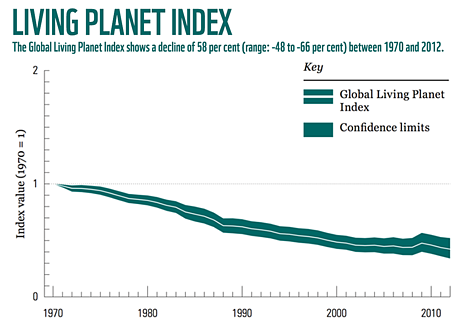
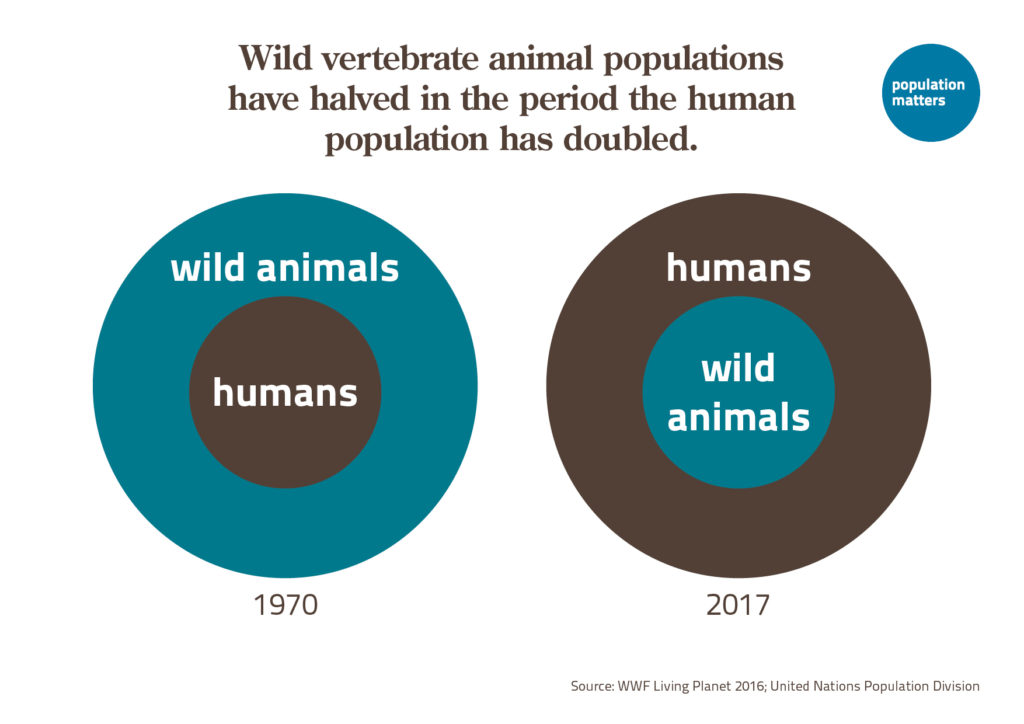
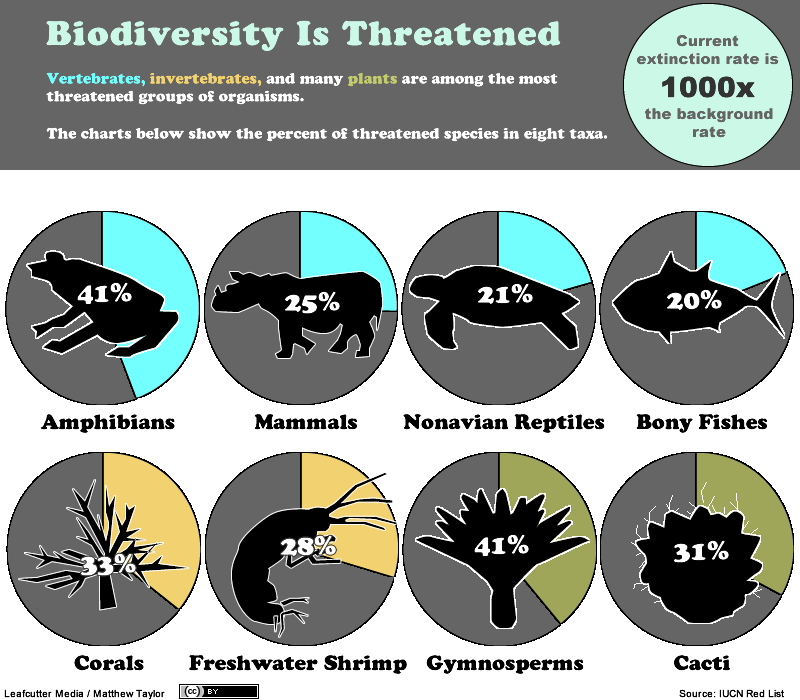
In our opinion, it would be more accurate to frame the question in terms of global biodiversity trends, or population trends for different animal groups, instead of only selecting those three flagship species. Here is a more accurate question that captures that idea (with the correct answer underlined):
By what average percentage did population sizes of wild vertebrate species decline between 1970 and 2012? [1]
- 18%
- 38%
- 58%

We are happy about decreases in extreme poverty around the world, and the increasing proportion of people who have access to electricity and other basic economic and health improvements. Nevertheless, for the sake of balance, the environmental costs of these improvements must be clearly acknowledged, which is not the case in Factfulness.
Here are some more questions showing negative environmental trends, with their surprising and depressing answers underlined:
Corals bleach and eventually die if the sea temperature becomes too high. What percentage of coral reefs surveyed have experienced severe bleaching events since 1980? [2]
- 14%
- 34%
- 94%
The tropical tree cover loss was 6.5 million hectares in 2003. In 2017, the amount of tropical deforestation … [3]
- Halved to 3.25 million hectares
- Remained more or less the same (6.5 million hectares)
- Increased more than 2.5 times (15.8 million hectares)
The percentage of global fish stocks that were overexploited or had collapsed was around 1% in 1950. By 2010, this percentage … [4]
- Stayed more or less the same
- Increased to 14%
- Increased to 34%
The public’s opinion on global inequality might be also unduly rosy after reading Factfulness. Despite rising global median incomes and some evidence of overall global inequality having declined since 2003, we still live in an extremely unequal world – as the following question illustrates (again, the correct answer is underlined):
The world’s richest 42 people hold the same wealth as how many of its poorest? [5]
- 1 million
- 1 billion
- 3.7 billion (half the world population)
We suggest more questions through the Roslings’ Gapminders form, and encourage our readers to do the same.
See also a well-written, detailed critical review of Factfulness, by Christian Berggren here!
The Overpopulation Project Team
Frank Götmark
Philip Cafaro
Jenna Dodson
Patrícia Dérer
Sources:
[1] WWF, “Living Planet Report 2016. Risk and resilience in a new era,” Gland, Switzerland, 2016.
[2] T. P. Hughes et al., “Spatial and temporal patterns of mass bleaching of corals in the Anthropocene.,” Science, vol. 359, no. 6371, pp. 80–83, Jan. 2018.
[3] M. Weisse and L. Goldman, “2017-was-the-second-worst-year-on-record-for-tropical-tree-cover-loss,” Global Forest Watch, 2018. [Online]. Available: https://blog.globalforestwatch.org/data/2017-was-the-second-worst-year-on-record-for-tropical-tree-cover-loss.
[4] A. Hsu, “Environmental Performance Index: Global Metrics for the Environment,” Yale Univ., no. January, p. 123, 2016.
[5] C. A. Suisse Group, “Global Wealth Databook 2017,” 2017.











Leave a Reply